Thank you! Your submission has been received!
Oops! Something went wrong while submitting the form.
MENU
Detailed breakdowns of the strategies, decisions, and results behind successful Teachable schools.

Amie Tollefsrud calls herself a lazy person. She has generated over $11 million on Teachable saying so.
"I am a self-proclaimed, very lazy person." – Amie Tollefsrud, Founder of Rebelle Nutrition and Lazy Millionaire
Most creators treat that word as the enemy. Amie treats it as the whole strategy.
She runs an eight-figure course business from her bed or a beach club lounger, and she got there by doing less of the wrong work, not more of it. The lazy move, in her hands, keeps turning out to be the smart one.
Before the eight figures, Amie worked a nannying job and felt certain it was not going to be her life. She trained as a nutritionist, started seeing clients one-on-one, and hit the ceiling every service provider eventually hits.
There are only so many hours in a day, and trading them for money never scales.
So she did the lazy thing, which also happened to be the smart thing. Amie took the advice she repeated to clients over and over and built it into an online course that could reach all of them at once.
"That's when I created my first online nutrition course to try and reach and help more people all at once. A little less effort from there." – Amie Tollefsrud, Founder of Rebelle Nutrition and Lazy Millionaire
She built that first course from a tiny hut in Maui, carrying five figures of debt and using an outdoor toilet. Amie had no business degree, no investors, and by her own account no tech skills. The slick tools creators reach for today did not exist for her, so she sold it without them. Then she ran her first launch.
"One of my first course launches ever, I think I had made like $5,000 in the span of an hour. And I just remember, like, jumping up and down. [It] was the most money I'd ever made at once in my entire life." – Amie Tollefsrud, Founder of Rebelle Nutrition and Lazy Millionaire

The nutrition courses worked, and as they kept working, her audience started asking her about something other than nutrition.
"All anybody ever wanted to ask me was, like, how I ran [and] how I built [my] business online, because it allowed me to travel the world and really do all the things that I dreamed about growing up." – Amie Tollefsrud, Founder of Rebelle Nutrition and Lazy Millionaire
That repeated question was its own market research. Her audience told her what they wanted before she ever built it, the exact validation signal she now teaches her students to watch for.
So she followed it. The nutritionist became the course-creation expert.
That pivot grew into Rebelle Nutrition's eight-figure education business: Online Course Academy, Passive Income Academy, and the program that ties them together, the Lazy Millionaire Method, which has helped more than 4,000 students across niches build profitable courses of their own.
Amie has been on Teachable since close to the platform's earliest days, running the same play on repeat for the better part of a decade: take lived experience, turn it into a course, sell the shift it creates, and let it run.
The throughline from that first nutrition course to the business today comes down to a handful of principles Amie applies every single time. Here are the ones doing the heaviest lifting.
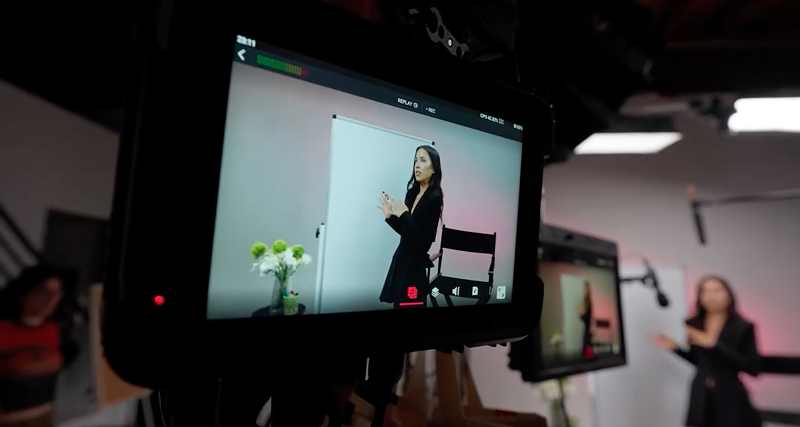

The biggest mistake Amie sees in first-time creators is selling the wrong thing. They list their modules, their PDFs, their hours of video, then wonder why nobody buys.
"When somebody buys a course, they're not just buying the number of lessons or modules or PDFs. They're buying a shift, a shift in how they feel, how they think, what they can do, or what their life is going to look like after the course is finished." – Amie Tollefsrud, Founder of Rebelle Nutrition and Lazy Millionaire
Amie points to her own dentist as the perfect salesperson.
Curious about Invisalign, she expected a pitch about process and timeline. Instead he showed her a photo of her teeth that day, next to a mockup of her teeth a year later. He simply sold her the result she actually wanted.
"Immediately, I was like, 'Take my money. I want that.'" – Amie Tollefsrud, Founder of Rebelle Nutrition and Lazy Millionaire
Amie has her students build what she calls a before-and-after blueprint. They write the student's exact frustration today in the student's own words, then the specific, tangible result waiting on the other side.
The result has to be concrete, never a fuzzy phrase like "feel empowered." It should be something a person could physically point to, like "I don't even need to wear foundation anymore because my skin is so clear," or "I got my 5K down by five minutes." The course becomes the bridge between those two points.
Take action
Selling a shift only works when it gets specific enough that the right person cannot scroll past it.
"Vague doesn't sell. Specific sells. Specific is what makes people stop scrolling. Specific is what makes people pull out their wallets and buy." – Amie Tollefsrud, Founder of Rebelle Nutrition and Lazy Millionaire
Her litmus test sits in the gap between "Learn how to eat clean" and "A step-by-step guide to clear your hormonal acne in 30 days."
Identical expertise sits underneath both titles. The second one aims at one specific person with a real promise, and that version is the one that sells. Broad offers leave buyers quietly wondering whether the thing is really for them, and uncertainty kills the sale.
"When somebody is not sure, they do not buy. But when your offer is specific, it builds instant trust. It shows people that you know exactly what they're going through and exactly how to help them." – Amie Tollefsrud, Founder of Rebelle Nutrition and Lazy Millionaire
Amie pushes for a timeframe wherever it stays honest, such as "in 30 days" or "in 90 days," because a clear timeline makes the result feel achievable. She also insists on the buyer's actual language over insider jargon.
Take action
Amie is blunt about why so many capable creators, even ones with big audiences, launch into silence. They guessed.
"You wouldn't want to open a French bakery without knowing if anyone in town likes croissants, right? So same thing here. Let's make sure you're baking what people are actually hungry for." – Amie Tollefsrud, Founder of Rebelle Nutrition and Lazy Millionaire
Her method skips surveys and spreadsheets.
Amie has creators hold three to five real conversations with people who feel like ideal students, through DMs, email, or a quick call.
The questions stay simple: their biggest frustration with the topic, what they have already tried and why it fell short, and whether a step-by-step course to the result would actually help. Then she listens for the line between polite interest and real urgency.
"We're not looking for perfection, we're just looking for proof. Proof that your idea has legs, and proof that people are already searching for this solution." – Amie Tollefsrud, Founder of Rebelle Nutrition and Lazy Millionaire
She also reframes the whole exercise so it never feels like begging for approval.
"Validation is not about asking for permission. You are the expert. You have the vision. This is just about making sure that your offer meets people where they are before you invest the time turning it into something amazing." – Amie Tollefsrud, Founder of Rebelle Nutrition and Lazy Millionaire
Take action
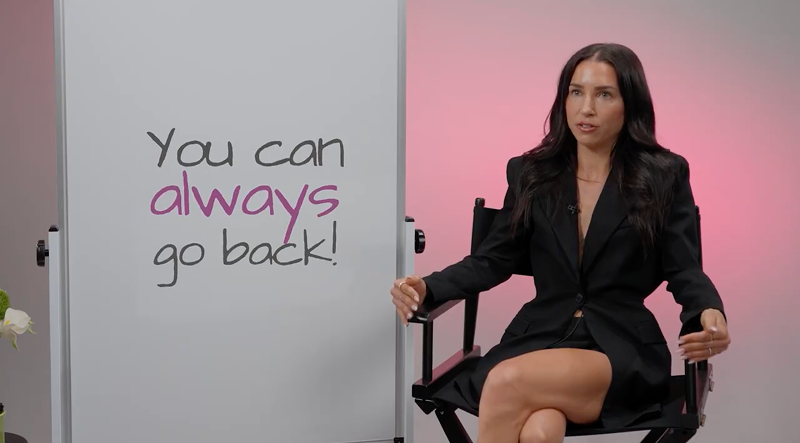
For all the strategy, Amie credits one unglamorous habit above the rest. She ships before it is ready.
"That's also, I think, exactly why I have been successful, because I take action and I launch things actually before they're perfect." – Amie Tollefsrud, Founder of Rebelle Nutrition and Lazy Millionaire
Her first launch, by her own description, was scrappy and far from what she wanted. It still made $5,000 in an hour.
The creators who never break through are usually the ones tweaking and refining until the moment to launch quietly slips past.
"Launch quickly and fast and let it be imperfect. And also just always go back and iterate, like, there's always something you can make better, and then you can get, like, 1% better every time. And it really, over time, does make a difference." – Amie Tollefsrud, Founder of Rebelle Nutrition and Lazy Millionaire
That iteration habit also keeps students coming back. Asked what most reliably turns a one-time buyer into a repeat customer, Amie answered without hesitating.
"The results that they get the first time around. So if they feel like you went above and beyond the thing that they thought they were going to get, they're definitely going to come back in for a second time." – Amie Tollefsrud, Founder of Rebelle Nutrition and Lazy Millionaire
Take action
Amie's revenue does not come from chasing new customers all day. It runs on a system that works without her and pulls more value from every person who already decided to buy.
The top of her funnel is her audience on Instagram, TikTok, and now Substack. From there she offers something free and valuable, a fully automated hour-long masterclass, and sells her program at the end of that training.
Automated email sequences of five to seven messages follow up over the next week with anyone who did not buy right away, paired with a real reason to act now.
The lazy genius shows up in what she layers on top: order bumps and post-purchase upsells.
"Think about, like, when you're at the grocery store and there's all the candy right before you checkout, the people are buying things anyway. So at the last minute, it's a really good time to upsell them on similar items that they might also want." – Amie Tollefsrud, Founder of Rebelle Nutrition and Lazy Millionaire
Someone who just decided to spend money will spend a little more, so one buyer becomes worth far more without any extra traffic.
"It's just a really easy and lazy way, honestly, to generate more revenue with the same amount of effort. You [don't] have to be continuously, like, chasing down [a new] client. You can just make more off of the one-time purchase." – Amie Tollefsrud, Founder of Rebelle Nutrition and Lazy Millionaire
Take action
The obvious objection to any course in 2026 sounds simple. Plenty of people ask why they would pay for a course when AI hands over information free.
Amie does not dodge that objection. She agrees that good free information exists everywhere, then explains why it falls short of the real thing.
"[AI] can give you a lot of valuable information, but [it hasn't] actually done the thing in real life and achieved the results that you're looking for. Like a human can." – Amie Tollefsrud, Founder of Rebelle Nutrition and Lazy Millionaire
Her edge comes from having lived the outcome she teaches, start to finish.
"I actually have achieved the results that I'm teaching in real life. I'm somebody who literally started from zero. I didn't have any money to invest. I didn't even have tech skills... I went through years of, like, struggle and figuring it out and trying things that didn't work and failing. And that was years of experience in real life." – Amie Tollefsrud, Founder of Rebelle Nutrition and Lazy Millionaire
She sees the same change defining the whole industry. The creators who win next will skip the losing game of competing with a chatbot on facts.
"The next wave of successful course creators will be the ones who are thinking really innovatively about what they can offer and sell that is... offering people more than what they can just go to [AI] and find an answer to." – Amie Tollefsrud, Founder of Rebelle Nutrition and Lazy Millionaire
In practice, that means pairing the digital course with something only a person can give: community, group support, an occasional live touchpoint, whatever fits the creator's energy and style.
This reframe helps any creator worried that AI made their knowledge worthless. Amie's bet runs the other direction. The more information becomes free and instant, the more valuable a real guide who has walked the path becomes.
"People don't want a robot or a guru or a PhD professor. They want a real person who's relatable and a few steps ahead of them." – Amie Tollefsrud, Founder of Rebelle Nutrition and Lazy Millionaire
These days, Amie is most excited about Substack, which she started in the past year.
It has become both a fresh revenue stream and a surprisingly strong top of funnel. Readers who find her there often go on to buy her courses, sometimes converting better than social media. Her approach to it stays pure Amie: every post gets treated like a tiny product.
"I look at every article I write almost like a 12-minute course." – Amie Tollefsrud, Founder of Rebelle Nutrition and Lazy Millionaire
For someone who has done eight figures, she stays remarkably clear that the path was never about being special.
"To be honest, I always imagined that this would be my life... I just had no clue, like, how [I was] actually going to do that." – Amie Tollefsrud, Founder of Rebelle Nutrition and Lazy Millionaire
The advice she would give the version of herself still working that nannying job is the same advice underneath everything she teaches today.
"Keep going. Let the things that you are excited about drive you. If you feel this excited about something, you're probably onto something. Keep going. Keep doing it, because it's just going to lead you to [the life] that you've always dreamed of." – Amie Tollefsrud, Founder of Rebelle Nutrition and Lazy Millionaire
Get Amie's free playbook: Grab The Profitable Course Playbook on Teachable, where Amie walks through how to find the right course idea, validate it, and build something people actually pay for.
Watch the full interview: See Amie tell her complete story on YouTube.
Explore more from Amie: YouTube | Instagram | Teachable School | Website
Explore more creator stories: Read how other educators are winning on Teachable in our Success Stories collection.
Try Teachable yourself: Amie turned a scrappy first launch into an eight-figure business by selling the shift her students want, validating before building, and refusing to wait for perfect. Start your free Teachable trial and build the course your audience already keeps asking you for.
Kelly McKenna's grandmother was a therapist. Kelly always assumed she would be one too.
She earned a Master of Social Work and an MBA from Florida State University, then spent eight years running programs at a nonprofit, managing over $10 million in federal funding and overseeing housing services for veterans and LGBTQ youth. She was good at the work. She was also exhausted by it.
When she began seeing private therapy clients on the side, she did what she had always done: she worked in the open. She shared candidly about her own anxiety. She celebrated on Instagram when she left insurance panels, filled her caseload, and quit her full-time job.
The account grew because people across the country recognized something in her posts they had never quite seen before: a therapist being a real human.
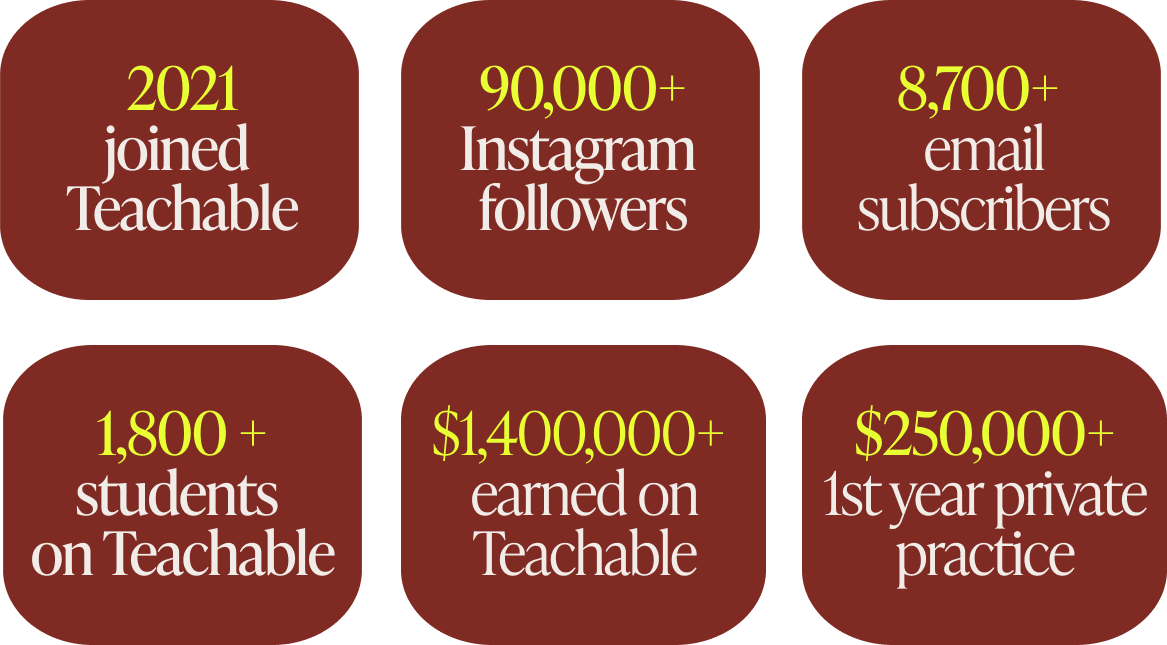
By the end of her first full year in private practice, Kelly had earned $250,000. Within four years, her revenue across practice and digital products had crossed $1 million annually.
"Creating a private-pay practice didn't just transform my income, it transformed my life. I became a better therapist, a more present wife and mother, and built a business aligned with the life I actually wanted to live." — Kelly McKenna, LCSW, MBA, Founder of Business of Therapy
When Kelly's Instagram audience started growing, so did the demand for her time. She filled her caseload, and quickly other therapists started asking her for help.
Therapists booked coaching calls. They asked how she found clients, how she left insurance, how she thought about pricing. She answered the same questions over and over: how to write a bio, how to structure content, how to set up a scheduling system.
She was managing a full therapy caseload at the same time. The math on one-on-one coaching made no sense as a long-term model. The calls were useful, but there was a ceiling baked into the format.
"There was a clear moment when I realized something had to change. I was receiving more inquiries and coaching requests than I could realistically handle alongside my full therapy caseload. It became obvious that continuing to grow demand without changing my delivery model would lead to burnout." — Kelly McKenna, LCSW, MBA, Founder of Business of Therapy

She had already built her first digital product: an anxiety course that mirrored the work she did in session, structured as psychoeducation followed by ten coping strategies with video lessons and downloadable handouts.
The signal that a course for therapists made sense: therapists kept DMing her asking her for help and booking 1-1 calls. The market had been asking for something before she had built it.
She moved the coaching content into a structured course, kept her therapy clients, and launched what would become the Private Practice Academy Bundle. Teachable was the platform she chose after testing several options. The interface was clean, the pricing was accessible, and the setup was direct enough that she could focus on the curriculum rather than the tech.
"I was drawn to Teachable's strong reputation, clean interface, ease of use, and low prices. After testing the free trial and experiencing how intuitive the setup was, it felt like the right platform to confidently build and scale my digital products." — Kelly McKenna, LCSW, MBA, Founder of Business of Therapy

Kelly did not separate her identity as a therapist from her identity as a business owner. The clinical training she had spent years developing turned out to be directly relevant to every part of her marketing work. Her approach to building the business reflected that.
Kelly's Instagram accounts grew because she said things other therapists in her position were not saying. She talked about her rates. She talked about leaving insurance panels. She documented the process of building a caseload in real time, including the parts that were uncertain.
This was not a calculated content strategy at the start. It was how she naturally worked. Clinical training taught Kelly about rapport and authenticity. Kelly brought that same instinct to her posts.
"As I built my own business publicly, I shared the real-time process including the wins, the pivots, the fear, and that transparency became a core value of my brand." — Kelly McKenna, LCSW, MBA, Founder of Business of Therapy
The result was that both therapy seekers and therapists who found her account recognized themselves in what she was describing. Kelly eventually started a second Instagram page @businessoftherapy. The posts about money and burnout and how to price sessions landed because they named things the profession tends to avoid naming publicly. Her @businessoftherapy account grew from zero to over 50,000 followers since December 2022. And her therapy-focused account @sitwithkelly has grown to nearly 100,000.
Take action
One of the clearest ideas in Kelly's teaching is that therapists already know how to market themselves. They have just never been told to think of it that way.
"Marketing, at its core, is reflective listening — understanding someone's pain, naming it clearly, and mirroring that back to them. That's exactly what therapists do every single day. When therapists learn how to translate their clinical skills into client-centered messaging, marketing stops feeling salesy and starts feeling aligned." — Kelly McKenna, LCSW, MBA, Founder of Business of Therapy
This reframe is the engine behind everything she teaches. Therapists arrive at her course convinced they have no marketing ability. They leave understanding that the skill they have been practicing in session for years, hearing what someone says, reflecting it back clearly, identifying the underlying need, is exactly the skill that makes marketing work.
The practical effect is that her students do not have to become different people to grow their practices. They apply what they already know in a different context. For many of them, that shift alone changes their relationship to the whole idea of putting themselves out there.
Take action
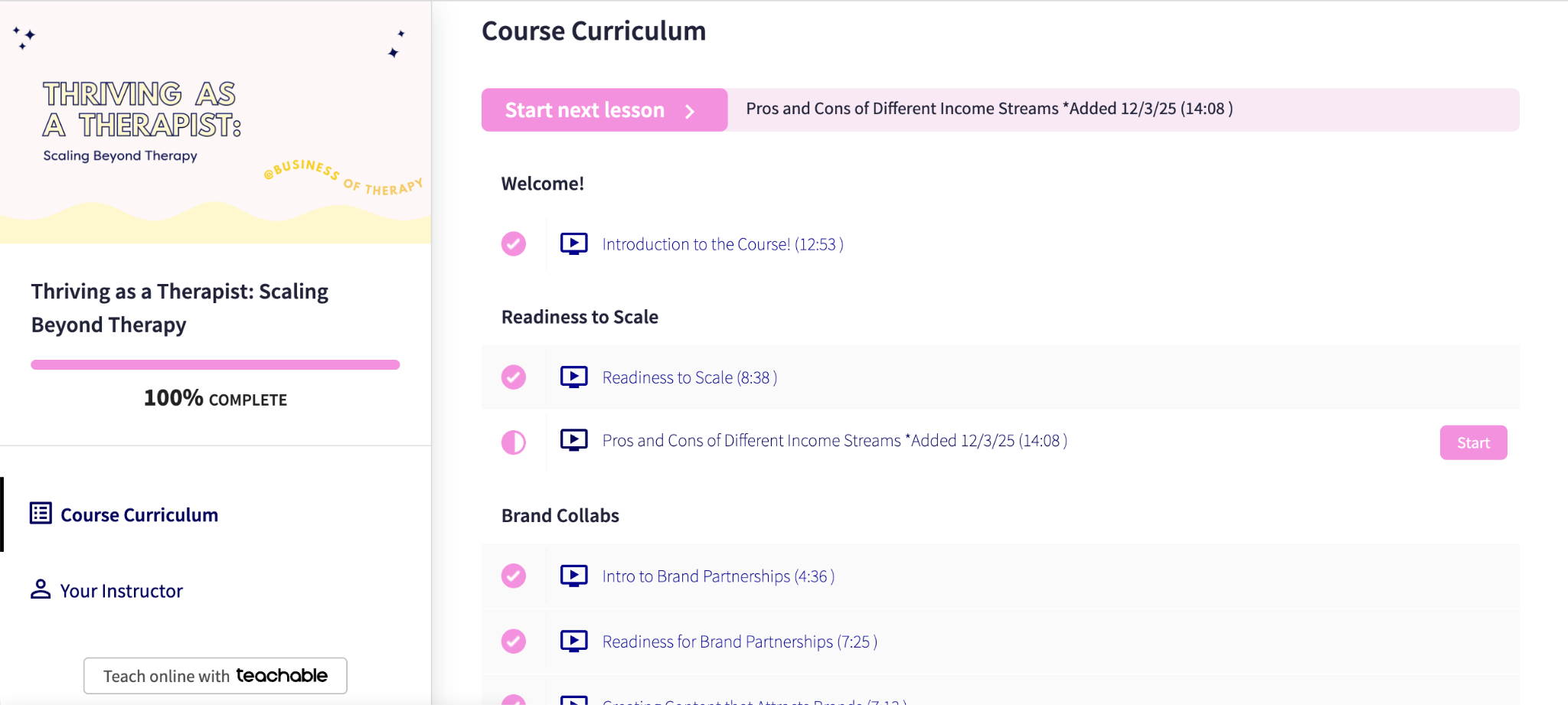
Kelly's first digital product, the anxiety course, was priced as a low-ticket entry point. The Private Practice Academy Bundle went in the opposite direction.
The original presale price was $447. Then $597. When she rebuilt and rebranded the course and added substantial new content, the price moved to $1,397. She runs regular launch pricing at $997, which is still a meaningful investment for most buyers.
"I firmly believe therapists are naturally some of the best marketers but they just don't realize it. Every therapist deserves to make six figures." — Kelly McKenna, LCSW, MBA, Founder of Business of Therapy
The pricing reflects the outcome on offer. A therapist who fills her caseload with private-pay clients at $250 per session and sees 15 clients a week earns over $190,000 a year. A course priced at $997 that delivers that result is not expensive relative to the change it produces. Kelly's students grasp that math, and the student messages in her submitted materials show the results: first condos purchased, debt paid off, babies born without financial anxiety.
She has also been direct about one misunderstanding she pushes back on consistently: the idea that digital products are passive income. The Private Practice Academy Bundle has gone through two major curriculum overhauls and quarterly updates since launch. The 1,000 students it has served received a living product, not a recording that sat untouched.
"The most profitable digital products are the ones that actually get people results. And that requires work. You should constantly be evolving your digital products as you learn more and get feedback from customers. Not necessarily to add more material, but to simplify and speed up what folks need to do to get the desired result." — Kelly McKenna, LCSW, MBA, Founder of Business of Therapy
Take action
The Private Practice Academy Bundle is a one-time purchase. The Reels Membership is a recurring subscription that gives therapists a steady stream of content ideas and templates for Instagram.
Kelly launched the membership in January 2021, generating over $413,000 with around 800 active members at any given time. The two products serve different needs without competing with each other. The course teaches the full system. The membership handles the ongoing execution problem that most therapists hit after they understand the strategy but struggle to maintain consistency.
"I'm constantly evolving the PPA Bundle. I see the course as a living resource that adapts alongside the therapists it serves." — Kelly McKenna, LCSW, MBA, Founder of Business of Therapy
Kelly’s ran two 4-day flash sales so far this year. The February 2026 PPA flash added 34 new therapists while the April 2026 Reels Membership flash sale added 51 new members. Running both products creates a flywheel: students who find the course often convert to the membership for ongoing support, and membership subscribers who want the full picture often upgrade to the course.
Take action
How Kelly thinks about scaling without losing the clinical foundation
Kelly holds two credentials that rarely appear together: a clinical social work license and an MBA. For most of her career, those two things lived in separate worlds. The clinical work was about presence and relationship. The business degree was about strategy and systems. Building her practice and then her education business forced her to understand that the division was artificial.
The same skills that make a therapist effective in session, hearing what is actually being said, identifying the real need underneath the presenting problem, creating a feeling of safety, are the skills that make marketing work. She did not just teach this as a concept. She built her own business by treating her Instagram audience the way she would treat a client: with honest attention to what they were actually struggling with.
"My background as a therapist has deeply shaped my teaching style. In clinical work, authenticity and relational safety are everything. People grow when they feel seen, not talked down to. I bring that same philosophy into my content and teachings." — Kelly McKenna, LCSW, MBA, Founder of Business of Therapy
She is also careful about what she promises. Students who move through the course quickly and implement consistently see results within weeks. Students who delay implementation see results that match their pace. She does not dress this up:
"The timeline depends less on the material itself and more on how quickly someone takes action. Those who implement consistently tend to see momentum build quickly." — Kelly McKenna, LCSW, MBA, Founder of Business of Therapy
The student messages Kelly shared in her case study application are not about follower counts or viral posts. They are about what financial stability makes possible.
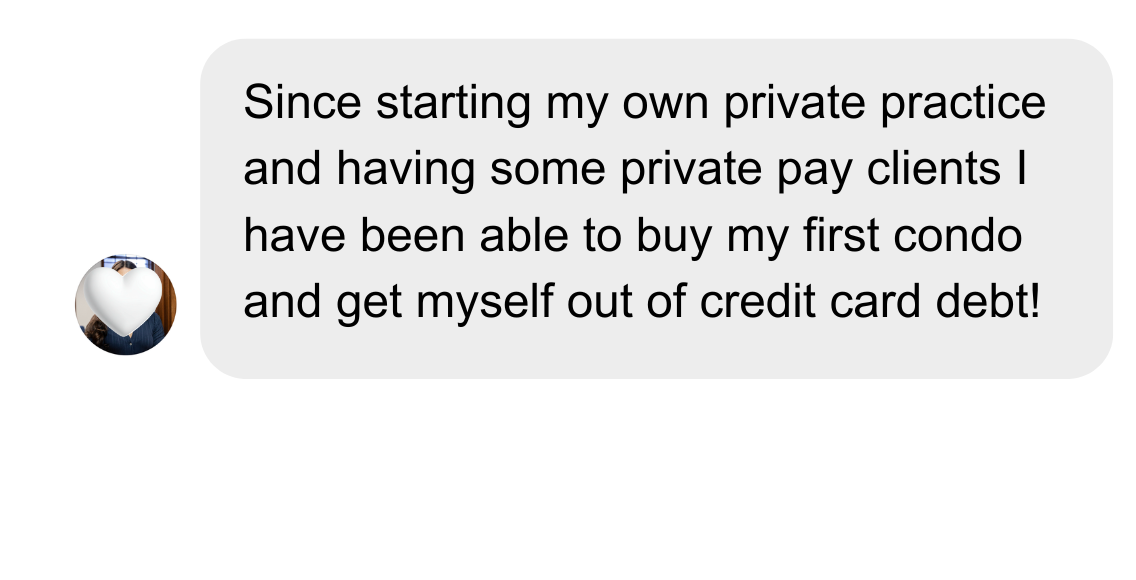
One student wrote: "Since starting my own private practice and having some private pay clients I have been able to buy my first condo and get myself out of credit card debt."
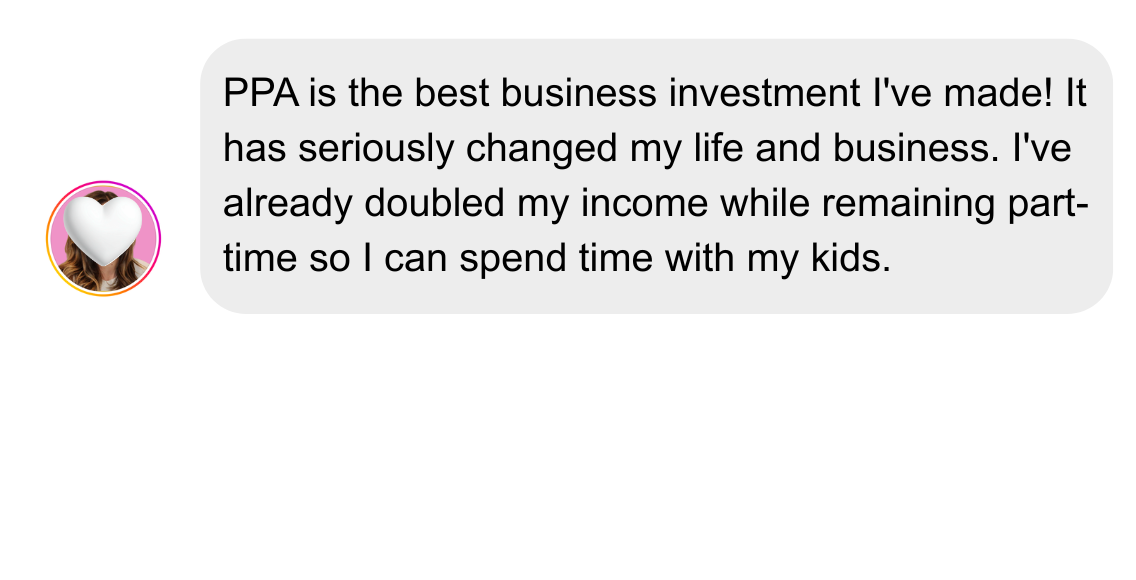
Another shared this: "PPA is the best business investment I've made. It has seriously changed my life and business. I've already doubled my income while remaining part-time so I can spend time with my kids."
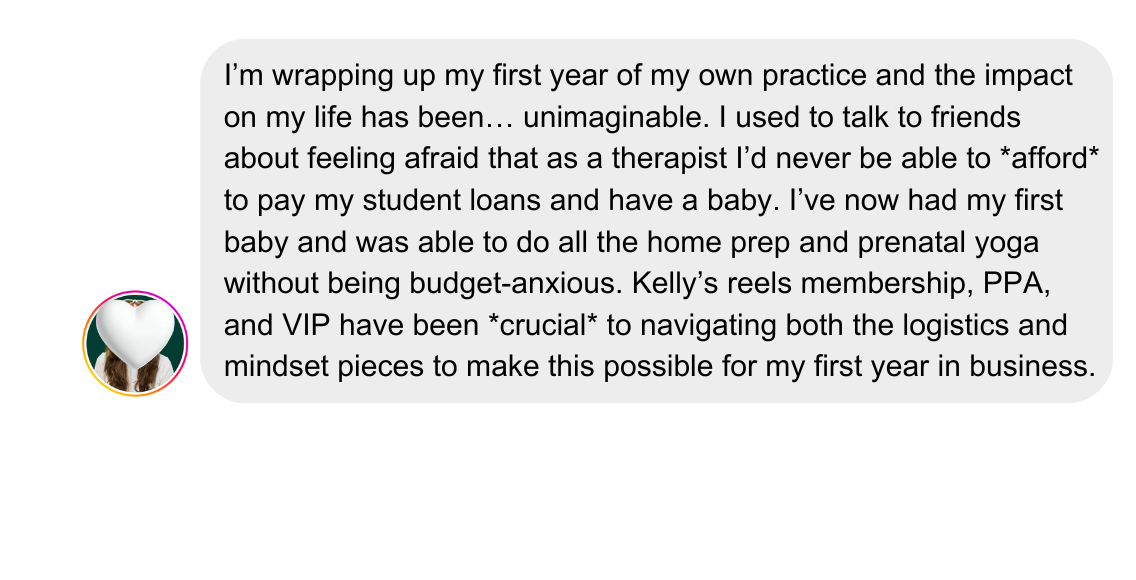
A third described finishing her first year in practice: "I used to talk to friends about feeling afraid that as a therapist I'd never be able to afford to pay my student loans and have a baby. I've now had my first baby and was able to do all the home prep and prenatal yoga without being budget-anxious. Kelly's reels membership, PPA, and VIP have been crucial to navigating both the logistics and mindset pieces to make this possible for my first year in business."
"The feedback that has meant the most to me isn't about follower growth or even revenue, it's about how therapists have been able to change their lives. When a therapist tells me they've bought their first home, paid off debt, doubled their income while working part-time, or finally felt financially secure enough to start a family, that's what stays with me." — Kelly McKenna, LCSW, MBA, Founder of Business of Therapy
Kelly lives in Miami with her husband Tom, their son Aidan, and their dog Jozi.
The Business of Therapy podcast launched in 2024 and added another channel for reaching therapists who prefer audio and longer-form content. She continues updating the Private Practice Academy Bundle on a quarterly basis at minimum, with major curriculum overhauls when the material needs it. The course is now on its second significant rebuild since the original launch.
Her stated goal is direct: every therapist deserves to make six figures. The financial sustainability she describes is not aspirational framing. It is the specific outcome she has built her entire curriculum to produce, starting from her own first year in private practice when she earned $250,000 without having built anything like this before.
Explore Kelly's work:
Visit businessoftherapy.com to access the Private Practice Academy Bundle, the Reels Membership, and Kelly's free training on marketing a therapy practice on Instagram.
Connect with Kelly:
Try Teachable yourself:
Kelly moved from one-on-one coaching calls to a course that has served over 1,000 therapists. Start your Teachable trial and build the product your audience has been asking for.
.avif)
Jason Murray has been making YouTube videos for 16 years. For most of that time, it was a hobby.
During the day, he was an art director and creative director working at agencies like BBDO, Huge, and Amazon's Brand Innovation Lab, leading campaigns for Coca-Cola, PepsiCo, Lululemon, and Adobe. The YouTube channel ran in parallel, always in the background, always just for fun.
He went independent, launched a newsletter and brand called Modern Art Direction, and started teaching the conceptual skills that agency life had given him. Eight months after announcing the idea publicly, he had run three live bootcamp sessions, enrolled over 120 students, and raised his price from $300 per person to over $800.
"I only needed week one ready, and I had a map. I kind of already had a blueprint because from my experience, I knew they need to understand insights, they need to understand big ideas, then they need to craft their campaign. So we'll just follow that roadmap." —Jason Murray, Founder of Modern Art Direction & NEXT Art Director

The mentorship problem in advertising had been building for years before Jason decided to do something about it.
Remote work removed the informal learning that happened in offices. Junior creatives no longer watched senior art directors work. Nobody looked over shoulders at slide decks and wondered why theirs looked different. The unspoken knowledge that passed between people in the same room stopped passing.
Jason had benefited from that kind of proximity early in his career. He was, by his own admission, not a very good art director at first. What saved him was being surrounded by people who were. He noticed things. He absorbed how they worked without being formally taught.
"I was lucky to not be a very good art director, but I was surrounded by great art directors. So I could look over their shoulders. And now with remote work, people aren't getting the mentorship. That professional experience is still so valuable. So that's what I'm trying to bring to social media." —Jason Murray, Founder of Modern Art Direction & NEXT Art Director
He also noticed something happening with AI. The tools that could generate and execute creative work were multiplying fast. What they could not do was think conceptually. Identifying the human insight behind an idea, the specific revelation that reframes a problem, remained something no model had figured out. Jason had spent eight years doing exactly that for some of the largest brands in the world.
When he quit his agency job in 2024, he did not build a course library or a self-paced curriculum. He announced a live class. Four weeks, one concept per week, 90 minutes every Tuesday. Students would leave with a portfolio-ready spec campaign project. Teachable was the obvious choice: payment processing, course delivery, and enough room to grow into more complex features when he needed them.
"For me, Teachable was like the obvious choice because it was just like, okay, this is simple to start, but there's features that I can move into when I need it." —Jason Murray, Founder of Modern Art Direction & NEXT Art Director
Jason built NEXT Art Director without a course library, without a complex launch funnel, and without finishing the material before the first student enrolled. His approach was deliberate, and most of the decisions he made ran against the standard advice for online course creators.
Most course creators record their entire catalog before launching. Jason flipped this. He committed to a live class format, which meant he only needed week one ready before enrollment opened. The rest got built while students were in the class.
"How do you start a course? What platform do I go with? For me it was just like, okay, if I want to start a class. All I need is a way to accept payments and a place to put the information. That's where I can start." —Jason Murray, Founder of Modern Art Direction & NEXT Art Director
The live format solved two problems at once. It removed the pressure of finishing before launching, since students were watching and participating in real time. It also removed the anonymity that kills completion rates in self-paced courses. When 30 to 40 people show up on Zoom every Tuesday, they know each other by face. They share work in a Slack channel. They feel accountable to the group, not just to a progress bar.
By the third cohort, 60 to 80 percent of enrolled students attended live each week. One student in Australia woke up at 4 or 5 AM for the Friday office hour sessions because she did not want to miss the live element.
Take action
NEXT Art Director runs for four weeks. Four 90-minute classes. Four office hour sessions. One concept per week, with one specific assignment that drills that concept before the class moves on.
Week one covers insights. Week two covers the big idea. Week three moves into execution. Week four is polish and portfolio presentation. Students do not touch execution in week one. They do not worry about their final project in week two. Jason holds the line.
"One of the things that I changed from the January session to this session was I actually took out a huge half of the first class. I moved it to an on-demand video. So when people sign up, there's a video you can watch — it's 40 minutes long — to give you an introduction to art direction. Originally I was doing that within the first class and it just took 40 minutes out of a 90 minute class. And it's just really hard to get to the most important part, which was they need to learn this single principle: insights." —Jason Murray, Founder of Modern Art Direction & NEXT Art Director
The format forces students to slow down in ways that resist their instincts. Creatives want to start designing. They want to jump to execution. Jason does not let them. His first week assignment is straightforward: come up with 20 to 30 insights on a brand and share your five best with the group. No designs. No campaigns. Just insights.
The constraint is the point. Creatives who spend years executing other people's ideas often have no language for the conceptual layer of the work. Week one gives them that language, and for many of them it is the first time they have heard an explanation that actually explains something.
Take action
Jason started his first cohort at $300 per person. The price reflected what he felt was fair for an unproven program. He was asking students to trust him before he had any track record as an educator.
After the first session delivered, he raised the price to $800 for the January cohort. Enrollment came in at 42 students. For the March cohort, he raised it again and capped enrollment deliberately.
"I want to keep the class small and make sure everyone's super invested, but we still had 35 students for that class. I want it to be at a price point that I feel like is an investment that I'm hopefully gonna get serious students, and it keeps the class small. And that's why it's also worth the price." —Jason Murray, Founder of Modern Art Direction & NEXT Art Director
The logic connects in both directions. A higher price means students arrive with more skin in the game. They show up to class. They do their homework. They are not passive observers hoping something will stick. A smaller class means Jason can give real feedback on real work, which is exactly what draws students who cannot get that quality of critique anywhere else.
He also noticed the enrollment pattern. In the March cohort, 25 of the 35 students signed up in the final weekend before the deadline. Urgency, not early-bird discounts, drove the last push. He now announces a short enrollment window and closes it.
Take action
Jason did not run paid ads for his first three cohorts. His launch strategy was almost entirely social.
He had been building a following for 16 years, first through YouTube and then more recently through Instagram, where his content about art direction and creative careers had grown an audience of over 160,000 followers. He used that audience through stories, a broadcast channel, and the newsletter, communicating about the bootcamp in the places where his most engaged followers spent time.
"The strategy really is there's only a small window to enroll. I let people know that next month the enrollments will open on X date, and there'll be only three weeks to enroll. And during that time window, I usually release a couple videos that just kind of spark people. Those will always be automated DMs that point people to the landing page." —Jason Murray, Founder of Modern Art Direction & NEXT Art Director
Creatives researching how to become art directors do not buy because of an ad. They buy because they have followed someone for months, watched their work, and already trust their teaching. Ads cannot replicate that. The social content builds it continuously.
Take action
Jason launched his first cohort while under contract for a two-month freelance project. He was simultaneously running 40-hour client weeks and building a curriculum from scratch. He did not sleep much.
What made it work was the same thing that makes the bootcamp work for students: a public commitment with real consequences for missing it.
"I only needed week one ready. The live aspect made it so I could just focus on week one and then I was committed. It's like we've got everyone signed up. I better get week two ready. And so the first session was just a really heavy month for me. But knowing it was live, I didn't have to deliver the whole thing in week one." —Jason Murray, Founder of Modern Art Direction & NEXT Art Director
By the second cohort, the heavy lifting was done. By the third, he was focused almost entirely on being a better teacher rather than building materials. The upfront investment, made under real pressure, produced an asset that kept improving with each session.
Take action
Jason's teaching is built around one observation: most creatives who struggle with conceptual work do not lack intelligence. They lack vocabulary.
The advertising industry has specific language for specific ideas. An insight is not just an observation. A big idea is not just a concept. These words mean precise things in the rooms where campaigns get approved, and people who have never worked in those rooms do not know the definitions. They do great execution work and cannot articulate why it works or what it is trying to do.
"A lot of young creatives entering the industry — they don't know what they don't know. I can help ungate keep some of the vocabulary that advertisers like to hold onto. Because for a lot of young creatives, it's just little things that they just don't know." —Jason Murray, Founder of Modern Art Direction & NEXT Art Director
He also has a clear position on where AI fits in the creative process, and where it does not. For generating mockups and visualizing early concepts, AI tools are useful. For finding actual insights — the human truths that reframe how you see a problem — he tells students to put AI away.
"In the insights territory, I usually recommend don't use any AI for that aspect because it's just so bad at finding an insight, an actual revelation that changes the way you see the world. It's usually obvious stuff. That's what you would gather if you're a machine learning model that's consuming stuff that's already been done." —Jason Murray, Founder of Modern Art Direction & NEXT Art Director
This position shapes what NEXT Art Director is selling. The course does not teach students to make things. It teaches them to think upstream from the making, in the part of the creative process where AI is least helpful and human judgment is most valuable.
By the end of NEXT Art Director, students have a portfolio-ready spec campaign project. For some of them, it is the only piece they need to reposition themselves as an art director.
Jason got a message shortly before the podcast recording from a student who had just landed a job at a social agency in London. The course content had been the deciding factor in the transition.
"Just last week got a message from one of my students who was just like, man, I just got a new job, and just wanted to thank me because of the class. He got a new job at a social agency in London." —Jason Murray, Founder of Modern Art Direction & NEXT Art Director
Student reviews from the published course page describe similar shifts. One student pivoted her career entirely after the first cohort. Another, a UI/UX designer with no advertising background, found that the art direction principles transferred directly into how she positioned her app in the App Store. A product line manager with no art direction experience finished with a complete portfolio project.
The pattern across the reviews is consistent. Students arrived knowing how to make things and left knowing how to think about what they were making. That shift opened doors that pure technical skill had not.
Jason runs NEXT Art Director once a month with a one-month break between sessions. The cadence is deliberate and personal. He has a family, a second child on the way at the time of the interview, and a creator business that includes brand deals alongside the education work.
The 30-day format works for his schedule because it also works for his students. Creatives who work full-time cannot commit to a six-month program. They can commit to one focused month. The deadline lights a fire that longer programs rarely sustain.
"I like being done with it for a month and then taking a one month break to focus on how can I make it better, how can I promote it. But also I find creatives thrive with deadlines and with a little bit of pressure." —Jason Murray, Founder of Modern Art Direction & NEXT Art Director
The near-term plan is to add a self-paced on-demand course alongside the live bootcamp, creating a more accessible entry point for students who cannot afford the flagship program or whose time zones make live attendance impractical. Guest speakers will continue to be a paid part of each session.
The longer arc points toward something he calls the School of Modern Art Direction, with the acronym MAD, which he notes with some satisfaction is exactly what the work requires.
Explore NEXT Art Director:
Visit modernartdirection.com to join the waitlist for the next NEXT Art Director cohort. The bootcamp opens enrollment for a short window every month. Follow @jasonmurray across Instagram and YouTube for weekly content on art direction, creative careers, and building a creator business.
Connect with Jason on Instagram / YouTube / TikTok: @jason_swet
Try Teachable today:
Jason built his first cohort while juggling a full client contract and running on less sleep than he recommends. Teachable handled payments, enrollment, and course delivery so he could focus on being in the room with his students. Start your free Teachable now.
.avif)
Tom Darling walked into the City of Albuquerque's HR department in 2016 with one task: build an employee training program for 6,000 city workers.
He already knew which platform he was going to use.
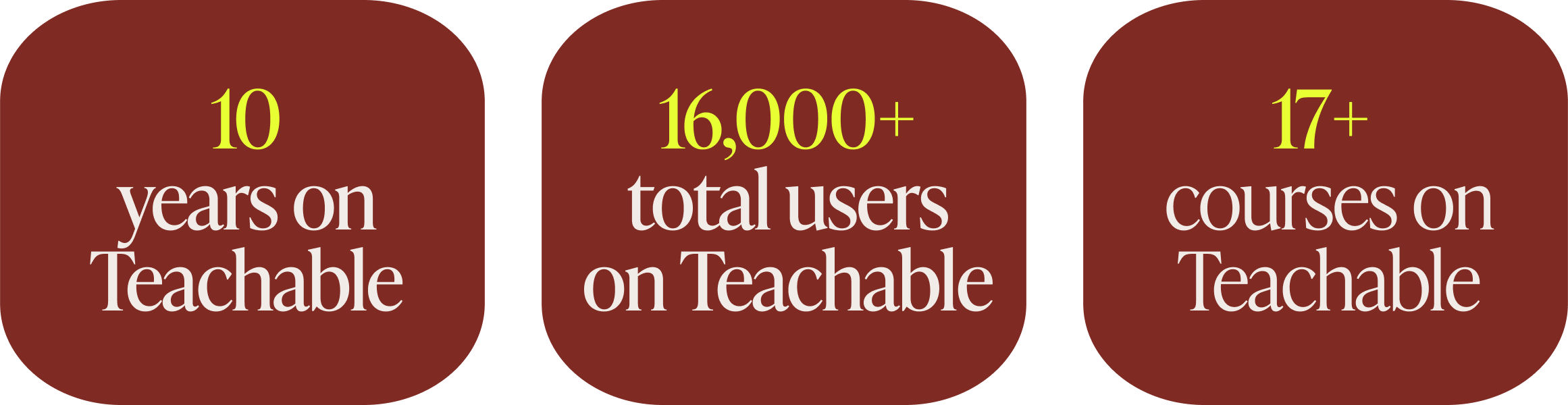
Tom had been a Teachable creator since around 2014 or 2015, running online courses through his personal coaching and consulting business. When he became the associate director of HR and took over the Employee Learning Center, he saw no reason to look elsewhere. Teachable was affordable, easy to use, and he could have courses live within days.
That was 10 years ago.
Today, Tom's team runs a three-platform training operation covering everything from mandatory HR compliance courses for full-time city staff to onboarding programs for roughly 900 summer seasonal workers who show up every June without a city email address. Teachable sits at the center of the piece that formal enterprise systems simply cannot reach.
"I feel like I've cheated a little bit, because I'm using Teachable in a way that it wasn't necessarily designed for. But it works. And I think if more people could see how they could use this tool this way, they would be able to accomplish a lot." —Tom Darling, Associate Director of HR, City of Albuquerque
Before Tom arrived, the city had a barely functional Moodle setup. The police department ran its own separate training system through PowerDMS. Tom scrapped Moodle on day one.
A few years in, the city adopted PeopleSoft ELM as its enterprise record repository. It was supposed to handle everything. In practice, PeopleSoft's learning module requires SCORM-compliant content to work, and the city has never been able to get that integration functioning reliably. PeopleSoft ELM also requires VPN access, which means a bus driver or patrol officer trying to complete a mandatory course on their phone during downtime runs into a security wall.
The city also brought on Knowledge City, a licensed LMS with a database of roughly 15,000–18,000 pre-built courses covering leadership, technology, and compliance. At approximately $11 per employee per year across 6,000 staff, Knowledge City runs the city about $67,000 annually. It works well for registered employees with city email accounts and employee ID numbers.
For everyone else, it falls apart.
Summer seasonal workers arrive in June without Microsoft accounts. Volunteers at animal shelters, homeless services, and the zoo have no city credentials. Boards, commissions, and committees connected to city council need training but never formally enter the city's records system. None of them can use Knowledge City.
That's where Teachable fills the gap.
"In a perfect world I would love to have one LMS that did everything, that we could pay one time for. Unfortunately, that's not the way the world works." — Tom Darling, Associate Director of HR, City of Albuquerque
Will Wheeler, the team's organizational learning analyst, handles most of the digital content production and manages Teachable day to day. The question he asks before building any new piece of content is always the same: who's the audience?
The answer determines everything. Full-time and part-time employees with city accounts go into Knowledge City. Everyone else goes into Teachable.
That 'everyone else' covers a lot of ground:
"Not only are we using it for that larger group, it's also a nice tool for small learning communities within the city. We wouldn't use Knowledge City for that because there's no way for people to interact with each other." —Tom Darling, Associate Director of HR, City of Albuquerque
Tom has spent 10 years refining what works. He's also shared his approach with four other New Mexico municipalities dealing with the same problem. Here's what he tells them.
Most organizations try to find one system that handles everything. Tom's team stopped chasing that. Knowledge City handles career development for registered employees. PeopleSoft ELM maintains the official training records. Teachable serves everyone the other two platforms cannot reach.
The result is a three-platform operation that Tom and Will manage without a large team. Each platform does one job well.
Take action: Before evaluating any new LMS, map your learner types. Who has accounts in your system? Who does not? The platforms serving your credentialed employees likely cannot serve your volunteers, seasonal staff, or external partners. A separate, lower-cost platform for those populations may be more defensible than forcing one enterprise solution to handle everyone. Explore Teachable's plans or get in touch with the Teachable team today to find an option that fits.
The most important outcome Tom described is simple: when someone logs in to take a course, the course works. No VPN required. No IT ticket to open an account. No multi-step security wall before a seasonal worker can watch an onboarding video.
Tom's team can have a new course live in Teachable within a day. They send a URL, and anyone anywhere can register and start using Teachable’s mobile apps. For a bus driver completing mandatory training on a lunch break, or a volunteer showing up to an animal shelter orientation, that frictionless access matters more than any advanced feature.
"The most important experience for the user is that every single time you're assigned a course, when you log into that course, the course works, you can hear it, you can access the content, you can complete it, and you can get your certificate." —Tom Darling, Associate Director of HR, City of Albuquerque
Take action: Audit your current training delivery from the perspective of your lowest-tech user. Walk through the exact steps someone with no company account, using a personal phone, would need to take to access a required course. Every friction point is a completion risk. Teachable's course compliance tools let you enforce lesson order and video completion without adding login complexity.
Will inherited a manual process. When a department needed confirmation that employees had completed required training, he checked each record individually, every day, until completions appeared.
Teachable's reporting changed that. Will can now see exactly who has logged in, how far they've progressed, and when the last activity occurred. For programs involving minors, like the summer seasonal workers who may be 16-year-olds in their first job, that oversight matters. Supervisors get regular completion updates. Departments can verify that the people they sent through training actually finished.
"That leaderboard has been a lifesaver for us. We can pull so much data out of that and see exactly what happened when. That's been a real big improvement." —Will Wheeler, Organizational Learning Analyst, City of Albuquerque
Take action: Set a weekly appointment to review student progress reports on your most compliance-critical courses. Build a simple reporting template so you can send department managers a one-page completion status update without digging through raw data each time.
When Tom recommends Teachable to smaller municipalities, he makes a specific argument. A city with 500 employees and 50 courses can run its entire custom training program for a fraction of the cost of other enterprise systems.
The content creation work exists either way. What changes is where you host it and what you pay.
"For a couple grand a year, you can buy access to a platform that will allow you to put all your stuff online. The hardest part of all this is finding somebody who can develop digital content for you." —Tom Darling, Associate Director of HR, City of Albuquerque
Take action: Build a simple cost comparison for your leadership. Line up your current per-seat LMS costs against the number of non-employee, temporary, or volunteer users you need to train annually. If that group is significant, a second, lower-cost platform may be the more defensible budget decision. Contact Teachable's sales team if you need a custom setup.
Tom has been watching the budget pressure on Knowledge City's $67,000 annual license for years. His contingency plan has always been the same: if the city stops paying for Knowledge City, everything moves back to Teachable.
That's not a crisis. Tom's team has built the content, knows the platform, and has a decade of workflow built around it. The flexibility to absorb a major platform change without rebuilding from scratch is itself part of Teachable's value.
The new apprenticeship program launching this year will be the city's most complex Teachable use case yet. Individual employees will track their own two-year development journey, uploading weekly reflections, working through assigned content, and documenting progress toward eventual supervisory credit. No equivalent exists in any of the city's enterprise systems.
New Mexico municipalities still call Tom for advice. His answer has not changed much in 10 years.
"Teachable is kind of the pinch hitter for us. When something doesn't work with the other platforms we have, Teachable always ends up being where we move it, and we know we can have that course delivered to those people next week." —Tom Darling, Associate Director of HR, City of Albuquerque
Explore Teachable for your organization: If your workforce includes volunteers, seasonal staff, contractors, board members, or anyone without an account in your primary system, Teachable's no-VPN access and simple enrollment model may solve a problem you've been working around for years.
Browse Teachable's plans here.
Talk to our team: Organizations with more complex training needs can contact the Teachable sales team to explore a setup that fits.
%2520(1).avif)
Elisa Azoum had a camera in her hands since childhood. Sleepless nights creating short films with friends eventually led her to Paris, where she worked as an assistant editor for television programs, including work at the Cannes Film Festival.
But after years of hectic Parisian life, something felt off. The extraordinary professional opportunities no longer compensated for the unsustainable pace. She considered becoming a yoga teacher, drawn by the idea of sharing something that brought her serenity.
Then came 2020. Elisa had taken a sabbatical year to travel the world and reflect on what she wanted from life. She explored breathtaking countries and met extraordinary people. Then the COVID-19 pandemic interrupted everything.
During lockdown, looking for a way to continue traveling virtually, she decided to teach her native language to students from around the world. She started tutoring on platforms like italki. The response from students surprised her. They wanted more than just conversation practice. They wanted structured learning, pronunciation help, cultural context.
Elisa realized she could combine everything she loved: languages, teaching, and her passion for visual creation. In 2021, she launched her YouTube channel. It grew rapidly. By May 2022, she launched her first course on Teachable. Three years later, French Mornings with Elisa has become one of the most successful French schools on Teachable.
"My courses are now my main revenue generator. It gave me flexibility that sponsorships never could. I stopped working on other people's deadlines and started building something that was truly mine." –Elisa Azoum, Founder of French Mornings with Elisa
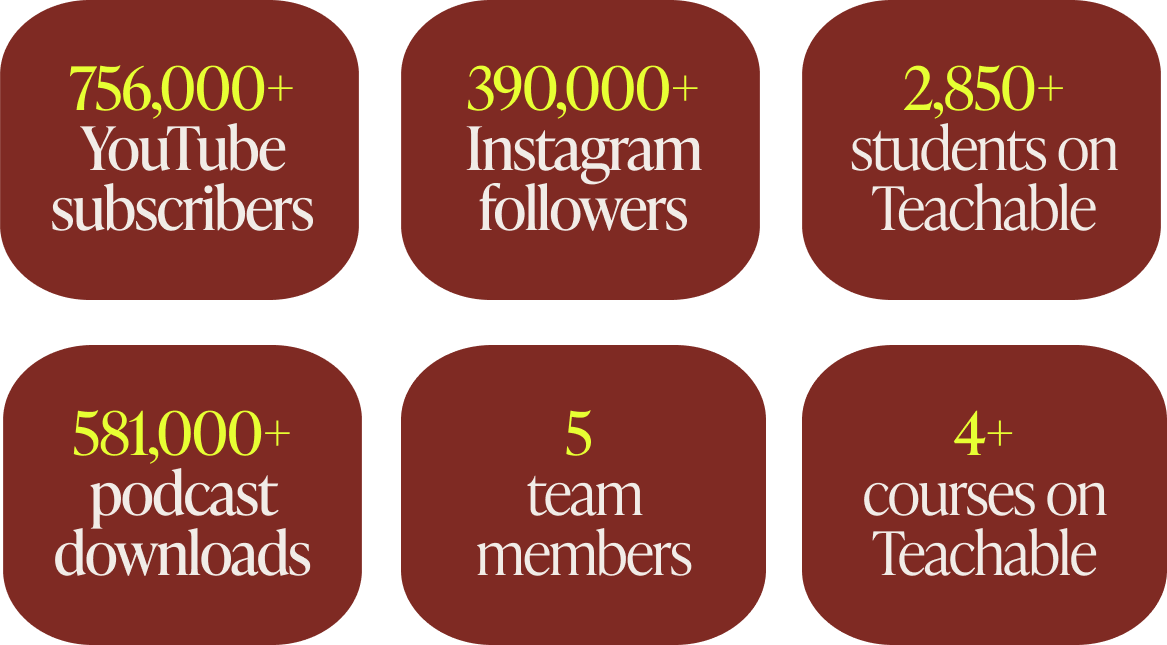
When Elisa started tutoring on italki during lockdown, she quickly realized something. One-on-one sessions had a ceiling. She could only help as many students as she had hours in the day. Meanwhile, her students kept asking for resources they could use between sessions. Pronunciation guides. Grammar explanations. Cultural context.
"I realized there was potential for a course-based business." –Elisa Azoum, Founder of French Mornings with Elisa
The YouTube channel came first, launched in 2021. Growth happened quickly because Elisa brought something rare: the combination of native speaker authenticity, professional video production skills from her Paris days, and genuine pedagogical instincts developed through hundreds of tutoring sessions.
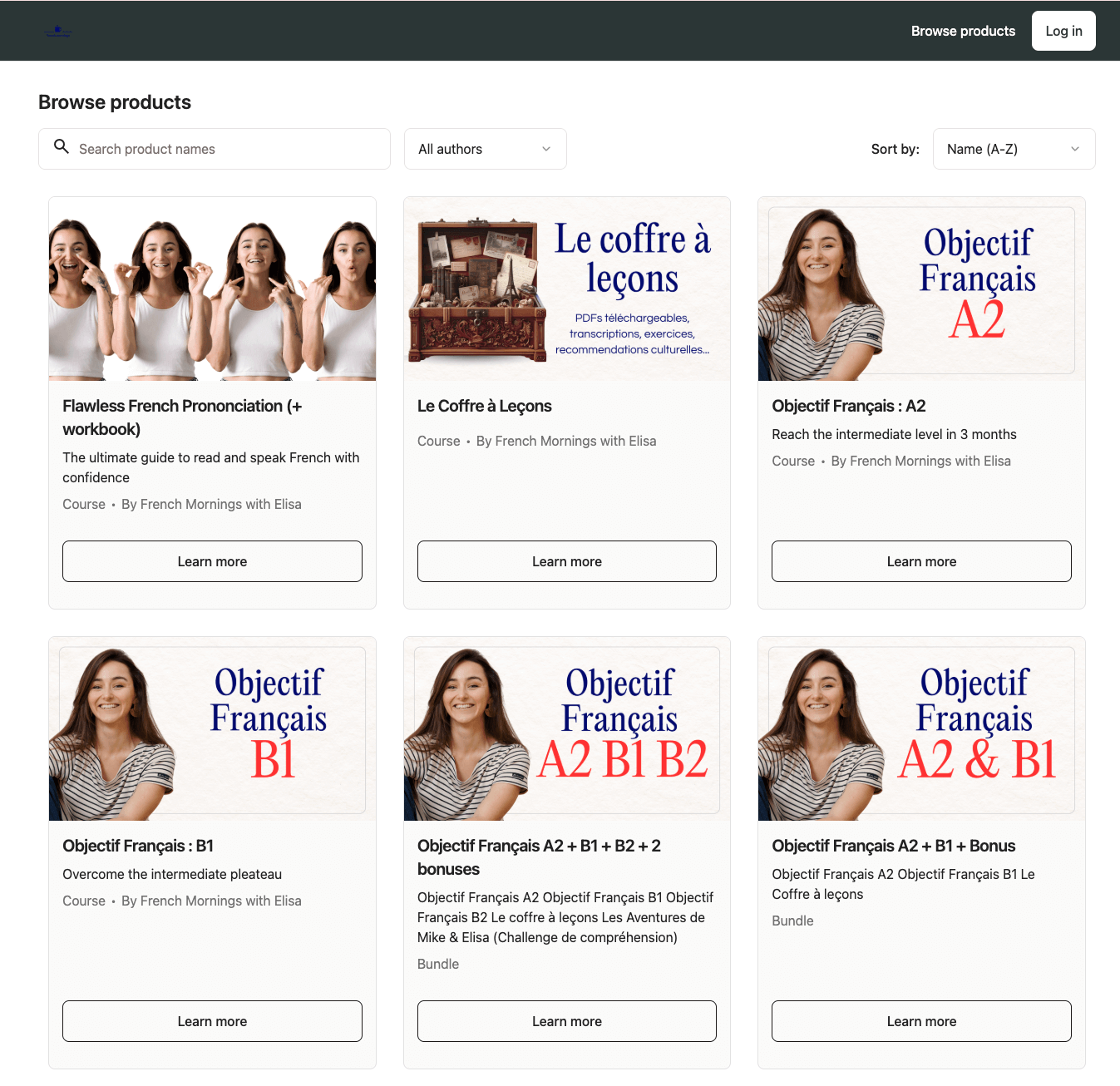
By May 2022, she was ready to launch her first course. The pronunciation course (Flawless French Pronunciation) addressed the exact pain point her YouTube audience kept mentioning: fear of speaking. Students knew the grammar rules but froze when it came time to actually say the words.
Teachable gave her something sponsorships and tutoring never could: recurring revenue that didn't depend on her being personally present. The course could sell while she slept, traveled, or created new content. Success allowed her to invest in creating more courses, expanding from pronunciation into complete learning paths for different proficiency levels.
Elisa built French Mornings the same way she teaches French: with structure, clarity, and genuine connection to learners. Here's how she turned a YouTube channel into a sustainable education business.
Early on, Elisa's YouTube revenue came from sponsorships, particularly from other language learning companies. The income was good, but the tradeoffs bothered her. Sponsor deadlines added pressure. Promoting competitors' products felt awkward. She had limited control over her own schedule.
"I eventually stopped doing sponsorships, particularly with other language course providers, to focus on promoting my own courses." –Elisa Azoum, Founder of French Mornings with Elisa
The shift required patience. Sponsorship money was immediate. Course revenue took time to build. But once her courses gained traction, the math worked decisively in her favor. Course sales provided more flexibility, more control, and income that compounded rather than reset to zero each month.
Take action: Calculate how much time you spend managing sponsor relationships versus creating content. If sponsors consume more energy than they provide value, consider redirecting that effort toward building your own product suite.
Elisa runs French Mornings with a team of five: a virtual assistant, scriptwriter, video editor, teacher, and email marketing specialist. Each role addresses a specific bottleneck that would otherwise limit growth.
The scriptwriter helps maintain content volume on YouTube without Elisa writing every word. The editor handles post-production so she can focus on filming. The VA manages administrative tasks. The teacher supports course delivery. The email specialist nurtures leads and students.
This structure lets Elisa remain the face and voice of French Mornings while multiplying her capacity. She didn't hire everyone at once. Each addition came when revenue justified it and a specific constraint demanded it.
Take action: Identify your single biggest bottleneck. Is it content creation? Student support? Marketing? Hire for that specific problem before expanding broadly.
Elisa's first course targeted pronunciation for a reason. Her tutoring students kept expressing the same frustration: they could read and write French, but speaking terrified them. Native speakers asked them to repeat themselves. They felt embarrassed ordering food in Paris. Written knowledge wasn't translating to verbal confidence.
The Flawless French Pronunciation course addresses this directly. It covers every single sound in the French language, teaches the syllabic method, includes over 70 practice exercises, and focuses as much on building confidence as teaching technique.
Her course progression (A2, B1, B2 levels) follows the same principle. Each course solves a specific problem for students at a specific stage. A2 builds foundation for first conversations. B1 takes learners from basic to conversational. B2 makes French feel natural.
Take action: Survey your audience about their biggest frustrations. Build your first course around the problem that appears most frequently. Specific pain points make better courses than broad topics.
One student testimonial captures why Elisa's courses resonate: the content teaches "real French and not school French." This distinction matters for adult learners who want to actually use the language, not pass academic exams.
Elisa incorporates slang, colloquial expressions, and cultural context that textbooks skip. Her audio courses (like Les Aventures de Mike et Elisa) use authentic dialogue that sounds like how French people actually talk. Students hear contracted forms, casual expressions, and natural speech rhythms.
This authenticity comes from Elisa being a native speaker who understands both formal French and everyday communication. Her production background means the content also looks and sounds professional, not like amateur recordings.
Take action: Identify the gap between how your subject is traditionally taught and how it actually works in practice. Position your courses to bridge that gap.
Elisa's mission extends beyond language instruction. She's helping people connect with cultures, pursue opportunities, and build confidence that transfers far beyond French vocabulary.
Her students come from Germany, Finland, the UK, the US, Canada, Spain, Indonesia, Austria, India, and dozens of other countries. They're learning French for travel, work, family connections, and personal growth. Some plan to move to France. Others want to reconnect with heritage. Many simply fell in love with French culture and want to engage with it more deeply.
The transformation isn't just linguistic. Students report reduced anxiety, increased confidence in challenging situations, and willingness to take risks they previously avoided. Learning a language, done well, teaches people they're capable of more than they thought.
French Mornings continues expanding. Elisa regularly releases new YouTube content, podcast episodes, and course updates. Student demand drives the roadmap, with learners frequently requesting advanced levels and specialized content.
The team structure means growth doesn't depend entirely on Elisa's personal time. She can travel to Paris to record content, take breaks when needed, and focus on the high-value creative work while her team handles operations.
Her vision extends beyond courses. French Mornings has become a community of French language enthusiasts sharing a learning experience together. The combination of YouTube, Instagram, podcasts, and courses creates multiple entry points for different learners with different preferences. Someone might discover Elisa through a YouTube short, subscribe to the podcast for daily practice, and eventually enroll in a structured course when they're ready for deeper commitment.
Explore French Mornings: Visit frenchmornings.com to browse Elisa's course catalog. Whether you're working on pronunciation, building foundational skills, or pushing toward advanced fluency, there's a structured learning path waiting for you. Subscribe to the French Mornings with Elisa YouTube channel. Follow French Mornings with Elisa on Instagram.
Try Teachable yourself: Ready to build your own language education business? Elisa's story shows what's possible when you combine authentic expertise with a platform built to help creators scale. Keep more of your revenue, build direct relationships with students, and create courses that sell while you sleep. Start your free Teachable trial today.
.avif)
Consider alternate title: Willa Workshops has grown into the largest art school on Teachable—while staying deeply committed to artist-led teaching, care, and creative permission.
By the time Wendy Solganik graduated from UCLA School of Law, she knew he would never practice.
The pull toward creativity was too strong. She spent her mid-to-late twenties as a production potter, then co-founded and ran a high-end invitation and stationery manufacturing company for 15 years.
Art education started almost by accident. A calligraphy class at Santa Monica College led her to The Society for Calligraphy of Southern California, where exposure to hand letterers and bookmakers from around the world planted seeds for what would eventually become Willa Workshops.
When her three children needed her more at home, Wendy stepped back from the stationery business.
She rediscovered making art for pleasure and remembered how essential working with her hands was to her emotional health. People on social media started noticing the handmade journals she posted.
The same question kept coming up: "Will you ever teach an online class?"
The pandemic gave her the time to finally say yes.
Today, Wendy runs Willa Workshops on Teachable, teaching watercolor painting, hand lettering, handmade book and journal making, and collage and mixed media art to mostly middle-aged and older women around the world.
She brings in guest instructors she wants to learn from, creating a school where competitors become collaborators and teachers get fairly compensated for their work.
"I consider myself more of a peer than a teacher. I'm learning as I go as much as I am teaching. I'm just really sharing that learning experience with other people in my unique way." —Wendy Solganik, Founder of Willa Workshops
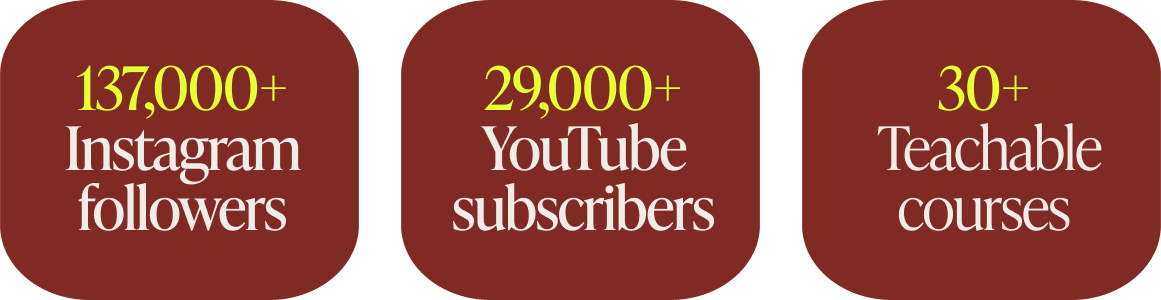
Before launching her own school, Wendy was a student of online art education. She noticed a pattern in the industry: schools built on affiliate marketing models where teachers could pour enormous energy into creating content without knowing what they would be compensated for their time, energy, and effort.
One experience crystallized the problem. She was teaching for another online art school that sold courses to consumers before allowing its own teachers to sell to that same audience. The consumer market overlapped completely, which meant teachers were competing against the platform that employed them.
"It awoke in me a personal challenge to see if I could create a different model that could work for both the teachers and the school owner." —Wendy Solganik, Founder of Willa Workshops
Running her own school became a challenge that felt compelling. Building Willa Workshops forced her to put on blinders and focus on what she actually wanted to create. Many of the artists whose courses she had been purchasing used Teachable. She experienced the platform as a student and knew it worked. Her first course, "Willa Journals," grew directly from audience demand and sold well from the start.
"The course sold really well right from the start... like really well. I knew there was a lot of potential to build a business." —Wendy Solganik, Founder of Willa Workshops
Wendy built Willa Workshops by rejecting the standard playbook for online art education. Instead of racing to the bottom on price or relying on affiliate marketing, she did her best to turn competitors into collaborators (let’s be real... it doesn’t always work out, be she tries!) and positions art as emotional health rather than perfection.
Here's how she built a global art school from her spare bedroom.

Rather than creating every course herself, Wendy brings in other experts she's interested in learning from and spotlights them as teachers. A lot of what she does with her Teachable school involves featuring guest instructors alongside her own courses.
Teachers receive a percentage of net sales no matter who drives the purchase. Whether Wendy markets and sells the class or the teacher does, the teacher gets paid the same. This eliminates the conflict she saw at other schools where teachers competed against the platform that employed them.
The model attracts talented artists who might otherwise see her as competition. Instead, they become collaborators. The result is a richer learning environment that no single teacher could build alone.
Take action: Consider whether your expertise could grow faster by partnering with other creators. Structure revenue sharing so teachers have no conflict between promoting their own work and promoting yours.
Willa Workshops doesn't promise to turn students into professional artists. The pitch centers on something deeper: the importance of creating things with our hands to our wellbeing.
"Just because you didn't go to an official art school doesn't mean that you shouldn't or can't make really satisfying art!" —Wendy Solganik, Founder of Willa Workshops
This philosophy attracts students who might feel intimidated by traditional art instruction. Wendy positions herself as a peer learning alongside her students, not an authority demanding perfection. She corrects one misunderstanding constantly: that students need to know a lot of techniques or understand a lot before they can get started.
In her school, students can start with little to no knowledge and make things beyond what they believed they were capable of. The focus on emotional health rather than gallery-worthy output removes the pressure that stops most people from ever picking up a paintbrush.
Take action: Identify the deeper benefit your courses provide beyond skill acquisition. Students often buy outcomes like stress relief, creative expression, and community rather than just techniques.
The online art education market has fierce competition that drives pricing toward rock bottom. Wendy made a deliberate choice: charge a bit more than competitors and invest in a world-class user experience.
She brought on other people to help run the school well, which requires real investment. The result is production quality and customer service that competitors racing to the bottom can't match.
Her product catalog spans every price point with mini technique courses, core skill courses, year-long flagship programs, and comprehensive bundles. Free content including a Mixed Media 101 course, printables, a podcast called "Show Up or Shut Up," and regular YouTube videos brings new students into the ecosystem. Once they trust her teaching style, moving up the price ladder feels natural.
Take action: Map your product suite by price point. Do you have entry-level offers that build trust? Mid-tier courses that deliver specific transformations? Premium programs for your most committed students?
Fodder School, Wendy's signature program, runs for a full twelve months with projects from different instructors. The program includes live Zoom sessions where Wendy shares personal stories and students connect with each other and the teachers.
Students find themselves reflected in what Wendy shares during these sessions. The connection goes beyond technique instruction. Alumni return for subsequent years, creating a loyal core audience that grows the community organically.
This long-form format builds relationships that short courses can't replicate. Students don't just learn skills. They become part of a creative community that sustains them through difficult times.
Take action: Design at least one signature program that creates ongoing engagement rather than one-time transactions. Live components build connections that recorded courses alone cannot replicate.
The feedback that means most to Wendy comes from students who were afraid to even make art before taking her classes. After going through Willa Workshops courses, they realize they can do it too.
One student wrote about discovering Willa Workshops during a mentally difficult year:
"I had a very rough year and I am going through a lot of problems and a mentally hard time but doing creative things is so much helping me and bringing me joy, just doing things with my hands. Beforehand I was collaging and doing scrapbooking etc. but since I discovered Willa Workshops I am so excited! I learned so many new things." –Willa Workshops student
Another student's story captured how Wendy's work connects to deeper personal history. Her grandmother was a watercolor artist who lived to 103. Losing her felt devastating. Watercolor had always felt too intimidating to try until she stumbled across one of Wendy's journal pages on Instagram.
"I was completely mesmerized by your color choices and inspired by everything you shared about life and creativity. I decided to take the plunge and sign up for Watercolor for Relaxation, then Willa Journals and Invitation to Play. After that, I jumped into a few more courses and finally went all in." –Willa Workshops student
This student found herself reflected in what Wendy shares during Zoom sessions. The connection goes beyond technique instruction:
"When I read the line in your newsletter, 'I'm going to keep showing up and creating art', I felt that deeply. I wanted you to know that I'll keep showing up for you too. I'll keep taking your courses, reading your newsletters, and cheering you on from the sidelines." –Willa Workshops student
Wendy approaches teaching differently than most online educators. She resists calling herself a traditional teacher and instead positions herself as a peer who happens to be a few steps ahead on the path.
Her core belief: the importance of creating things with our hands to our wellbeing often gets overlooked. Making art isn't about producing gallery-worthy pieces. It's about the process, the materials, and what happens in your body and mind while you create.
This philosophy shapes everything about Willa Workshops. Courses emphasize exploration over perfection. Students are encouraged to experiment without judgment. The "coffee break with a creative friend" atmosphere makes learning feel less like work and more like play.
The ripple effect extends beyond individual students. Wendy is helping demystify art education for people who never thought they could be creative. Her students discover that making things with their hands can be a form of self-care, meditation, and emotional processing.
Willa Workshops continues expanding its course catalog while deepening the programs in its core areas: watercolor, mixed media, handmade books, and art journaling.
New seasons of Fodder School release annually, each featuring fresh instructors and projects. The multi-teacher model means the school can offer more variety than any single creator could produce alone.
Wendy sees the rise of AI as an opportunity to emphasize what technology can't replicate: authentic human connection, cultural context, and the encouragement that comes from a real teacher who remembers struggling with the same challenges. Her courses deliberately include elements that AI wouldn't think to add.
Explore Wendy's courses: Visit Willa Wanders to browse Willa Workshops' catalog of mixed media, watercolor, and handmade book courses. Start with the free Mixed Media 101 course to experience Wendy's teaching style, then explore Fodder School for a full year of creative exploration.
Connect with Wendy: Follow @willa.wanders on Instagram for daily creative inspiration. Listen to the "Show Up or Shut Up with Wendy Solganik" podcast. Subscribe to the Willa Wanders YouTube channel for exclusive updates and free resources.
Try Teachable yourself: Ready to build your own multi-teacher school or creative community? Start your free Teachable trial and see how creators like Wendy turn expertise into thriving online education businesses.
%2520(1).avif)
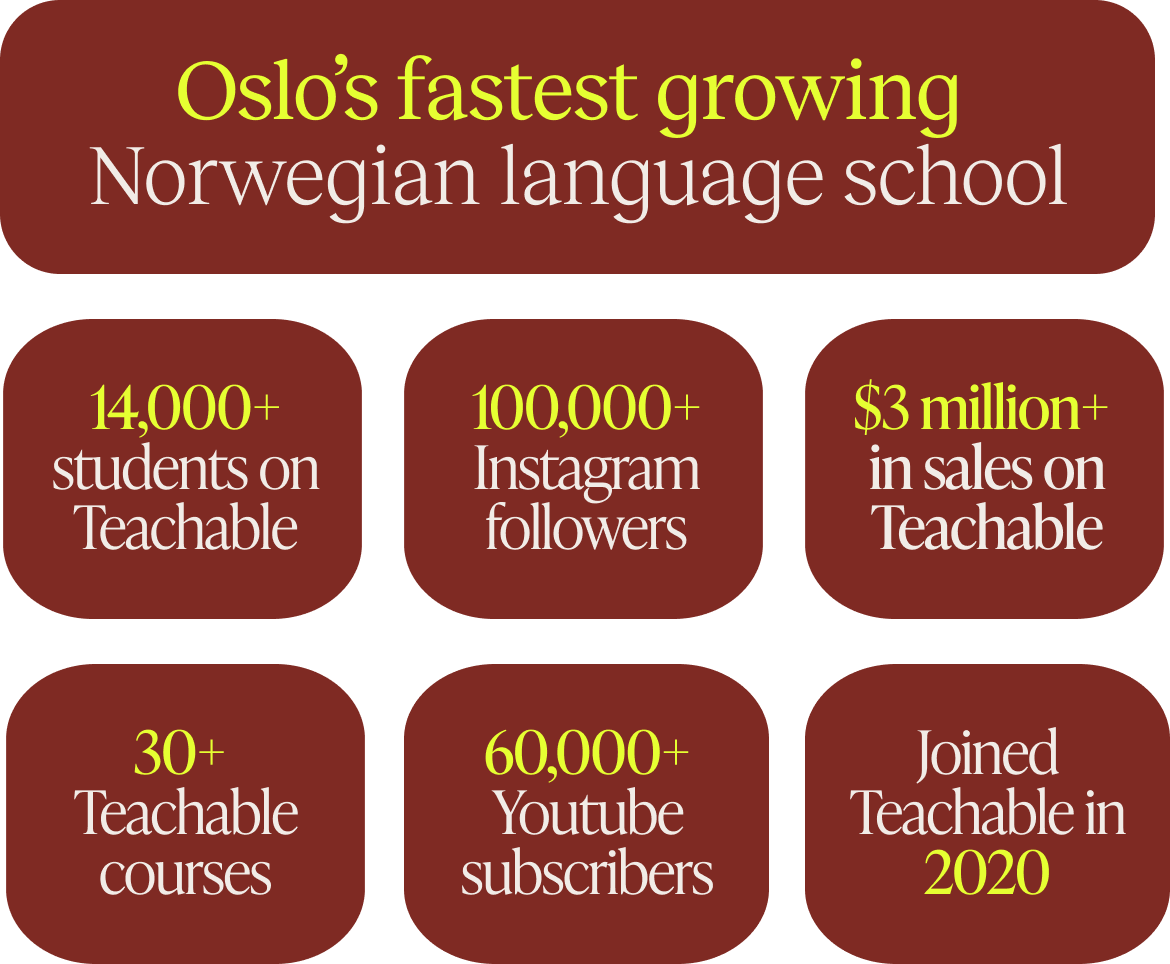
Speak Norsk CEO & Founder Huzan Raad and her business partner Nicoleta Stratan nearly went bankrupt when COVID-19 forced them to close their thriving in-person Norwegian language school.
Just two years earlier, they'd built something special. Founded in 2018 by Huzan, a former immigrant from Iraq who grew up in Norway and learned Norwegian through conversation rather than textbooks, Speak Norsk had become one of Norway's fastest-growing Norwegian language schools.
Their innovative conversational teaching method attracted students so quickly they moved locations seven times in three years due to rapid growth. Each move was to accommodate more students who wanted to learn Norwegian the Speak Norsk way: Through real conversations, not dry grammar books.
Related: How to make money selling courses right now
When COVID hit Speak Norsk's biggest location sat empty. Revenue dropped to zero overnight. With most of their team laid off, just Nicoleta and Huzan remained, facing a choice: shut down or find a completely new way to teach.
"At one point, we thought this might be the end for the company. But then we observed a shift — many competitors were moving their classes online and offering live lessons on Zoom.." –Nicoleta Stratan, Managing Director & Partner at Speak Norsk
But Speak Norsk chose a different path.
While competitors rushed to replicate their in-person classes on Zoom, Nicoleta and Huzan realized they needed something more scalable. With just two people left, they couldn't teach live classes and run the entire business.
“We realized that we couldn’t do everything on our own — teaching, managing operations, and handling course delivery all at once. That’s when Teachable came into the picture. We knew we needed a platform that would allow us to easily create and deliver our courses.” –Nicoleta Stratan, Managing Director & Partner at Speak Norsk
They chose Teachable because it let them focus on what they did best: creating engaging, conversation-focused Norwegian lessons. The platform's user-friendly interface meant their teachers could create and manage courses without needing technical expertise.
The decision proved transformational. Within their first year on Teachable, they earned the platform's 1M Sales Award, and their online student count soon surpassed what they'd achieved with their physical locations.
“Learning a language should be an exciting journey for adult learners. Unlike traditional methods, we combine entertainment with proficiency—bringing modern, practical topics, engaging illustrations, and simple, clear grammar explanations. With us, learning becomes as enjoyable as reading a novel.” -Huzan Raad, CEO & Founder of Speak Norsk.

Instead of simply adapting their in-person classes into an online format, Speak Norsk reimagined language learning by combining visual storytelling, personal guidance, and strategic course packaging. A prime example is the Viking Course, an all-in-one program that takes students from complete beginner to confident communicator by bundling multiple levels into one seamless learning journey serving Norwegian learners worldwide.
Here's how they turned a near-bankruptcy into a business that exceeds their pre-COVID revenue.
Speak Norsk's growth engine starts with a comprehensive free Norwegian course hosted directly on Teachable. This isn't a basic teaser, it's substantial content that gets people familiar with both their teaching style and the platform.
"Our pre-recorded videos are created by the same highly skilled Norwegian teachers who contributed to our own-produced book series from A1 to C1. Praised by our classroom students, they make learning feel smooth and easy, keeping you motivated with clear, encouraging, and easy-to-understand explanations.”-Huzan Raad, CEO & Founder of Speak Norsk.
They promote this free course heavily on social media while keeping their paid course promotions exclusively within Teachable. This creates a natural progression: social media followers become Teachable users, then Teachable users become paying students.
“We offer a free course on Teachable to give students a chance to explore the platform and get comfortable with how it works before starting their paid courses.”– Nicoleta Stratan, Managing Director & Partner at Speak Norsk
The strategy works because it removes friction. Instead of asking people to pay immediately, they let the quality of their teaching do the selling.
Take action: Create a substantial free course that showcases your teaching style and gets people comfortable with your platform before asking them to buy.
While most online course creators focus purely on scalable, hands-off models, Speak Norsk adds a personal touch that sets them apart: free language consultations.
“We strive to make the learning experience as personal as possible and provide students with added value they wouldn’t find anywhere else.”– Nicoleta Stratan, Managing Director & Partner at Speak Norsk
These 15-30 minute consultations help students choose the right courses based on their specific goals. Whether someone wants to pass a citizenship test, learn business Norwegian, or prepare for immigration, Nicoleta and her team provide personalized recommendations.
The consultations serve multiple purposes: they increase conversion rates, collect valuable data about student needs, and often lead to higher-value course purchases. Students feel guided rather than abandoned to figure things out alone.
Take action: Consider adding a personal consultation layer to your self-paced courses to increase perceived value and conversion rates, even if it doesn't scale infinitely.
Speak Norsk doesn't just teach general Norwegian. They've built courses around specific student needs and seasonal patterns, particularly immigration and certification cycles.
Their Norwegian citizenship test preparation courses come with a bold promise: 100% pass guarantee with unlimited retakes until students succeed.
“If a student takes the course and, for any reason, doesn’t pass the test, they can retake it as many times as needed—with unlimited access until they succeed.” –Nicoleta Stratan, Managing Director & Partner at Speak Norsk
They also time their marketing around seasonal patterns. When Norwegian language tests approach, they promote test preparation courses. When companies are hiring, they push their business Norwegian content.
This targeted approach allows them to charge premium prices for specialized content while serving students exactly when they need help most.
Take action: Identify seasonal peaks or certification cycles in your industry and create targeted courses around those specific needs and timing.
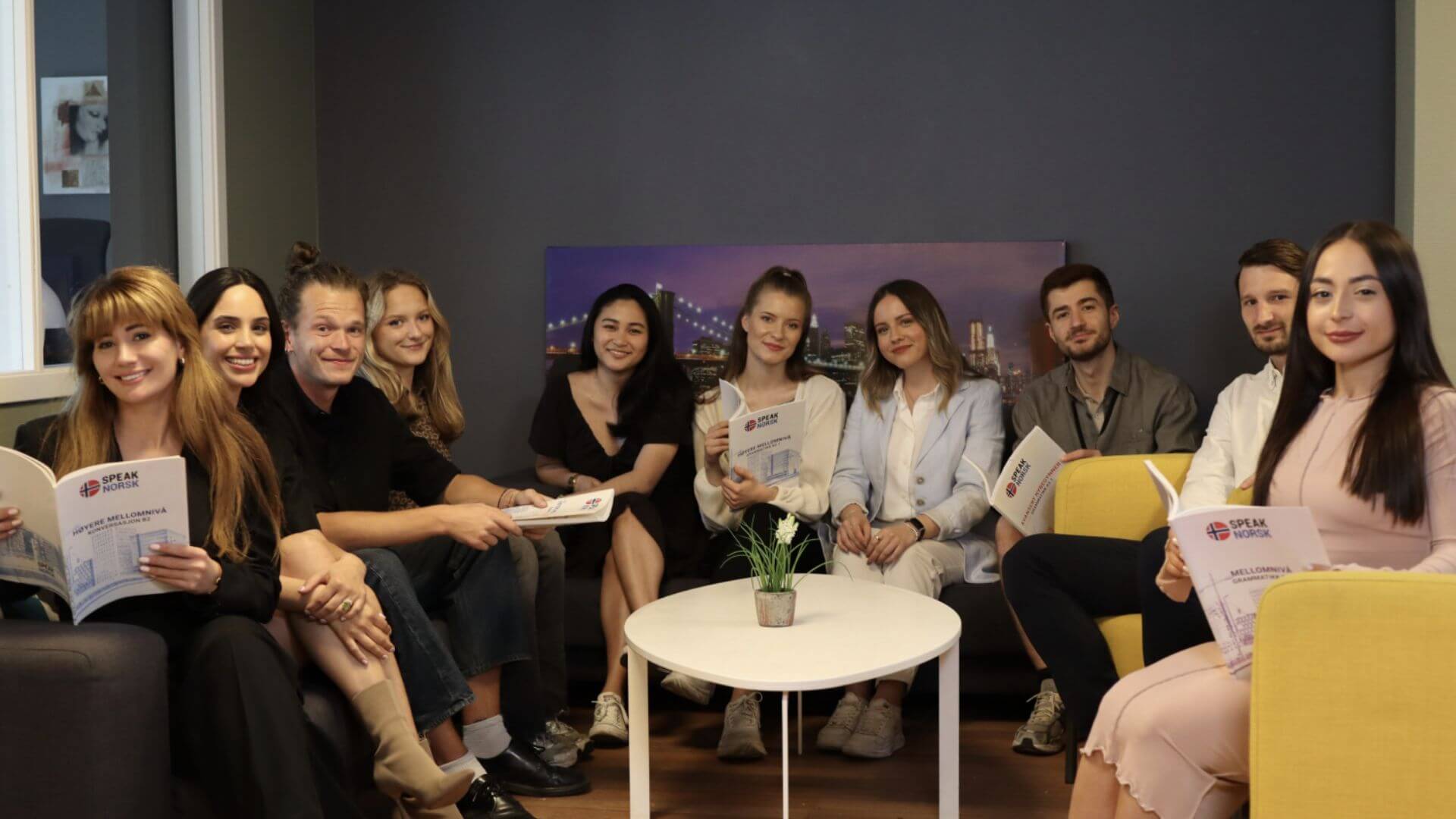
Unlike most online educators who build around personal brands, Speak Norsk deliberately chose a company-focused approach with multiple teachers.
"We ensured a unified structure and provided the same training to all our teachers, so lessons are easy to follow even if the teacher changes. This keeps students focused and progressing at the same steady pace, as if guided by one teacher from beginning to end, while saving time, money, and making life easier by learning fast and efficiently” - Huzan Raad, CEO & Founder of Speak Norsk.
This strategy eliminates "key person risk." If one teacher leaves, the business continues. Students trust the Speak Norsk methodology and brand rather than depending on a single instructor's availability or personality.
The approach also allows them to scale more effectively. Different teachers can specialize in different levels and topics, creating a more comprehensive educational experience.
“It was a deliberate choice not to rely on a single central teacher. Instead, we wanted multiple instructors teaching across different levels, so that students would build trust in the brand as a whole rather than in just one individual.”–Nicoleta Stratan, Managing Director & Partner at Speak Norsk
Take action: If possible, build your brand around your methodology or company rather than just yourself to create a more scalable, sellable business model.
Speak Norsk's biggest competitive advantage comes from rejecting traditional language learning methods. Founder Huzan experienced the frustration of "open your books to page 82" teaching and was determined to create something better.
Their courses emphasize visual elements, real conversations, and interactive exercises over text-heavy traditional approaches. This methodology proved so effective that competitors have started copying their methods.
“Around 95% of our courses are self-paced, but we’ve invested so much time and effort into developing them that we know it would be difficult for competitors to match the same level of work and quality.” –Nicoleta Stratan, Managing Director & Partner at Speak Norsk
The extra effort creates a competitive moat. While competitors can try to copy their approach, few are willing to invest the time and resources needed to match Speak Norsk's production quality.
Take action: Audit your course content for text-heavy sections and find ways to make them more visual, interactive, and engaging than your competitors.
Speak Norsk's transformation from near-bankruptcy to online success demonstrates the power of choosing the right platform and methodology for your audience.
Their numbers tell the story: over 14,000 students enrolled on Teachable, earning them Teachable's 1M Sales Award in their first year. Their online student base now surpasses what they'd achieved from their multiple physical locations before COVID.
The reach extends far beyond course sales. With over 10 million Instagram reach, 100,000+ followers, and millions of TikTok views, they've built a global community around Norwegian language learning.
%2525201%252520(1).png)
More importantly, they've maintained quality while scaling. Their courses consistently receive positive reviews, with students successfully passing citizenship tests, securing job offers in Norway, and achieving family reunification through their language progress.
Speak Norsk serves a unique and important mission: helping people achieve their dreams of living in Norway. Their students include future immigrants, professionals seeking Norwegian job opportunities, and people working toward citizenship or family reunification.
"We had a few students that actually came from the US to Norway. They knew they were going to move and they started learning with us ahead of time. And by the time they came, they already had an intermediate level and could integrate easily, apply for different jobs and so on." – Nicoleta Stratan, Managing Director & Partner at Speak Norsk
The impact goes beyond language skills. Students learn from native Norwegian speakers, understanding cultural nuances and dialects that traditional methods miss. Many report feeling prepared not just for language tests, but for real conversations with Norwegian colleagues, friends, and neighbors.
The ripple effect extends to Norwegian society as well, helping immigrants integrate more successfully and contributing to more welcoming communities for newcomers.

Speak Norsk's immediate plans include launching specialized courses for healthcare vocabulary and C1-level Norwegian test preparation. Both are already built on Teachable and awaiting final design elements.
"Our vision for Speak Norsk is globally oriented, expanding our methodology to more languages and making it accessible to learners worldwide. We plan to launch a groundbreaking language app, supported by our own book series in multiple languages and e-courses across the globe. In addition, we are planning to open in-person schools in London, New York, and Dubai.” - Huzan Raad, CEO & Founder of Speak Norsk.
“We have two upcoming courses. One focuses on healthcare in Norway, covering medical vocabulary and terminology. The other, called Norskprøve C1, is a preparation course designed for the Norwegian language test at the C1 level.” –Nicoleta Stratan, Managing Director & Partner at Speak Norsk
Their bigger vision involves expanding beyond Norwegian through their new Speak More platform. English courses are already live, Spanish is launching soon, and Arabic is in production. They're also developing books for all languages using the same conversation-focused methodology.
"We just want to bring a new type of learning to the market, something that's very fun and interactive." –Nicoleta Stratan, Managing Director & Partner at Speak Norsk
The goal is creating a comprehensive language learning ecosystem that applies Speak Norsk's proven methods to multiple languages, always with native teachers and real-world conversation focus.
Check out Speak Norsk's Norwegian language courses on Teachable, including their free introductory course that has helped thousands of students start their Norwegian language journey. Whether you're planning to visit Norway, immigrate permanently, or advance your career, their conversation-focused approach will prepare you for real-world success.
Learn more about Speak Norsk: Instagram | YouTube | LinkedIn | Website
Try Teachable yourself: Ready to turn your teaching expertise into a scalable online business like SpeakNorsk? Start your free Teachable trial today and discover why educators worldwide choose Teachable to build and grow their online schools. With features designed for course creators, student engagement tools, and business growth capabilities, Teachable provides everything you need to create educational impact at scale.
%2520(1).avif)
Sabrin Hietanen was broke in Japan when she bought a secondhand laptop with a Japanese keyboard from a thrift shop.
She had no students, no teaching experience, and no clear path forward. All she knew was that she needed a job she could do while traveling the world.
Six years later, she's taught over 8,000 one-on-one Finnish lessons, built a following of 32,000+ on Instagram, and created multiple courses that reach students while she backpacks through Croatia or cat-sits in Helsinki.
The secret wasn't just teaching Finnish. Sabrin noticed a problem nobody else was solving: students could study the language for a decade and still struggle to have a basic conversation with native speakers. Finnish textbooks teach written Finnish, but Finns don't actually speak that way. The gap between classroom Finnish and real Finnish was leaving learners stranded.
Sabrin built her business by filling that gap, teaching the spoken Finnish that textbooks ignore.
I had some students who had been learning Finnish for like 10 years and they still could not understand anything I was saying. I knew this needed to change." --Sabrin Hietanen, Sabrin The Finnish Teacher

Before becoming a Finnish teacher, Sabrin had held more than 20 different jobs. Taxi driver. Soccer coach. Housekeeper. Nanny. Each position was just something to fund her next trip, another temporary stop in a life built around travel.
"I've done so many jobs because I was traveling so much. Everywhere I went, I needed a new job. And then that's actually how I started teaching Finnish, because I was traveling and I needed an online job." -Sabrin Hietanen, Sabrin The Finnish Teacher
Her ex-boyfriend, a Japanese teacher, mentioned a platform called italki where anyone could sign up to teach languages. Sabrin was skeptical but desperate. With almost no money and a keyboard she couldn't read, she signed up at $6 per hour just to get some students.
The first few lessons were terrifying. Sabrin had no curriculum, no structure, and no idea where to begin with students. A breakthrough came when one student showed up with a textbook and asked her to teach from it. That student saved her from paralysis. Suddenly she had a framework.
But teaching from that textbook revealed something troubling. Students who had studied Finnish for years couldn't understand her when she spoke normally. The written Finnish they'd learned was essentially a different language from what Finns actually use in conversation.
"These poor students are wasting their time learning a Finnish in a way that nobody speaks." -Sabrin Hietanen, Sabrin The Finnish Teacher
By 2022, Sabrin's calendar was fully booked. Every slot she opened filled immediately. The success created a new problem: she was burning out from back-to-back lessons and couldn't scale beyond the hours in her day.
"Relying on 1:1 lessons was so stressful that I felt like every minute that I have is spent on these students. And I really didn't want to say no. But I also didn't want to get burnt out. So I thought, 'what can I do so these people can still keep learning with me while I still have my sanity?'" -Sabrin Hietanen, Sabrin The Finnish Teacher
The idea of creating courses had been floating around, but the catalyst came from an unexpected place. A company that helps creators build courses booked a fake lesson with Sabrin to pitch their services. They'd handle marketing, they said, in exchange for 50% of her revenue. And she'd need to post four times a day on Instagram.
"If I have to do all the work anyway, why would I give you 50%?" -Sabrin Hietanen, Sabrin The Finnish Teacher
That conversation was the push Sabrin needed. The same day she rejected the offer, she filmed her first Instagram reel and started building her audience. Teachable gave her a way to host her courses without surrendering half her income or spending hours a day on marketing someone else required.
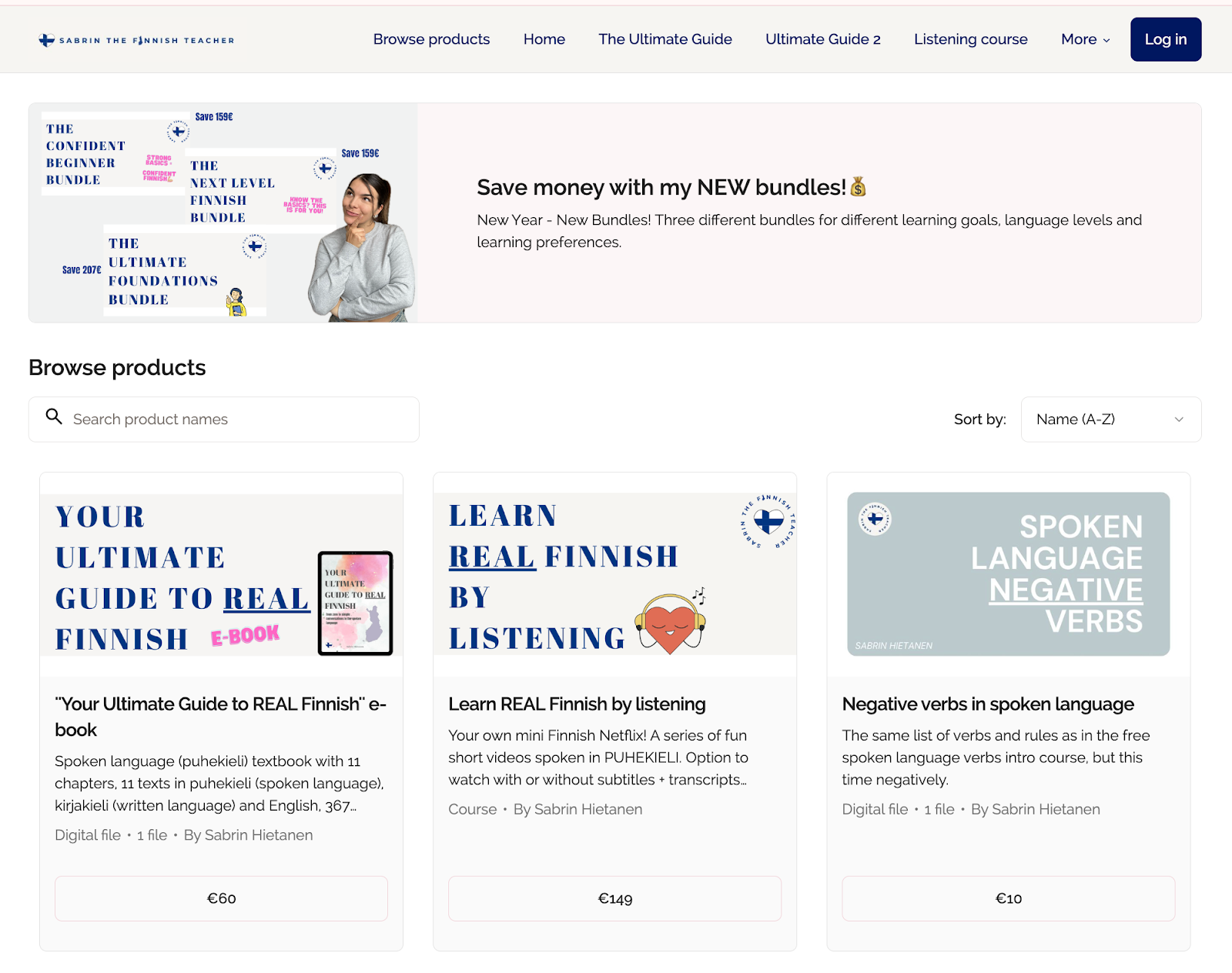
Sabrin spent a year and a half writing her spoken Finnish textbook before filming any courses. The content came directly from thousands of hours teaching one-on-one students and observing where they got stuck.
"I really wanted to be different... I really wanted to publish a book, not just some quick PDF material." -Sabrin Hietanen, Sabrin The Finnish Teacher
That book became the foundation for her courses. The first course covers the first six chapters (15 hours of content for total beginners), and the second covers the remaining five chapters for students who know the basics. Students who purchase the courses get the book as course material.
Take action: Before creating a course, spend time documenting the patterns you see in one-on-one work. Your best course material comes from real student struggles, not what you think they should learn.
Many course creators want to eliminate one-on-one work entirely. Sabrin chose a different approach. She reduced her lesson load from 150-200 lessons per month at peak to around 60-80 now, keeping individual teaching as part of her income mix.
Take action: Consider keeping a reduced schedule of direct student interaction. Live teaching provides a feedback loop that makes your courses better and breaks up isolated course creation work.
Sabrin kept her Instagram account private for the first three months because she was embarrassed. When she finally went public, she committed to posting every single day. That sprint from 100 to 10,000 followers took roughly six weeks.
"I knew that I need to do focus on social media content at some point be making sales. This is the way for me to find my customers, so I have to do this. I didn't even think about it." -Sabrin Hietanen, Sabrin The Finnish Teacher
The daily posting pace was unsustainable. After two months she scaled back to two or three posts per week. But the initial intensity established her presence and built momentum she could maintain with less effort.
Take action: When launching on social media, consider an intense sprint to establish presence, then settle into a sustainable rhythm. Building audience before you have products to sell removes the pressure of immediate conversion.
Sabrin started at $6 per hour to get her first students. As demand grew, she used price increases strategically to control her workload and reclaim time for course creation.
"Whenever I felt like I was getting too many students, I just raised my prices. So then I always lost some, but then I was happy with more time." -Sabrin Hietanen, Sabrin The Finnish Teacher
Take action: If you're overwhelmed with demand, raise prices before burning out. Losing some customers to gain time for product development is often the right trade.
Finnish presents a unique challenge that most language learners don't expect. The written form taught in textbooks differs dramatically from the spoken language used in daily conversation. Students can master grammar rules and vocabulary but still struggle to understand native speakers.
"In Finnish there's a really big difference between written Finnish, which is the official Finnish, but nobody actually speaks that way, and then the spoken Finnish, how people actually speak... most students don't know any of the spoken Finnish. So they cannot actually speak with Finns at all because they don't understand us at all." -Sabrin Hietanen, Sabrin The Finnish Teacher
Sabrin's approach addresses this gap directly. Rather than teaching textbook rules and then noting the real-world exceptions, she teaches spoken Finnish alongside the formal grammar so students can actually use what they learn.
Her third course, "Learn Real Finnish by Listening," extends this philosophy by focusing on audio comprehension. Students hear natural speech patterns rather than the artificially slow pronunciation common in traditional courses.
Sabrin's immediate focus is refining her marketing approach. After initially hitting her goal of three course sales per month with minimal promotion, she recognized that passive income requires active work.
The travel lifestyle continues. During her interview, Sabrin was cat-sitting for a student in Helsinki while planning a backpacking trip through the Balkans with a friend. Her apartment in northern Finland sits on Airbnb when she's away. Teaching Finnish online means she can work from anywhere with wifi.
Explore Sabrin’s courses: Visit Sabrin’s website and Teachable school to explore her courses. Want to learn Finnish? Check out Sabrin’s Ultimate Guide, Ultimate Guide 2, and Listening course.
Connect with Sabrin: Instagram | TikTok | italki
Try Teachable today: Begin turning your expertise into a profitable online education business with Teachable. Start your free Teachable trial and launch your first course in minutes.
.avif)
Erin Booth has been teaching virtual assistants how to build profitable businesses since before most people knew what a VA was.
She launched her own VA business in 2012, back when there were no standards, no established training programs, no roadmaps.
Erin figured it out through trial and error, building her business entirely through LinkedIn connections without even having a website for the first six years.
By 2018, aspiring VAs kept asking her the same questions:
Erin started making YouTube videos to answer them. The response was overwhelming.
Today, Erin runs a multi-program education business on Teachable with courses ranging from her free VA Launchpad to her premium VA Business Blueprint and Skills programs.
Her students log in almost daily, post wins in her community, and keep asking about her next programs before she has finished building them.
"You should never have anyone dictating the prices you charge for your content. With Teachable, you get full control. You can talk to your students, match their learning styles, and build real relationships instead of going through third parties." –Erin Booth, Virtual Assistant Coach
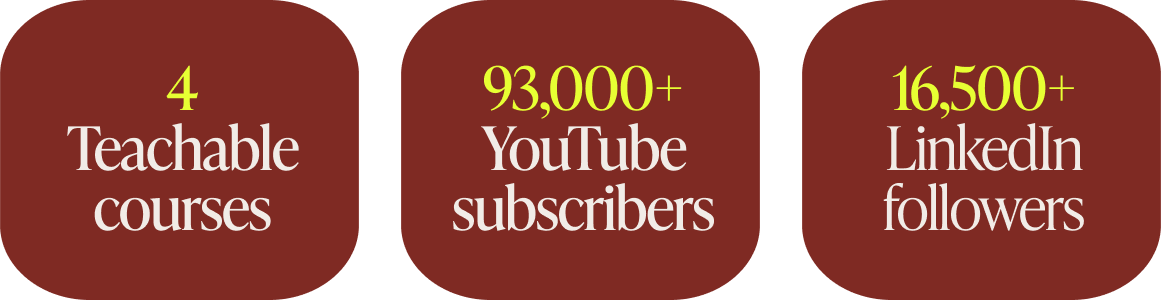
Erin's path to course creation started with exhaustion.
After six years working grueling schedules in the New Orleans film industry, she was burned out. The creativity and problem-solving were rewarding, but the demanding hours were unsustainable. She thought her answer was an in-person concierge business for busy film professionals who did not have time to run errands.
The market research looked promising. Everyone said yes, they would use this service. When launch day came? Almost no one actually wanted to pay.
Then a producer she had been helping said something that changed everything: "You would make so much more money if you did this virtually."
That was the light bulb moment. Virtual work meant no cap on hours, no geographic restrictions, and the ability to scale beyond what one person could physically accomplish in a day.
For years, Erin built her VA business quietly through LinkedIn. When she started getting constant questions from aspiring VAs in 2018, she launched YouTube videos to answer them. The teaching side took off.
"I do not like to gatekeep any information. I do not believe that you should only have helpful information if you pay for my courses. The info on YouTube has really grown into its own. And then my flagship program is for the people who want to learn how to run their businesses in order from start to finish." –Erin Booth, Virtual Assistant Coach
Erin initially explored platforms like Udemy. The reach was appealing, but the tradeoffs were not. Limited control over pricing. No direct student relationships. Revenue sharing that cut into her earnings. The platform stood between her and the people she was trying to help.
Once Erin started researching, the decision was obvious. Teachable offered:

Erin spent years building trust on YouTube and LinkedIn before launching premium programs. Her free content establishes credibility with people who may not be ready to commit financially. Some cannot afford a full program. Others are not ready. Either way, she wants them starting their businesses with correct information.
This approach creates a natural funnel. Students who have spent months learning from Erin's free videos already trust her teaching style. When they are ready to go deeper, the paid courses are not a hard sell. They are the logical next step.
Take action: Calculate how much free value you genuinely provide to potential students. If your free content is not good enough to build real trust, your paid courses will always feel like a harder sell than they need to be.
Most course creators launch a product and hope students complete it. Erin takes a different approach. She monitors her student progress dashboards regularly, watching for engagement patterns that signal someone might be falling behind.
When a student has not logged in for seven to ten days, they get a personalized check-in. When students hit major milestones, they get celebration emails. The result: students who log in "almost daily" and actively post wins in her community.
"Most importantly, people are launching their businesses and they are landing clients." –Erin Booth, Virtual Assistant Coach
Take action: Set a recurring calendar reminder to check your student progress dashboard weekly. Create an email template for re-engagement that feels personal, not automated.
Instead of selling courses as one-time transactions, Erin gives students lifetime access. When she updates content, and she does regularly, students automatically get the new material. Her 2025 VA Business Blueprint relaunch gave existing students access to completely refreshed content at no extra cost.
This model builds fierce loyalty. Students who took her course years ago on other platforms do not have access to her latest updates. Teachable students get the benefit of her evolving expertise forever, especially critical as AI transforms the VA industry.
Take action: Schedule a content audit every six to twelve months. Ask your students what is working, what is outdated, and what they wish you had covered. Use their feedback to guide your updates.
Erin does not have one course. She has built a full curriculum ecosystem where students can grow with her business rather than completing one program and leaving.
Her program ladder includes the VA Launchpad ($9.99) for getting started, the VA Business Blueprint ($297) for complete business foundation, Premium VA Skills ($397) for advanced hard and soft skills training, and a bundle option ($544) for students who want everything. Students who complete her foundation program are already asking about the additional programs she is developing.
Take action: Map out your "what's next" for students who complete your core program. Even if you have not built it yet, knowing what is coming next helps you plant seeds throughout your current content.
Unlike many coaches who leave their original profession behind, Erin maintains two active VA clients. This keeps her grounded in the reality her students face, especially as AI transforms the industry.
"I maintain two VA clients to stay updated on industry changes." –Erin Booth, Virtual Assistant Coach
Her students are not learning from someone who used to be a VA five years ago. They are learning from someone billing clients right now, navigating the same challenges they will face, and integrating AI as a tool rather than viewing it as a threat.
Take action: Do not completely abandon your practitioner work as you build your education business. The credibility and current knowledge are invaluable teaching assets.
Erin's teaching philosophy centers on something she calls "foundation first." Before students worry about advanced skills or the latest AI tools, they need rock-solid systems, boundaries, and confidence.
Since 2012, she has been helping people swap "Someday I will start" for "Wow, this is my business." Her students are not just learning how to be VAs. They are learning how to escape jobs they hate, work from anywhere, choose their own clients, and build businesses that do not require physical offices or grueling schedules.
The ripple effect extends beyond individual students. Erin is helping professionalize the virtual assistant industry itself. By creating standardized training in a field that had none, she is setting benchmarks for what excellent VA work looks like. Her students work with clients across coaching, e-commerce, real estate, healthcare, and dozens of other industries.
Erin is simultaneously developing new programs while students are "already asking about those next programs." Building for confirmed demand rather than guessing what might work.
Her vision: creating the definitive VA training institution. Students start with foundational skills, build their business infrastructure, level up with premium skills, specialize in high-demand niches, and stay current through ongoing access to updated content.
As Erin scales, Teachable's infrastructure becomes even more critical. The platform handles payments, taxes, and enrollments across international students, logistics that would be what she calls "a nightmare" otherwise. She can focus on teaching and curriculum development while Teachable manages the operational complexity of a growing education business.
"It automatically takes care of payments, taxes, and enrollments, freeing me from administrative tasks so I can fully focus on the creative side of my job." –Erin Booth, Virtual Assistant Coach
Explore Erin's programs: Visit Erin’s website or Teachable school to see how Erin structures her VA training. Start with the VA Launchpad for basics, dive deeper with the VA Business Blueprint, or master advanced skills with Premium VA Skills.
Connect with Erin: YouTube | LinkedIn | Udemy
Try Teachable yourself: Ready to build your own education business with the same control, community features, and growth tools Erin uses? Start your free Teachable trial and launch your first course in minutes.