Thank you! Your submission has been received!
Oops! Something went wrong while submitting the form.
MENU

Kelly McKenna's grandmother was a therapist. Kelly always assumed she would be one too.
She earned a Master of Social Work and an MBA from Florida State University, then spent eight years running programs at a nonprofit, managing over $10 million in federal funding and overseeing housing services for veterans and LGBTQ youth. She was good at the work. She was also exhausted by it.
When she began seeing private therapy clients on the side, she did what she had always done: she worked in the open. She shared candidly about her own anxiety. She celebrated on Instagram when she left insurance panels, filled her caseload, and quit her full-time job.
The account grew because people across the country recognized something in her posts they had never quite seen before: a therapist being a real human.
By the end of her first full year in private practice, Kelly had earned $250,000. Within four years, her revenue across practice and digital products had crossed $1 million annually.
"Creating a private-pay practice didn't just transform my income, it transformed my life. I became a better therapist, a more present wife and mother, and built a business aligned with the life I actually wanted to live." — Kelly McKenna, LCSW, MBA, Founder of Business of Therapy
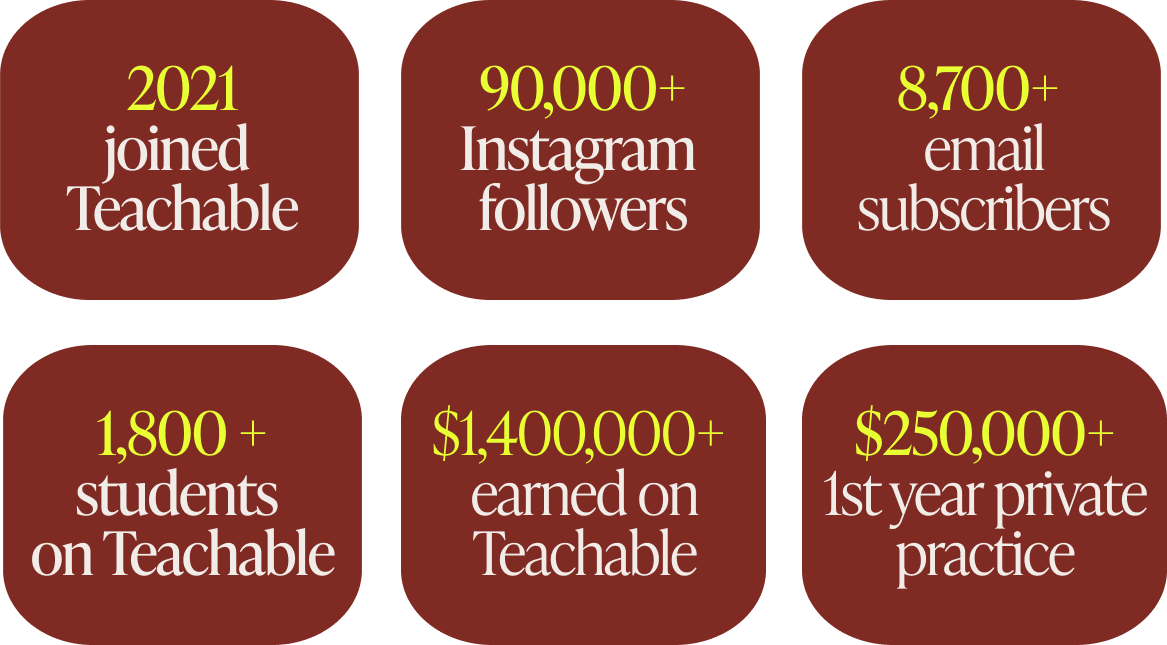
When Kelly's Instagram audience started growing, so did the demand for her time. She filled her caseload, and quickly other therapists started asking her for help.
Therapists booked coaching calls. They asked how she found clients, how she left insurance, how she thought about pricing. She answered the same questions over and over: how to write a bio, how to structure content, how to set up a scheduling system.
She was managing a full therapy caseload at the same time. The math on one-on-one coaching made no sense as a long-term model. The calls were useful, but there was a ceiling baked into the format.
"There was a clear moment when I realized something had to change. I was receiving more inquiries and coaching requests than I could realistically handle alongside my full therapy caseload. It became obvious that continuing to grow demand without changing my delivery model would lead to burnout." — Kelly McKenna, LCSW, MBA, Founder of Business of Therapy

She had already built her first digital product: an anxiety course that mirrored the work she did in session, structured as psychoeducation followed by ten coping strategies with video lessons and downloadable handouts.
The signal that a course for therapists made sense: therapists kept DMing her asking her for help and booking 1-1 calls. The market had been asking for something before she had built it.
She moved the coaching content into a structured course, kept her therapy clients, and launched what would become the Private Practice Academy Bundle. Teachable was the platform she chose after testing several options. The interface was clean, the pricing was accessible, and the setup was direct enough that she could focus on the curriculum rather than the tech.
"I was drawn to Teachable's strong reputation, clean interface, ease of use, and low prices. After testing the free trial and experiencing how intuitive the setup was, it felt like the right platform to confidently build and scale my digital products." — Kelly McKenna, LCSW, MBA, Founder of Business of Therapy

Kelly did not separate her identity as a therapist from her identity as a business owner. The clinical training she had spent years developing turned out to be directly relevant to every part of her marketing work. Her approach to building the business reflected that.
Kelly's Instagram accounts grew because she said things other therapists in her position were not saying. She talked about her rates. She talked about leaving insurance panels. She documented the process of building a caseload in real time, including the parts that were uncertain.
This was not a calculated content strategy at the start. It was how she naturally worked. Clinical training taught Kelly about rapport and authenticity. Kelly brought that same instinct to her posts.
"As I built my own business publicly, I shared the real-time process including the wins, the pivots, the fear, and that transparency became a core value of my brand." — Kelly McKenna, LCSW, MBA, Founder of Business of Therapy
The result was that both therapy seekers and therapists who found her account recognized themselves in what she was describing. Kelly eventually started a second Instagram page @businessoftherapy. The posts about money and burnout and how to price sessions landed because they named things the profession tends to avoid naming publicly. Her @businessoftherapy account grew from zero to over 50,000 followers since December 2022. And her therapy-focused account @sitwithkelly has grown to nearly 100,000.
Take action
One of the clearest ideas in Kelly's teaching is that therapists already know how to market themselves. They have just never been told to think of it that way.
"Marketing, at its core, is reflective listening — understanding someone's pain, naming it clearly, and mirroring that back to them. That's exactly what therapists do every single day. When therapists learn how to translate their clinical skills into client-centered messaging, marketing stops feeling salesy and starts feeling aligned." — Kelly McKenna, LCSW, MBA, Founder of Business of Therapy
This reframe is the engine behind everything she teaches. Therapists arrive at her course convinced they have no marketing ability. They leave understanding that the skill they have been practicing in session for years, hearing what someone says, reflecting it back clearly, identifying the underlying need, is exactly the skill that makes marketing work.
The practical effect is that her students do not have to become different people to grow their practices. They apply what they already know in a different context. For many of them, that shift alone changes their relationship to the whole idea of putting themselves out there.
Take action
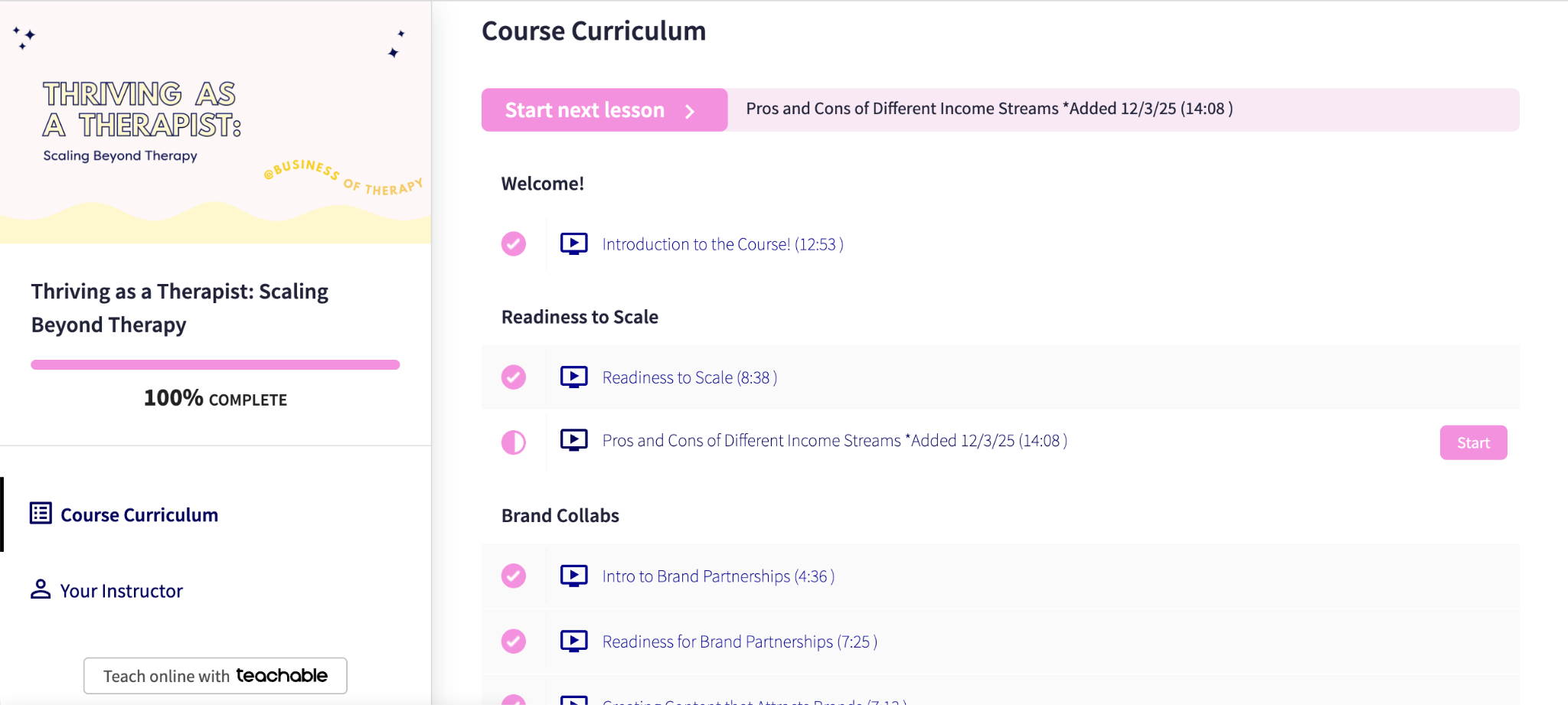
Kelly's first digital product, the anxiety course, was priced as a low-ticket entry point. The Private Practice Academy Bundle went in the opposite direction.
The original presale price was $447. Then $597. When she rebuilt and rebranded the course and added substantial new content, the price moved to $1,397. She runs regular launch pricing at $997, which is still a meaningful investment for most buyers.
"I firmly believe therapists are naturally some of the best marketers but they just don't realize it. Every therapist deserves to make six figures." — Kelly McKenna, LCSW, MBA, Founder of Business of Therapy
The pricing reflects the outcome on offer. A therapist who fills her caseload with private-pay clients at $250 per session and sees 15 clients a week earns over $190,000 a year. A course priced at $997 that delivers that result is not expensive relative to the change it produces. Kelly's students grasp that math, and the student messages in her submitted materials show the results: first condos purchased, debt paid off, babies born without financial anxiety.
She has also been direct about one misunderstanding she pushes back on consistently: the idea that digital products are passive income. The Private Practice Academy Bundle has gone through two major curriculum overhauls and quarterly updates since launch. The 1,000 students it has served received a living product, not a recording that sat untouched.
"The most profitable digital products are the ones that actually get people results. And that requires work. You should constantly be evolving your digital products as you learn more and get feedback from customers. Not necessarily to add more material, but to simplify and speed up what folks need to do to get the desired result." — Kelly McKenna, LCSW, MBA, Founder of Business of Therapy
Take action
The Private Practice Academy Bundle is a one-time purchase. The Reels Membership is a recurring subscription that gives therapists a steady stream of content ideas and templates for Instagram.
Kelly launched the membership in January 2021, generating over $413,000 with around 800 active members at any given time. The two products serve different needs without competing with each other. The course teaches the full system. The membership handles the ongoing execution problem that most therapists hit after they understand the strategy but struggle to maintain consistency.
"I'm constantly evolving the PPA Bundle. I see the course as a living resource that adapts alongside the therapists it serves." — Kelly McKenna, LCSW, MBA, Founder of Business of Therapy
Kelly’s ran two 4-day flash sales so far this year. The February 2026 PPA flash added 34 new therapists while the April 2026 Reels Membership flash sale added 51 new members. Running both products creates a flywheel: students who find the course often convert to the membership for ongoing support, and membership subscribers who want the full picture often upgrade to the course.
Take action
How Kelly thinks about scaling without losing the clinical foundation
Kelly holds two credentials that rarely appear together: a clinical social work license and an MBA. For most of her career, those two things lived in separate worlds. The clinical work was about presence and relationship. The business degree was about strategy and systems. Building her practice and then her education business forced her to understand that the division was artificial.
The same skills that make a therapist effective in session, hearing what is actually being said, identifying the real need underneath the presenting problem, creating a feeling of safety, are the skills that make marketing work. She did not just teach this as a concept. She built her own business by treating her Instagram audience the way she would treat a client: with honest attention to what they were actually struggling with.
"My background as a therapist has deeply shaped my teaching style. In clinical work, authenticity and relational safety are everything. People grow when they feel seen, not talked down to. I bring that same philosophy into my content and teachings." — Kelly McKenna, LCSW, MBA, Founder of Business of Therapy
She is also careful about what she promises. Students who move through the course quickly and implement consistently see results within weeks. Students who delay implementation see results that match their pace. She does not dress this up:
"The timeline depends less on the material itself and more on how quickly someone takes action. Those who implement consistently tend to see momentum build quickly." — Kelly McKenna, LCSW, MBA, Founder of Business of Therapy
The student messages Kelly shared in her case study application are not about follower counts or viral posts. They are about what financial stability makes possible.
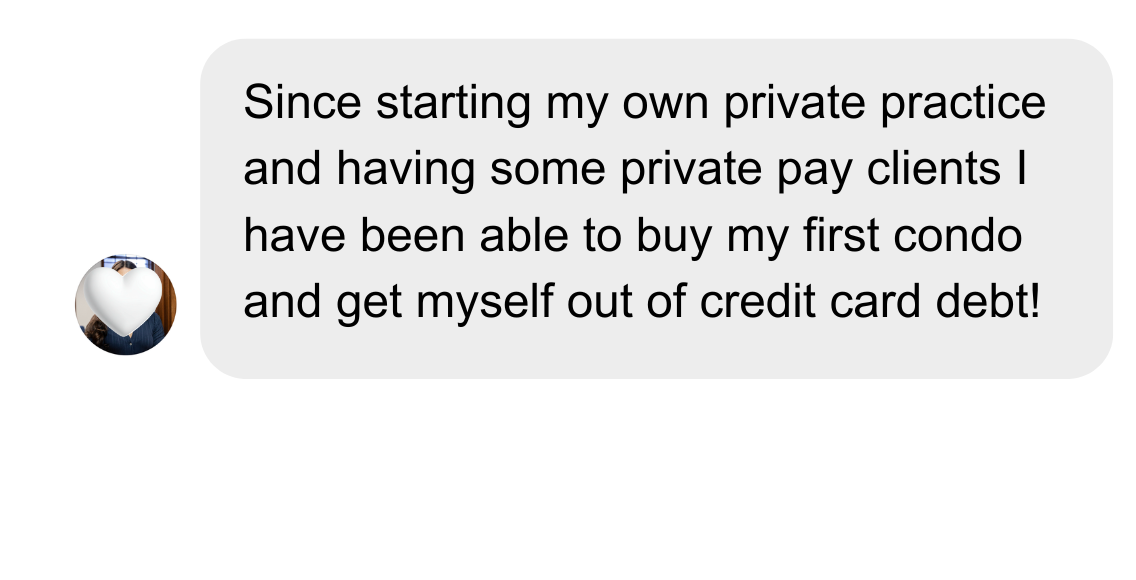
One student wrote: "Since starting my own private practice and having some private pay clients I have been able to buy my first condo and get myself out of credit card debt."
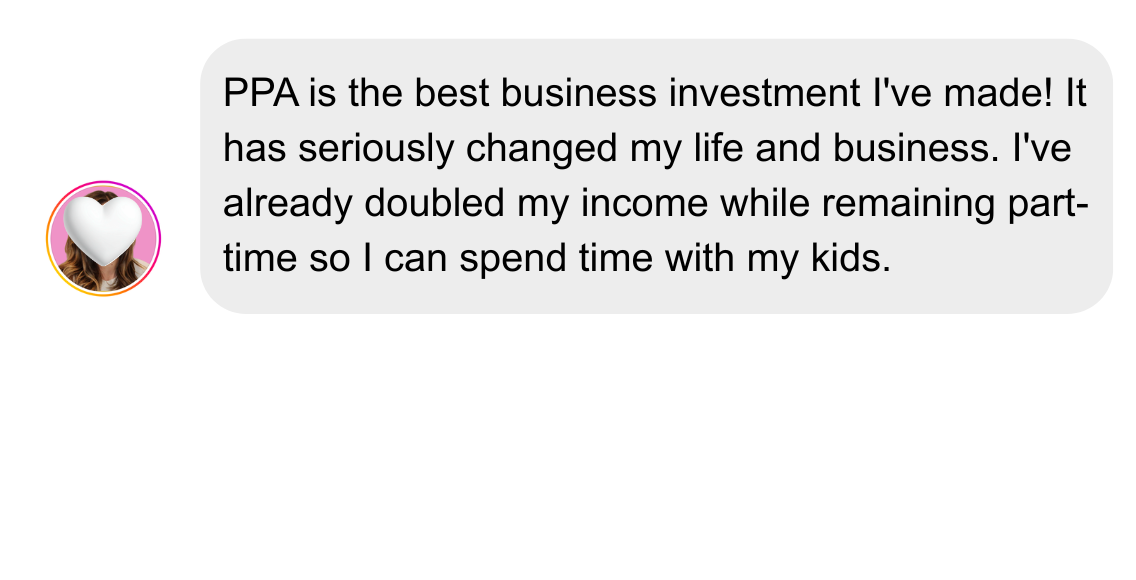
Another shared this: "PPA is the best business investment I've made. It has seriously changed my life and business. I've already doubled my income while remaining part-time so I can spend time with my kids."
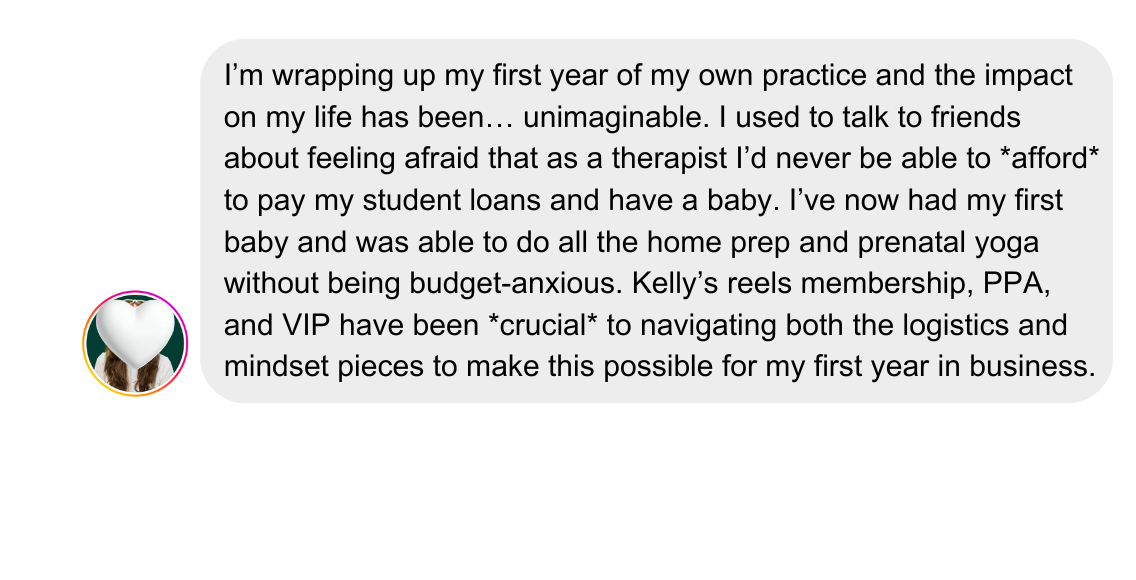
A third described finishing her first year in practice: "I used to talk to friends about feeling afraid that as a therapist I'd never be able to afford to pay my student loans and have a baby. I've now had my first baby and was able to do all the home prep and prenatal yoga without being budget-anxious. Kelly's reels membership, PPA, and VIP have been crucial to navigating both the logistics and mindset pieces to make this possible for my first year in business."
"The feedback that has meant the most to me isn't about follower growth or even revenue, it's about how therapists have been able to change their lives. When a therapist tells me they've bought their first home, paid off debt, doubled their income while working part-time, or finally felt financially secure enough to start a family, that's what stays with me." — Kelly McKenna, LCSW, MBA, Founder of Business of Therapy
Kelly lives in Miami with her husband Tom, their son Aidan, and their dog Jozi.
The Business of Therapy podcast launched in 2024 and added another channel for reaching therapists who prefer audio and longer-form content. She continues updating the Private Practice Academy Bundle on a quarterly basis at minimum, with major curriculum overhauls when the material needs it. The course is now on its second significant rebuild since the original launch.
Her stated goal is direct: every therapist deserves to make six figures. The financial sustainability she describes is not aspirational framing. It is the specific outcome she has built her entire curriculum to produce, starting from her own first year in private practice when she earned $250,000 without having built anything like this before.
Explore Kelly's work:
Visit businessoftherapy.com to access the Private Practice Academy Bundle, the Reels Membership, and Kelly's free training on marketing a therapy practice on Instagram.
Connect with Kelly:
Try Teachable yourself:
Kelly moved from one-on-one coaching calls to a course that has served over 1,000 therapists. Start your Teachable trial and build the product your audience has been asking for.