Thank you! Your submission has been received!
Oops! Something went wrong while submitting the form.
MENU
.avif)
Stefan Kunz can fill a room. Before he recorded a single lesson, he was teaching hand lettering in person to sold-out workshops in New York, Los Angeles, London, and beyond.
Reaching the rest of his audience meant teaching online, and the first online setup he saw up close looked complicated. Stefan taught a guest course for a fellow lettering educator whose school ran on WordPress, Vimeo, and password protection, all wired together by hand. The arrangement delivered the course. Keeping it running took constant attention.
Stefan wanted the opposite of that. He went looking for one place to build, sell, and run his courses, even if a packaged platform meant giving up some custom control. A recommendation from his friend and podcast co-host Lauren Hom pointed him to Teachable, and he has stayed there ever since.
“It felt like a platform that would let me focus on creating and teaching rather than managing technology.” — Stefan Kunz, Founder of Stefan Kunz Studio
Related: How to make money selling courses right now
Stefan never set out to become a teacher. His path ran through filmmaking, then wedding photography, then hand lettering, each craft picked up on his own and turned into a living.
Lettering took off as a trend, and people kept asking him the same question about how he did it.
Answering that question in person became a business of its own.
In 2019 he hired an assistant, cleaned out his studio, and ran his first lettering workshop off a big chalk wall in his own office, with pizza for about fourteen people. Demand kept showing up, so the rooms kept getting bigger.
By the time recording crossed his mind, he had taught hundreds of students face to face. He understood that whatever platform he picked would carry all of that online, which raised the stakes on choosing well.
That first online teaching, the guest course for a fellow lettering educator, ran on a custom mix of WordPress, Vimeo, and password protection stitched together piece by piece.
The setup delivered the lessons, and it also showed Stefan how much upkeep a hand-built system demands.
He wanted one place that handled the whole job, and he was willing to give up some custom control to get it. When Lauren Hom, his friend and Striving Artist podcast co-host, told him she was running her own courses on Teachable and loving it, the platform went straight to the top of his list.
A closer look confirmed the fit. The course builder, student management, comments, and online course tools all sat in one place, with a setup simple enough to learn in an afternoon. What stood out most was speed, since payments and delivery already worked together, so he could put his attention on the course instead of the connections between separate tools.
One detail settled it for him. Stefan could build his entire course before paying anything, which let him confirm everything worked before he committed. He created his first course, an online version of his lettering workshop, in a few days.
The feature he reaches for most today solves a problem that used to eat his evenings. Teaching a global audience, he once uploaded every video to separate services to make transcripts and subtitles by hand. Teachable now generates them for him, which feeds the kind of student experience that keeps international learners moving through a course.
“Being able to upload a video and have transcripts and translations generated automatically saves an incredible amount of time and helps me make my courses accessible to students around the world.” — Stefan Kunz, Founder of Stefan Kunz Studio
Stefan started with Teachable and has stayed. Switching platforms later, he points out, is no small task, which made getting the first choice right worth the care he gave it.
When Stefan started, having payments built into the platform mattered. He could open enrollment without wiring up a separate processor, which kept his attention on the course itself.
His needs changed as the business grew, and the platform gave him room to adjust. Stefan now connects his own Stripe and PayPal accounts through Teachable while keeping the built-in option available for whenever he wants it.
“As my business expanded, I had more flexibility to customize parts of my setup, including connecting my own payment processors like Stripe and PayPal.” — Stefan Kunz, Founder of Stefan Kunz Studio
Those options matter more for someone teaching across borders. Stefan's students reach nearly every continent, and Teachable Payments, powered by Stripe, handles tax and local payment methods across dozens of countries. For a creator selling to that kind of audience, the platform manages each market so the creator does not have to.
Stefan is the first to say there is no single right platform for everyone. Predicting how a business will grow is hard at the start, so he tells new creators to pick a tool that can grow with them.
“I would highly recommend choosing a platform that can grow with you.” — Stefan Kunz, Founder of Stefan Kunz Studio
The economics deserve early attention too. Giving up a small percentage feels minor in the beginning, and it adds up as the numbers get bigger.
“When you are just starting, giving up a small percentage may not seem significant. But as your business grows, every percentage point starts to matter.” — Stefan Kunz, Founder of Stefan Kunz Studio
The last thing he weighs is presentation. How a course looks and feels is part of a creator's brand, so Stefan wants a platform that lets him organize content, shape the student experience, and use tools like drip release to deliver a course the way he pictured it.
Take action
Stefan has launched more than 25 courses since 2019, and along the way he built a way of working that any creator with an audience can follow. The core of it is simple. He proves that people want something before he spends weeks building it.
Stefan learned this the hard way. Early on he poured months into courses he felt sure would land, then watched some of them open to near silence.
“You should sell first and then build it later. If it sells really well, then you build it. If it does not sell, what is the point of building it?” — Stefan Kunz, Founder of Stefan Kunz Studio
His model came from outside the course world. A sportswear brand he follows released a limited shoe by inviting people to enter their payment details for a chance to buy a pair, which told the brand exactly how much demand existed before it produced anything.
Stefan runs his launches on the same logic. For his animation course, he set up a tool that sent a waitlist link to anyone who commented the word animate on his videos. Around 3,000 people signed up within a couple of weeks, and that list became his proof.
“I had to have around 3,000 people on the waitlist to get 250 students. That conversion is still really good.” — Stefan Kunz, Founder of Stefan Kunz Studio
Take action
Stefan began in the smallest way possible, with a chalk wall and a pizza order.
His first workshop ran in his own office, with room for about fourteen people, and he taught it across a weekend before running it again. From there he booked a thirty-seat space, then back-to-back weekends in New York and Los Angeles with 120 seats to fill, followed by London, the Philippines, and India.
By the time recording crossed his mind, he had taught more than 300 students in person. He knew the questions they asked, the parts that confused them, and the moments things clicked.
“Start small, understand how it works, build up, and you can grow it piece by piece.” — Stefan Kunz, Founder of Stefan Kunz Studio
Take action
Stefan rarely changes his order of operations. He runs a live workshop first, turns it into a multi-week bootcamp next, and records the evergreen course last, once the material has proven itself several times.
The bootcamp stage is where Teachable's comment feature earns its place. In his weekly animation bootcamps, students post their homework and Stefan replies with video feedback, something a single-day workshop never had room for. The multi-week format makes space for that exchange, and the work students hand in gets noticeably better.
“Like a band performing the same show at different stadiums, I have refined it with every iteration.” — Stefan Kunz, Founder of Stefan Kunz Studio
By the time he records the evergreen version, real students have pressure-tested every lesson. The final course is the polished result of all those rounds.
Take action
Stefan compares a good course to a football team with one play it runs perfectly. The other side knows exactly what is coming and still fails to stop it.
“They were so good at that one single play that nobody could beat them.” — Stefan Kunz, Founder of Stefan Kunz Studio
He has watched his own launches grow so elaborate that even his team lost track of the plan. The fix was always the same. He stripped the launch back until everyone understood it again.
Simple plans are the repeatable ones. A launch you can run cleanly the second and third time is worth more than a clever one you manage to pull off once.
Take action
Plenty of creators teach students to copy one finished piece, step by step, which produces good imitations and little else. Stefan teaches the thinking underneath instead, the principles he uses to make any piece, and he gets students to a first win as fast as possible because an early result keeps them going.
He has a phrase for the balance.
“People want the quick win. So I try to hide the vegetables in the food.” — Stefan Kunz, Founder of Stefan Kunz Studio
The quick win is the food, and the principles are the vegetables. Students arrive for the result they saw on Instagram and leave able to make work of their own.
Take action
A common worry among creators is that teaching will pull them away from their craft. Stefan found the reverse to be true.
“You try to figure things out yourself, and then there comes the next level. Now you have to teach it to someone else, and that is when you learn whether you really understood it.” — Stefan Kunz, Founder of Stefan Kunz Studio
Explaining a technique forces him to understand why it works, which sharpens his own work. When he shares a method and watches other artists run with it, the pressure to find the next idea pushes him forward.
That loop is why he keeps taking client projects alongside teaching. His wife, a primary school teacher, pointed out that he learns the most when he solves real problems for paying clients. One recent brand project asked for a painterly texture effect he had never made before. He spent hours working it out, and now it is one more thing he can teach.
His path has run from lettering to Procreate to animation, and each new area started as a client challenge or a personal experiment. The teaching always follows the making.
Stefan prefers to let his reach tell the story rather than share revenue figures.
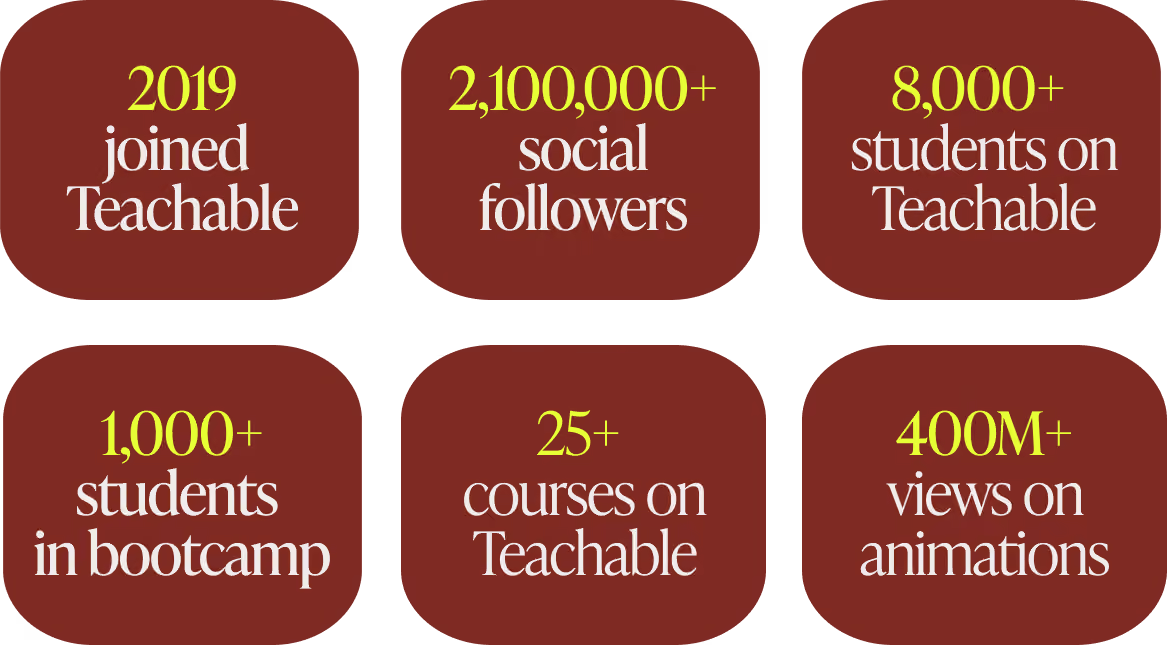
His brand animations have passed 400 million views, and his audience across social platforms sits above 2.1 million people. More than 8,000 students have come through his courses and workshops, with over 1,000 in his animation bootcamp alone. He has worked with brands including Coca-Cola, Apple, and Adobe, and he has taught students on nearly every continent.
For an artist who started by adding words to his Instagram photos, the pattern holds steady. He keeps making the work, and the teaching grows out of it.
Stefan is one of many creators using Teachable to reach students far beyond their home country. Elisa Azoum grew French Mornings to more than 2,850 language students across dozens of countries on the same platform, and Amie Tollefsrud built an eight-figure course business on it. The pattern repeats: real expertise, a clear program, and a platform that travels with the student.
Stefan's focus right now is client work, which has kept him busier this year than ever. He treats every project as research.
The lessons stack up quietly. How to use AI as a real tool in animation rather than a shortcut, how to build a studio camera setup, how to edit a video that travels well. Each one is a future course waiting for the right moment.
When the season turns and he has room to teach again, the material will be ready. The order will stay the same as always. Prove the demand, run it live, then record it.
The wider market is moving in his direction. Goldman Sachs Research projects the creator economy could reach $480 billion by 2027, roughly double its 2023 size. Creators who prove demand before they build, the way Stefan does, are the ones ready to claim a share of it.
See Stefan's work: Follow his animation on Instagram and YouTube, explore his Teachable school, or browse his full portfolio at stefankunz.com. You can also hear him on the Striving Artist podcast.
Read more creator stories: See how Youness School chose Teachable to train more than 2,000 engineering-prep students, and browse the full Success Stories collection.
Learn the sell-first approach: Stefan proves demand before he builds. For more on that, read how to make money selling courses right now.
Try Teachable yourself: Teachable gave Stefan one place to build, sell, and run his courses, with Teachable Payments handling tax and local methods for a global audience. Start your free Teachable trial and build the course your audience keeps asking you for.