Thank you! Your submission has been received!
Oops! Something went wrong while submitting the form.
MENU
%25201%2520(1)%2520(1).png)
Building a scalable education business isn’t about producing more content. It’s about designing a structure that allows scalable growth, and that delivers real transformation for the right students.
That’s the foundation of The Mentorship Model, the final December webinar led by Victor Damásio, one of the most recognized mentorship and high-ticket education experts in the creator economy.
Victor has helped creators and entrepreneurs reach consistent 7-figure results, working with mentees in 20+ countries. His approach to mentorship isn’t theoretical, it’s built from years of execution, iteration, and direct involvement in high-stakes education businesses. In this session, he shared how creators can layer mentorship on top of existing products to scale revenue, impact, and clarity.
Early in the session, Victor made one thing clear: most creators don’t have a content problem, they have a structure problem.
He’s worked with creators who already have:
Yet they feel stuck because growth depends on launches, personal time, or endlessly creating “the next thing.” Mentorship, in Victor’s words, is what allows creators to stop restarting and start compounding.
A recurring idea throughout the webinar was that information alone doesn’t create change.
Victor emphasized that:
At higher levels, students aren’t looking for more content, they want help deciding what to do next, what to ignore, and how to execute with confidence. This is where mentorship becomes the natural evolution of an education business.
One of Victor’s strongest arguments was against defaulting to 1:1 as a premium solution.
He explained that:
In group settings:
As Victor put it during the session, people don’t just learn from their own questions, they learn from everyone else’s. That collective pattern recognition creates faster clarity and fewer blind spots.
One line from the session resonated strongly with attendees:
Inside every group, there’s always a smaller group eager to pay more to get more.
Victor explained that most creators already have mentorship demand, but it shows up indirectly:
Mentorship isn’t about pushing people up the ladder. It’s about making the next step visible and intentional for those who are already raising their hand.
Another key theme from the webinar was the relevance of pricing, positioning, and energy.
Victor stressed that mentorship only works when it sits inside a clear value ladder:
When each level solves a different depth of problem, mentorship doesn’t cannibalize other products—it completes the ecosystem.
Victor was explicit about pricing: mentorship is not priced on content alone—it’s priced on access, responsibility, and outcomes.
That’s why strong mentorship offers typically include:
Saying “no” is part of the model. According to Victor, filtering for readiness isn’t about exclusivity, it’s about protecting results and delivery quality.
Three practical realities shaped the pricing decisions Victor described:
Application-based enrollment shows up here as a tool. A strong filter keeps delivery clean, retention high, and the mentor focused on the right clients.
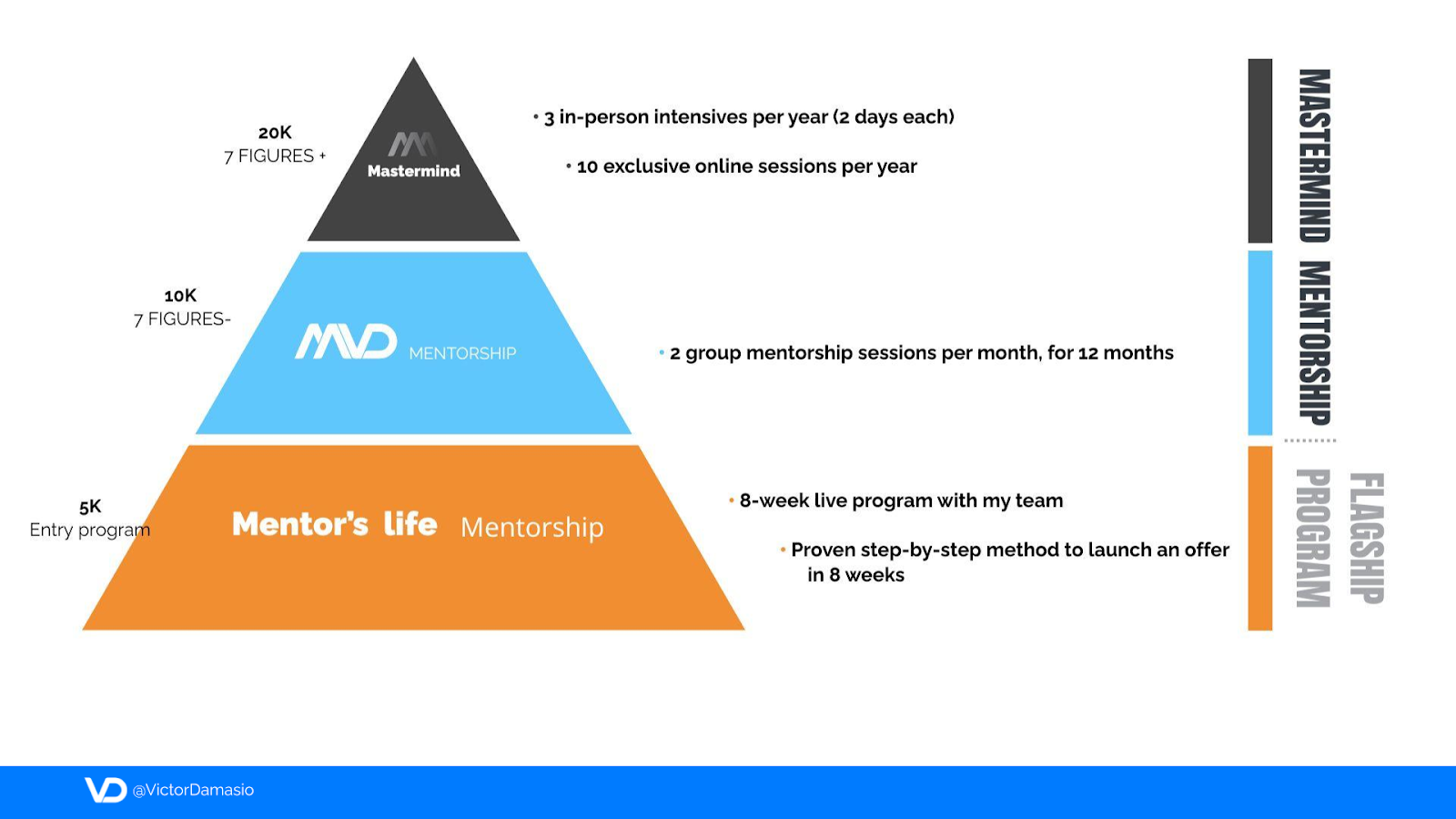
Victor showed his own offer ladder as a reference point, with clear price anchors and clear delivery commitments.
The important part is the design logic. Each tier solves a deeper problem than the one below it, and each tier increases access and responsibility.
Victor mapped mentorship to five stages with clear outcomes. Each stage tightens the offer and strengthens delivery.
Throughout the session, Victor reinforced that mentorship isn’t a launch tactic or a one-off offer. It’s a structural layer that, when done right:
As he summarized during the webinar: the right offer, for the right client, at the right moment, changes everything.