Thank you! Your submission has been received!
Oops! Something went wrong while submitting the form.
MENU
.avif)
.avif)
In March 2026, my team ran a survey to find out more about Teachable students: how they’re finding courses, what drives them to buy courses, what they value the most in their learning experience, and more.
One finding especially stuck out to me. When we asked people what makes them actually finish a course, the top answer wasn’t better videos or interactive elements. It was clear milestones and progress tracking. Sixty-six percent of students named it the #1 factor.
That tells us that the biggest opportunity for online educators isn’t necessarily in making better courses. It’s in better structure.
That’s where Learning Paths come in. Brand new to Teachable, Learning Paths allow you to turn your existing courses into structured, multi-course programs.
There’s undeniable value in a great standalone course: students learn real skills, get real value, and walk away better than they came in. But a single course can only take a student so far. There’s a ceiling on the transformation one course can deliver, no matter how good the content.
For the student, an isolated course can lack the depth and a defined arc they need to make a meaningful transformation. And that can cost you down the line. A student who doesn’t feel like they got results doesn’t come back for the next thing, doesn’t refer their friends, and doesn’t become the kind of long-term customer your business needs for sustainable growth.
Learning Paths can help raise that ceiling. Instead of selling a single course and hoping it carries a student all the way to a meaningful outcome, you’re delivering a program with a clear beginning, a defined progression, and an end state student can actually point to.
The courses you’ve already built do more, because they’re working together.
Here are two more numbers from the same survey:
Repeat purchase intent is high, and most students aren’t asking for a community or a workbook or a cheaper option. Instead, they want the next level of the thing they just finished.
Learning Paths essentially let you give that to your students from the start. If repeat purchase intent is high, we can also assume that students’ willingness to buy a higher ticket product—one that includes the advanced coursework they’re after—is there too. So your work is less about convincing them and more about actually building the thing.
It’s safe to assume a higher price tag for a Learning Path than a course because it includes, well, multiple courses. It’s simple math. But let’s dig deeper: it’s more of a positioning shift than a product shift.
A course says: here’s a topic I’ll teach you.
A program says: here’s a transformation, and these are the stages you move through to get there.
That reframe alone justifies more premium pricing. It’s the difference between “I bought a yoga course” and “I enrolled in a 200-hour teacher training.”
You’re selling your same expertise, just packaged differently. The way you market your learning should be less about content and more about outcomes.
Best of all, you can build a Learning Path from your existing course catalog. The work is in deciding what comes after what, defining the outcome the full sequence delivers, and pricing it like a program rather than the sum of its parts.
Many course creators assume their next jump in revenue has to come from a bigger audience. Sometimes it does. More often, it comes from giving the audience you already have the more advanced options they want.
That’s what Learning Paths are built for: turning the courses you already sell into a structured program students can buy as one thing, complete in the right order, and finish with a real sense of accomplishment.
Note: Learning Paths are currently available in beta. To request to join the beta group, complete this form.
.avif)
Cyber Monday may be over, but did you know that buyer interest often peaks after that initial rush? Plenty of students miss the first deadline or need extra time to budget. Extending your offer (even briefly) helps you turn that lingering interest into revenue without having to create a whole new promotion.
Here are a few simple, low-lift email templates you can use to capture last-minute sales without starting from scratch.
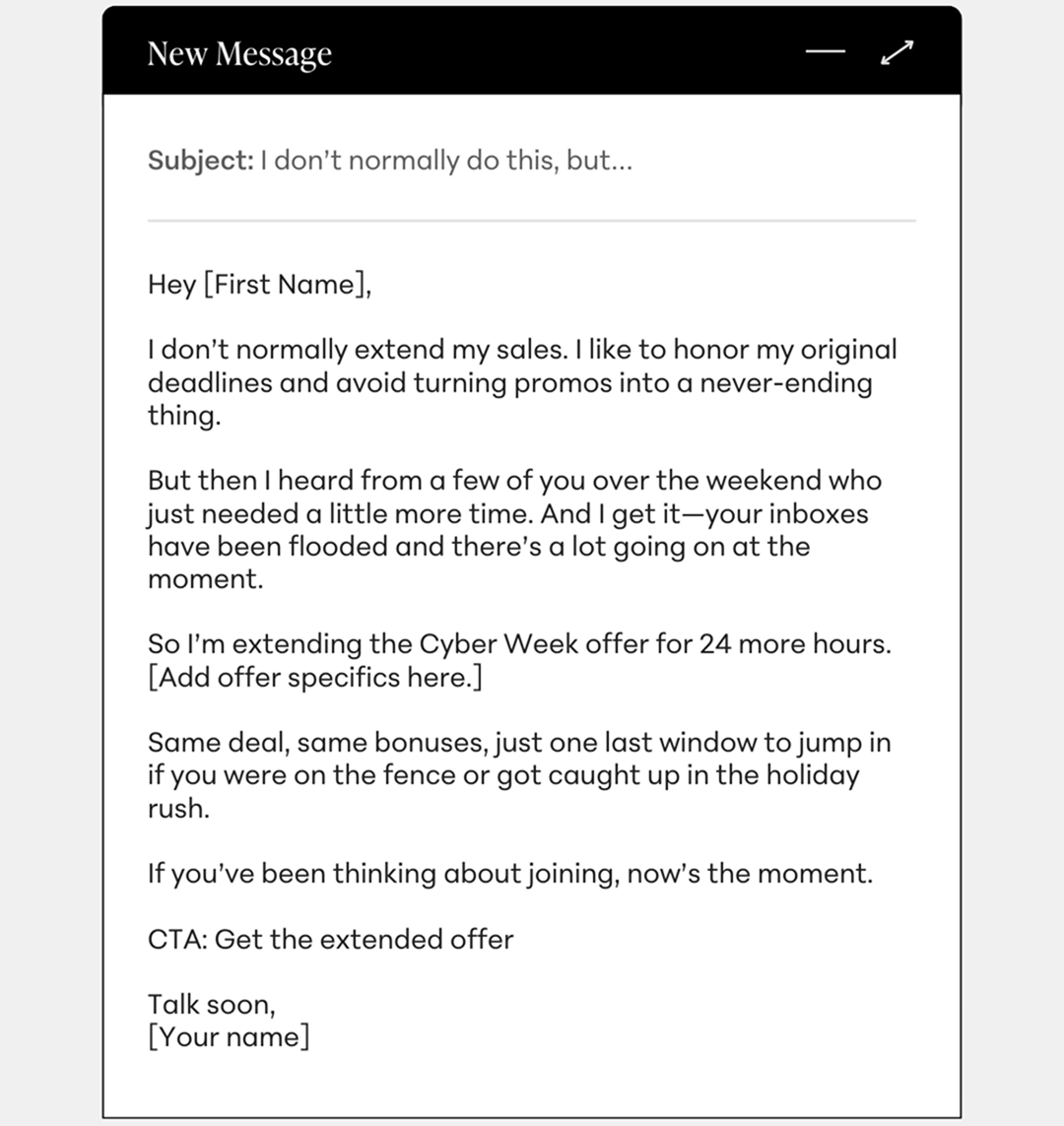
Try a warm, personal note that acknowledges your student relationship and creates a justifiable reason for extending the offer. It feels personal and is best suited for tight-knit communities or high-touch programs.
Subject line ideas:
Email body (copy and paste this):
Hey [First Name],
I don’t normally extend my sales. I like to honor my original deadlines and avoid turning promos into a never-ending thing.
But then I heard from a few of you over the weekend who just needed a little more time. And I get it—your inboxes have been flooded and there’s a lot going on at the moment.
So I’m extending the Cyber Week offer for 24 more hours. [Add offer specifics here.]
Same deal, same bonuses, just one last window to jump in if you were on the fence or got caught up in the holiday rush.
If you’ve been thinking about joining, now’s the moment.
CTA: Get the extended offer
Talk soon,
[Your name]
Pro tip: Hyper-personalization works great here—mention real questions that came in, delays your audience faced, or specific reasons people asked for more time. It makes the extension feel earned, not manufactured.
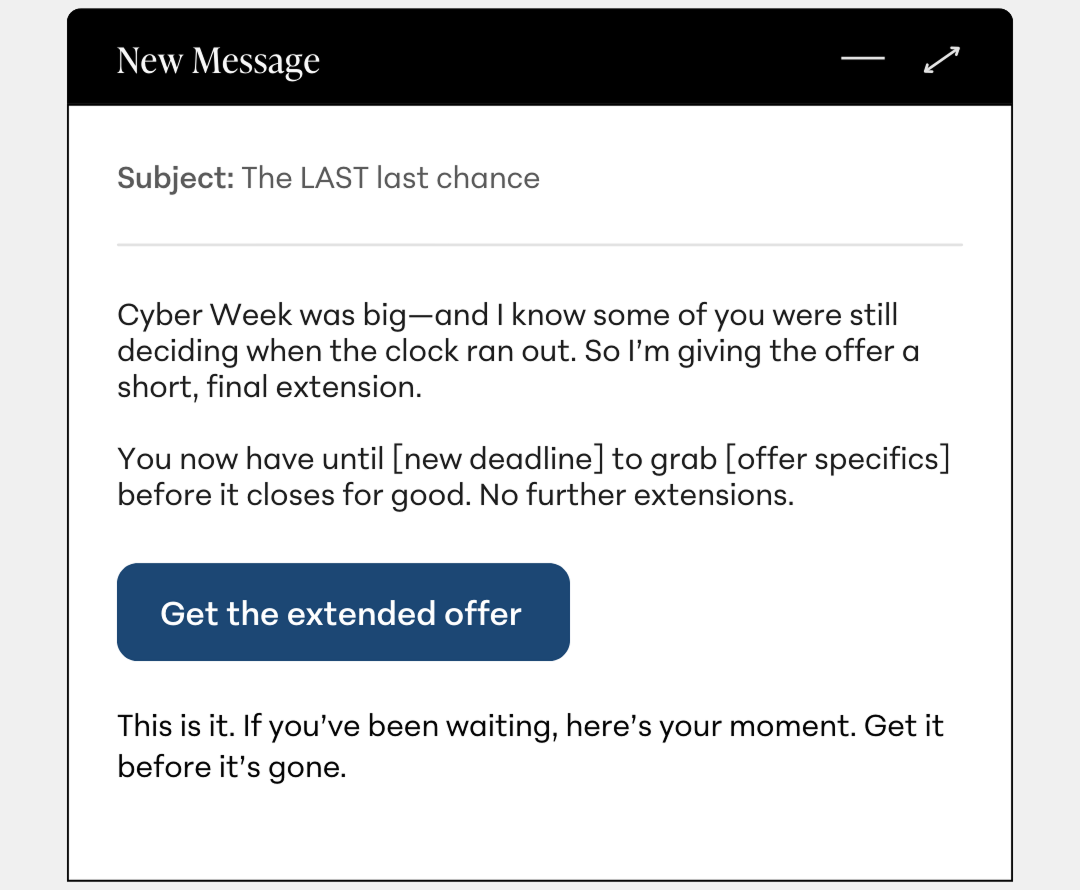
When it comes to closing last-minute sales, high urgency and to-the-point copy go a long way. This is your strongest “the deadline is real” message.
Subject line ideas:
Email body (copy and paste this):
Cyber Week was big—and I know some of you were still deciding when the clock ran out. So I’m giving the offer a short, final extension.
You now have until [new deadline] to grab [offer specifics] before it closes for good. No further extensions.
CTA: Get the extended offer
This is it. If you’ve been waiting, here’s your moment. Get it before it’s gone.
Pro tip: Pair this email with a countdown timer or a clear timestamp (“ends tonight at 11:59 p.m. ET”). Urgency lands harder when the deadline feels real and specific.
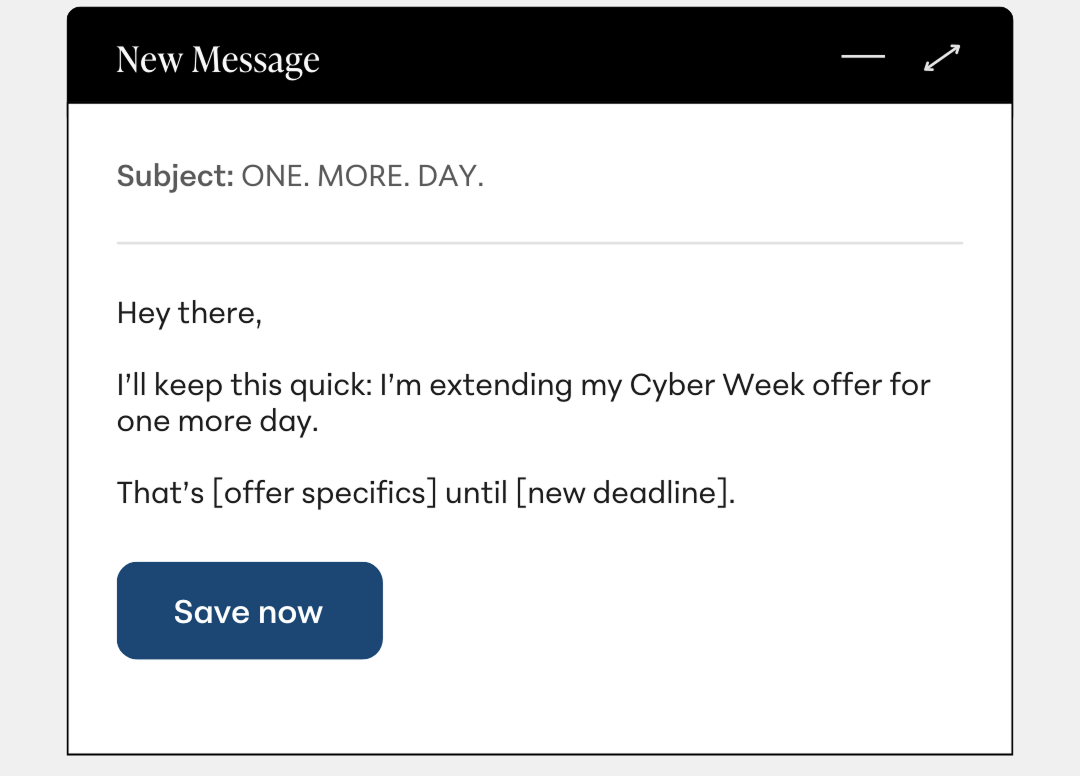
Simplicity is the strategy. A minimalist extension email keeps the important details (the offer and the deadline) front and center. You can do plain text, but this approach really works well as an eye-catching, design-forward announcement.
Subject line ideas:
Email body (copy and paste this):
Hey there,
I’ll keep this quick: I’m extending my Cyber Week offer for one more day.
That’s [offer specifics] until [new deadline].
CTA: Save now
Email body [design-friendly variation]:
Think of this version like an announcement card—clean, high-impact, and instantly scannable
Pro tip: This approach shines when sent fast—think right after the original sale closes—to the right people. If you delay the extension too long, the simplicity reads flat. By sending it to a segmented group of people who have already opened your previous emails, you can be sure that they already have a clear understanding of the benefits of your offer.
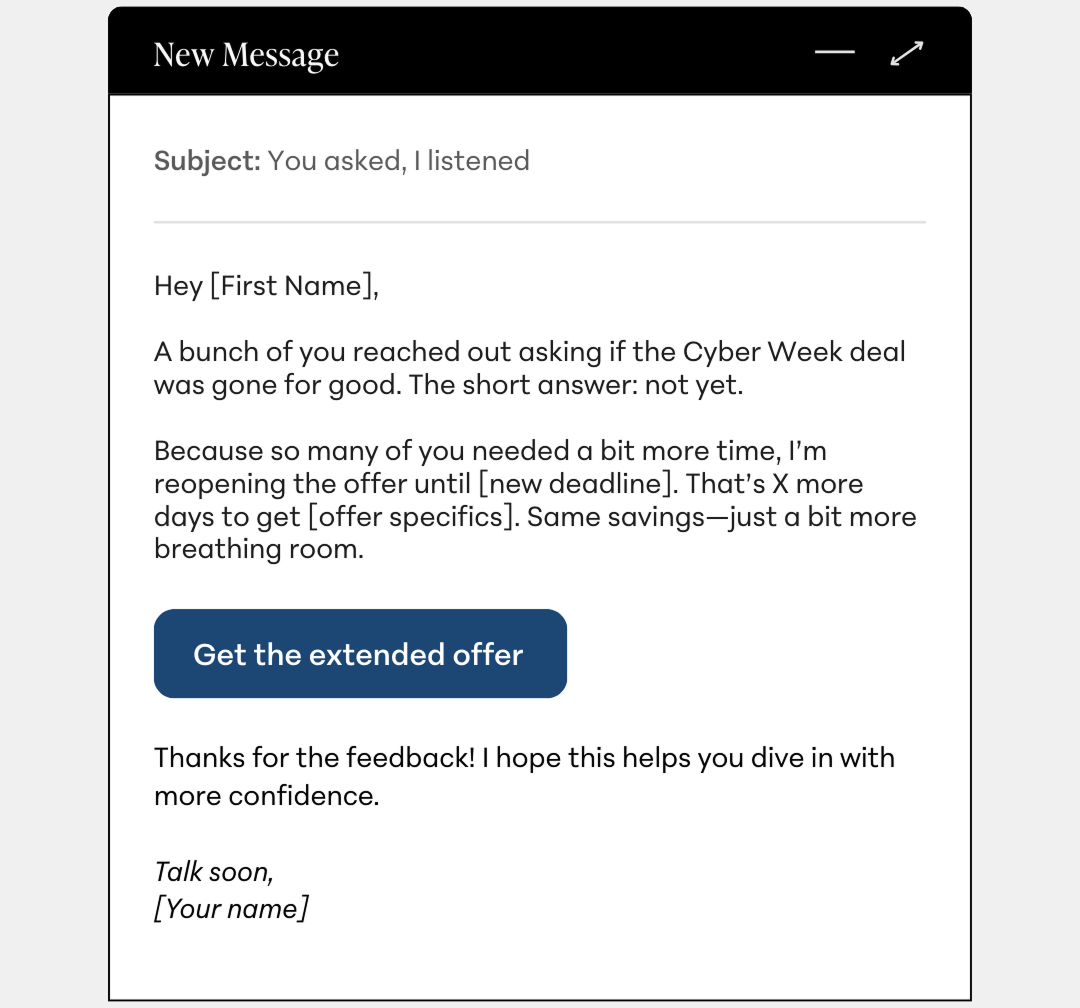
By opting for a feedback-driven approach, you can leverage the power of social proof to get people to buy. This is perfect for audiences that regularly reply to or interact with you.
Subject line ideas:
Email body (copy and paste this):
Hey [First Name],
A bunch of you reached out asking if the Cyber Week deal was gone for good. The short answer: not yet.
Because so many of you needed a bit more time, I’m reopening the offer until [new deadline]. That’s X more days to get [offer specifics]. Same savings—just a bit more breathing room.
CTA: Get the extended offer
Thanks for the feedback! I hope this helps you dive in with more confidence.
Talk soon,
[Your name]
Pro tip: Screenshot a DM (with permission!) or reference a real note you got. It adds specificity and reinforces that the extension is in response to genuine demand.
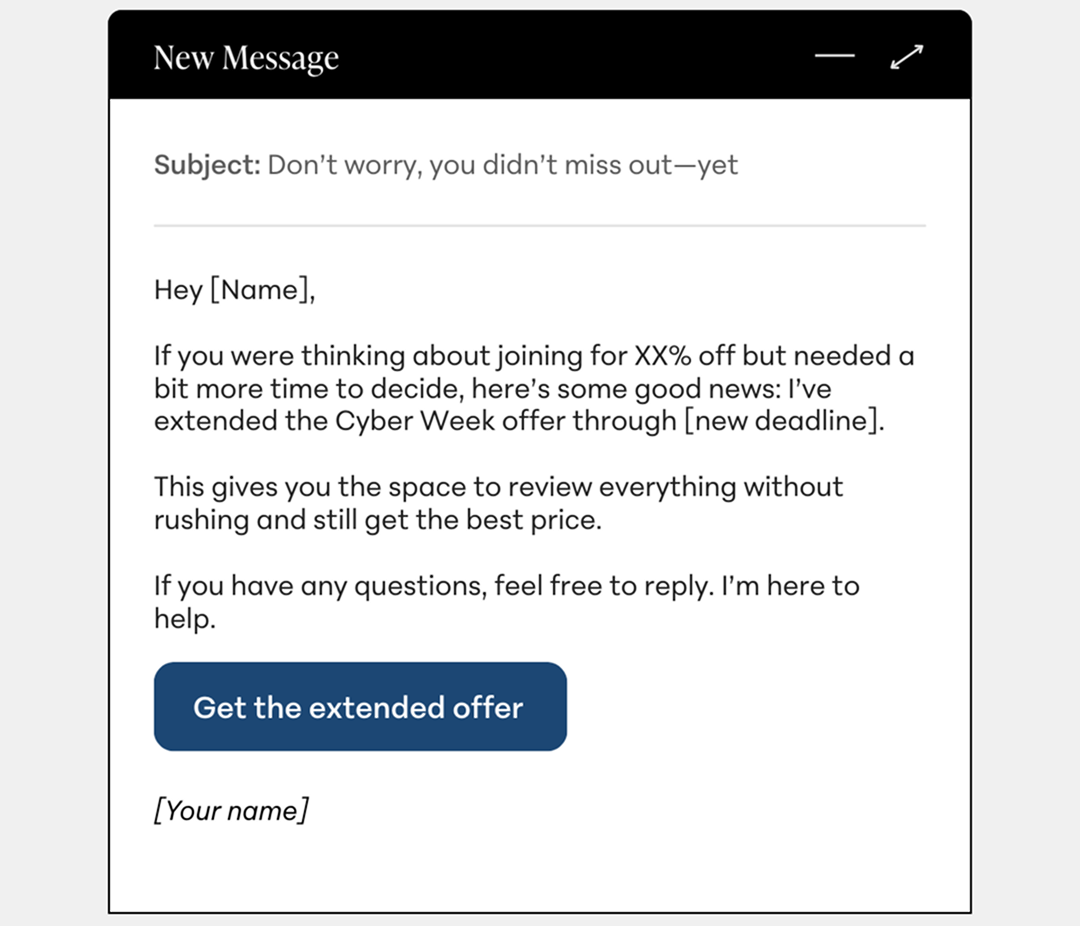
This option is great for higher-ticket offers where the decision cycle is longer. Potential buyers will naturally take more time to decide when the investment is higher, so it’s important here to reiterate the value of what you’re offering.
Subject line ideas:
Email body (copy and paste this):
Hey [Name],
If you were thinking about joining for XX% off but needed a bit more time to decide, here’s some good news: I’ve extended the Cyber Week offer through [new deadline].
This gives you the space to review everything without rushing and still get the best price.
If you have any questions, feel free to reply. I’m here to help.
CTA: Get the extended offer
[Your name]
Pro tip: This email works even better if you briefly remind people why the offer is compelling—one sentence on the transformation, bonuses, or value goes a long way for hesitant buyers.
Offer extensions work best when they feel thoughtful, time-bound, and rooted in actual customer behavior instead of like a never-ending promo cycle. These templates will give you a clean, compelling way to wrap up your end-of-year sales with confidence.