Thank you! Your submission has been received!
Oops! Something went wrong while submitting the form.
MENU

I’ve built 368 digital products, 30 courses, 3 summits, a high-end group coaching program, a mastermind, and three different iterations of the same membership.
Which means I know a thing or two about creating something people will pay for.
But after more than a decade of doing this, I think one of the most valuable skills I’ve learned has nothing to do with creating the next thing.
It’s knowing when to stop selling the old thing.
Today, only eight of those courses are actively for sale. The summits are gone. The group coaching program and mastermind are gone. And instead of trying to convince people to choose between hundreds of individual products, most of what we’ve created now lives inside one membership.
But here's where it gets interesting:
Most of those products didn't fail.
Some made us a lot of money. Some were genuinely beloved by our customers. Some still contain really valuable information. And very few have actually disappeared from existence.
When I say I “kill” a product, I'm usually making a much more nuanced decision about whether that product still deserves my attention and my audience's attention.
And after hundreds of offers and millions of dollars in sales, I've learned something I wish more creators talked about:
A product doesn't have to be bad—or even stop making money—to stop deserving a starring role in your business.
So how do I know?
There are five reasons I consistently stop putting my weight behind a product—and surprisingly, “it stopped making money” isn't one of them.
One of the hardest products to stop selling is one that still sells.
When something flops, the market makes the decision pretty easy for you. But what happens when people still want the thing—and you know you wouldn't create, use, or recommend that same solution today?
For me, that's usually a sign that a product needs to move out of the spotlight.
Trello for Business is probably the best example of this in Boss Project's history.
It was undoubtedly one of our biggest viral hits. People loved it enough that they voluntarily promoted it on their websites, email lists, and podcasts. We had created the kind of product people genuinely wanted to tell their friends about.
Which made it particularly difficult to stop promoting.
The problem wasn't that Trello for Business had suddenly become a bad product.
We had outgrown it.
Trello represented how we operated Boss Project when the company consisted of two people and the business itself was considerably simpler.
Eventually, we were managing a team of 10 full-time employees and more than 20 contractors. Asana had become the operating system behind the entire company. It was how we assigned work, managed projects, communicated across the team, and kept dozens of moving pieces headed in the same direction.
So continuing to actively promote Trello for Business started to feel strange.
We would have been teaching people to operate their businesses using a system we weren't actually using to operate ours.
Instead, we built its grown-up sister: Asana for Business.
That didn't mean Trello for Business suddenly became worthless. In fact, you can still buy it today.
But I wouldn't point you toward it to learn how I currently operate my business.
At this point, I think there's almost more value in studying why Trello for Business worked: how we packaged it, positioned it, and created something compelling enough that other people promoted it for us without being asked.
The product didn't fail.
Its role in our business changed.
That's an important distinction, because if I'd made the decision based exclusively on whether Trello for Business could still generate revenue, I could have justified promoting it for much longer.
If I were solving this problem for my customer today, is this still the solution I'd tell them to use?
If the answer is no, I'm not going to keep putting my marketing weight behind it just because it still makes money.
Sometimes the underlying problem is still relevant, but the way people expect to solve it has changed.
In 2018, many of our courses included worksheets customers could print or fill out digitally.
That was useful at the time.
Today, most people don't want the important information they created six months ago trapped inside a PDF they downloaded somewhere or a piece of paper sitting on their desk.
They expect their resources to be:
The information may still be valuable. The format became outdated.
The same thing happened constantly with our design products.
At one point, Instagram graphics were predominantly individual images. If you wanted to create a larger visual experience, you might design three separate posts that formed a banner across your profile grid.
Then Instagram introduced carousels.
Customer behavior changed. The platform changed. The strategy changed with it.
Making the old template prettier wouldn't necessarily make it more relevant.
Sometimes I don't retire the idea. I retire the format.
A lot of our products were also designed to solve problems technology hadn't solved yet. We created hacks because software companies weren't evolving as quickly as the people using their products.
Eventually, technology catches up.
When that happens, I don't need to make a big announcement that a hack is obsolete. I need to keep paying attention to the next problem my audience needs solved.
This one goes both directions.
Over nearly a decade, our audience evolved. But so did we.
The person Boss Project served in one stage of the business wasn't necessarily the person we wanted to build for forever. And sometimes our customers simply had bigger problems than the one an older product solved.
That's why I don't start a product audit by looking through everything I've already created and asking:
“Which of these sounds fun to update?”
That's backwards.
I want to know:
What problem does my customer urgently need solved right now?
For Boss Project, we had an unusual advantage: much of what we taught was meta.
We were running the kind of business we were teaching other people to build.
We would encounter a problem in our own marketing or operations, test different ways of solving it, determine what actually worked, and then teach what we'd learned.
We were usually solving our own problem first.
Not everyone teaches people how to do what they themselves do. But every creator can find a way to stay “in the trenches” with the people they serve.
Talk to customers. Interview people. Pay attention to their questions. Look for the problems appearing repeatedly.
At the same time, give yourself permission to acknowledge when you've moved on too.
You may become more sophisticated in your approach. Your expertise may deepen. Your positioning may change. You may decide you want to serve someone at a different stage of life or business.
An old product can still be perfectly good while no longer representing the business you're building.
Don't keep an old product at the center of your business simply because you already own the IP.
Your existing catalog shouldn't determine what you sell next.
Your customer's current problems—and the problems you're uniquely positioned and excited to solve—should.
For five years, one of the central promises of our membership, The Co-op, was simple:
Four new digital products every month.
Those products could be social media templates, client presentations, internal business documents, or practically any piece of collateral a small business needed to operate.
The constant releases were part of the reason to stay subscribed.
And it worked.
Until eventually, producing four new products every month stopped being sustainable.
About six months before ending monthly releases, I changed the promise on the membership sales page. Then we stopped creating at that pace.
Members still had access to the enormous catalog we'd spent five years building. And roughly nine months later, we'd experienced minimal churn.
That taught me something important:
The value was bigger than the production schedule we'd originally wrapped around it.
For several years, we also ran The Incubator, a high-end, year-long group coaching program designed for business owners who were further along in their growth. It paired our curriculum with a much higher level of hands-on support, including group calls and personalized video reviews of members' work.
When we eventually stopped running the program, we were left with something interesting: a really valuable body of intellectual property wrapped inside a delivery model we no longer wanted to maintain.
The average person of our standard membership at the time wasn't at the right stage of business for that material. So we didn't immediately dump it into the membership because we happened to have it.
Eventually, we created a higher membership tier.
Those members could access the content at a dramatically lower price than clients had previously paid for the high-end program—but they weren't getting the same offer.
There were no group calls. They couldn't submit work for personalized video reviews. The labor-intensive support disappeared.
We preserved the valuable IP while retiring an expensive delivery model.
Sometimes the thing that needs to die isn't the product. It's the way you deliver it.
Sometimes an offer starts getting harder to sell and the instinct is to immediately start fixing it. Change the positioning. Rewrite the sales page. Adjust the price. Add another bonus. Maybe scrap the whole thing and build something new.
But before you assume the product is the problem, you have to ask another question: Are you still putting it in front of enough people who are actually qualified to buy it?
Our high-end group coaching program, The Incubator, is one of my favorite examples of why that distinction matters.
The initial launch was incredible. We essentially doubled our business in about six weeks while developing and launching the program. The first time we opened applications, we received more than 250.
The next launch generated around 50 applications. By the third, we received nine.
Looking at those numbers alone, you might reasonably conclude that the offer had stopped working. But our conversion rate told us something completely different. Conversion among qualified applicants held—and at times actually improved.
When the right person encountered the offer, they bought.
We didn't have an offer problem. We had an audience problem.
The Incubator was an expensive, year-long program designed for business owners at a particular stage of growth. There were only so many people in our existing audience who were both a fit for the program and in a financial position to make that kind of investment.
And we'd already enrolled a lot of them.
What we weren't doing fast enough was growing our visibility and bringing enough new, qualified people into our world to replace the people we'd already converted.
When we did more cold outreach, that became even clearer. Many of the people who had been hanging around our audience without applying weren't necessarily uninterested in the program. They simply weren't ready for it. Their businesses weren't large enough yet, or they weren't in a financial position where that investment made sense as their next step.
We could have responded by loosening our standards for who qualified. We could have gotten more aggressive about overcoming objections or tried harder to convince people they were ready.
We didn't.
We weren't willing to sell the wrong people an expensive program simply because doing so would make us more money.
Eventually, we shut the program down. Not because the offer had stopped converting. Not because the people inside weren't getting value. And not because we'd suddenly decided the underlying product was bad.
There simply weren't enough right-fit customers entering our audience to sustainably keep selling it at the pace the model required.
You can't diagnose a product problem when you actually have an audience-growth problem.
Revenue can tell you that fewer people are buying. Conversion rate can help you understand whether the people you're putting the offer in front of still want it. But neither number exists in a vacuum.
If you're repeatedly selling the same offer to the same audience, eventually you have to bring new people into that audience. You can't just be selling. You also have to be growing your awareness.
And sometimes a profitable product still deserves to be retired—not because it stopped working, but because continuing to grow it would require selling it to people you don't believe should buy it.
One of the advantages of running so many products through Teachable is that I have a lot of data at my fingertips. I can look at sales and revenue, refunds, student progress and completion, video engagement, and how individual courses are performing over time.
All of those numbers can answer different questions about the health of a product. But when I'm trying to decide whether something still deserves my marketing attention, I tend to zero in on two things:
Revenue and conversion rate.
Revenue tells me whether an offer is producing meaningful dollars for the business. Conversion rate helps me understand something different: when I actually put this product in front of the right people, do they still want it?
That distinction matters because products don't sell in a vacuum.
Yes, something can continue selling organically long after you've stopped actively promoting it. But almost every product is going to sell more when you intentionally put it in front of people through email, social media, a launch, or another funnel.
You can't stop promoting something, watch the revenue decline, and decide the product must be dead. Most people aren't going to dig through your website hoping to stumble across the perfect solution to their problem. You have to actually put it in front of them.
That's why I think of Teachable's reporting as evidence, not an oracle.
The data gives me an objective view of what's happening inside the business. It helps me see patterns that would be incredibly easy to miss if I were making decisions based purely on how I felt about a launch or product.
But the dashboard can't know everything happening outside of it.
If revenue is declining but conversion remains strong when I actively promote the offer, I probably don't have a product problem. I might have a visibility problem.
If I'm consistently putting an offer in front of right-fit people and selling it suddenly feels like pulling teeth, that's when I start looking beyond the numbers. Has the trend passed? Does my customer have a more urgent problem now? Has technology made my solution unnecessary? Has another tool created an easier way to accomplish the same thing? Or am I simply not bringing enough new, qualified people into my audience?
Those are questions no dashboard can answer for me. But having years of Teachable data means I don't have to start the investigation with a guess.
Teachable gives me the evidence. Staying close to my customer gives me the explanation.
And after hundreds of products, I've found that I need both to know what deserves my attention next.
After all this talk about killing products, I should probably clarify: very few things we've created have actually disappeared.
When we make reasonable updates to a product, I generally believe the people who bought it should get those updates. And when we stop actively promoting something, that doesn't mean existing customers should suddenly lose access to something they paid for.
More often, a product simply moves through different seasons in our business:
Launch it → promote it → update it → deprioritize it → bundle it → replace it → preserve access.
Teachable has made it possible for us to keep that history intact while evolving what we put our marketing energy behind.
Today, instead of trying to sell hundreds of individual products, we're largely pointing customers toward one primary buying decision: our membership. Inside, they get access to hundreds of the digital products and courses we've created over the years.
The catalog still creates enormous value.
I just don't need to actively sell every individual piece of it.
If you have 15 old products sitting in your Teachable school and you're wondering which ones you should update, don't start by opening your product catalog. Start with your customer.
Don't ask, “What do I already have that I could sell?” or “Which product sounds fun to update?” Go talk to actual people. Interview your audience until you start hearing the same problems repeatedly. Pay attention to what feels urgent enough that someone genuinely wants it solved—not someday, but now.
Then look at your existing intellectual property.
Maybe you've already created exactly what they need. Maybe the idea is still great, but the format needs updating. Maybe you've outgrown the product—or your customer has. Maybe technology has changed the way the problem gets solved. Or maybe the right answer is to create something entirely new.
The point isn't to keep your entire catalog alive simply because you worked hard to create it. It's to make sure what you're putting your time, energy, and audience's attention behind still solves a problem that matters today.
After building 368 digital products, I've found that the right product tends to hit you in the face.
You just have to stay close enough to the people you're serving to notice it.
Your next bestselling course might already be half-written. It’s hiding in your highest-performing posts, your most-shared podcast episodes, the reels people keep saving, and the offhand comments in your DMs that sparked entire conversations.
The money doesn’t get better every time you start from scratch. You get paid for turning your proven ideas into repeatable results.
This is your invitation to reverse engineer your next course from content that has already resonated and delivered value. And to do it faster (and smarter) using a few well-placed AI tools, especially the ones baked into Teachable’s new AI Hub.
Whether you’ve launched before or this is your first course, we’re ditching perfectionism and overplanning for a method that’s lean, strategic, and wildly effective.
I’m Abagail Pumphrey, a digital product strategist and host of the Strategy Hour Podcast. I’ve helped tens of thousands of entrepreneurs turn their ideas into profitable digital products. Honestly, I wish this process existed sooner. It would’ve saved me hundreds of hours over the years.
I’ve got the whole process laid out for you, just follow along step-by-step. You’ll have a full course outline in less than 5 minutes, and could have a course 90% there in under an hour.
{{trial-component="/blog-shortcodes/blog-cta"}}
Before you start planning anything new, go back and dig into what you’ve already created. You’ve already shown up as the expert, now’s the time to pull together your best work.
Pull your analytics: blog posts, podcast episodes, YouTube videos, email campaigns, IG reels, TikToks. Anything that had high engagement, shares, saves, replies, or repeat views can be a starting point.
Look for patterns:
This step is where Teachable’s Take Back Control of Your Content guide comes in clutch. It’s the foundation for treating your content library like an asset. You’re sitting on a catalog of ideas that are already validated. You just need to connect the dots.
You don’t need to have it all figured out. That’s what AI is here for.
Paste your high-performing content into ChatGPT using the following prompt:
I want to turn the following content into a course using Teachable’s AI Curriculum Generator, which has a 1,000-character input limit.
Please:
Copy ChatGPT’s response (you’ll use that in Step 2).
Once you’ve surfaced a few promising topics, it’s time to shape the skeleton of your course.
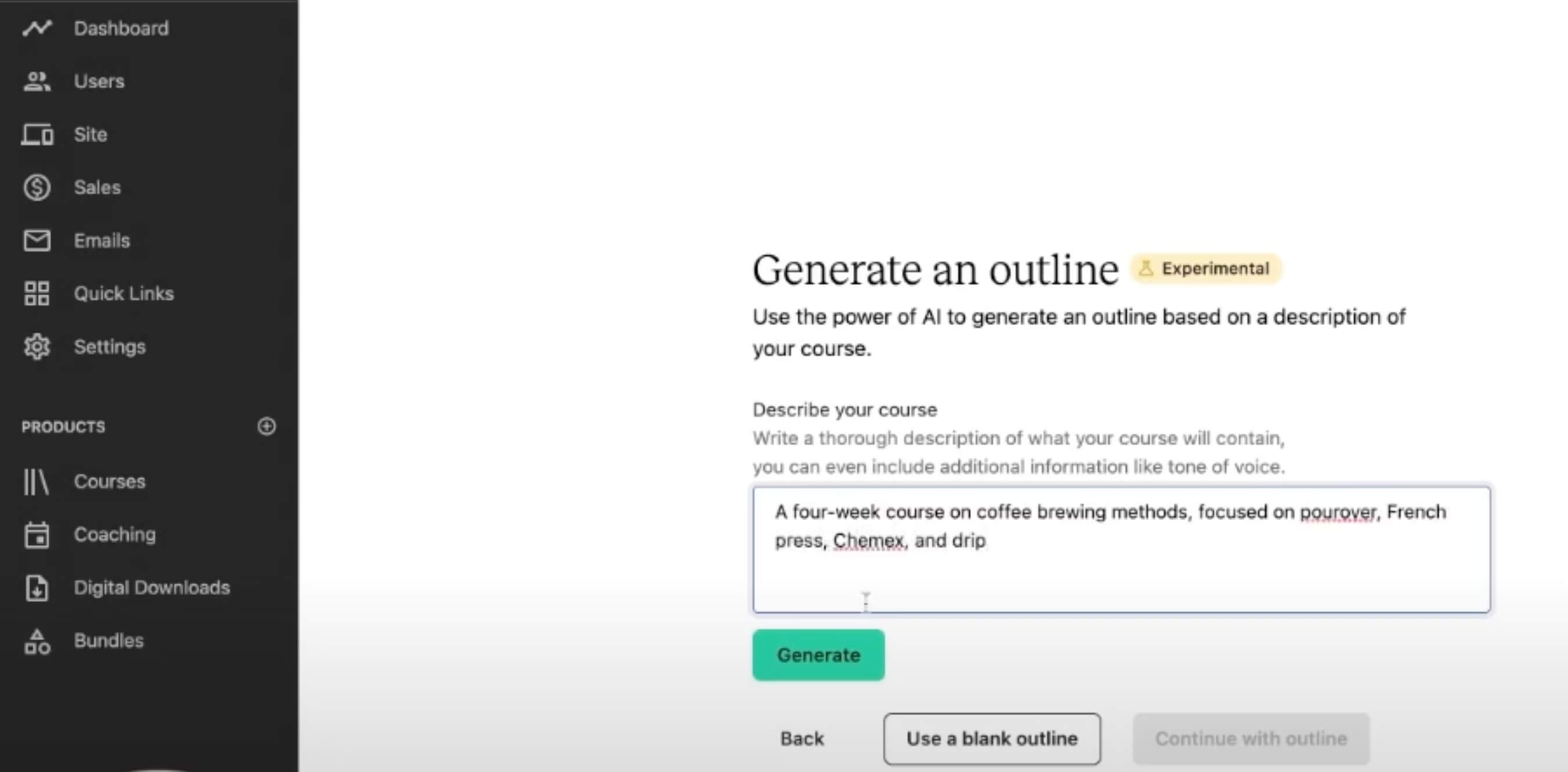
We’re going to drop your main course idea into Teachable’s AI Course Starter inside their course builder and let it do the heavy lifting.
In seconds, it will:
This is a huge mental load off. Especially if you tend to spin out trying to decide what goes where, or whether your idea is “robust enough.”
Teachable’s Modern Course Creator Playbook reminds us that it’s not about cramming everything you know into a 47-lesson course. It’s about choosing what matters most, structuring it for action, and building a course that drives real transformation.
If you haven’t already, start your free Teachable trial.
Then follow these steps:
That’s it. In under five seconds, you’ll have a full draft of your brand new course.
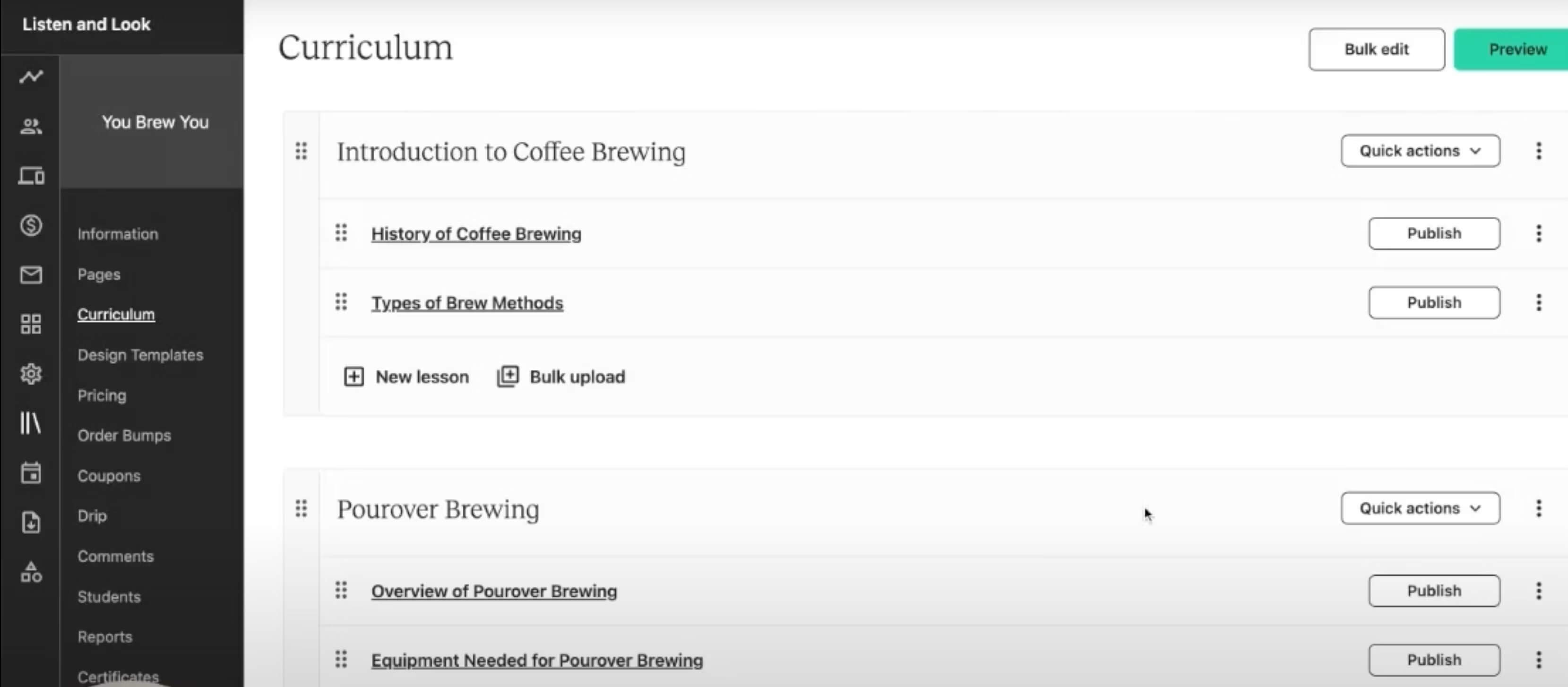
Now that you have the bones, let’s start putting some meat on them. Infusing each lesson with your voice, stories, and experience.
We’re going to use ChatGPT to take your high-performing content and revise Teachable’s AI-generated lesson drafts. By the end, you’ll have complete, compelling lessons that:
In the same ChatGPT thread you used to generate your course description, copy/paste this prompt:
I’m building an online course and using AI to help expand my outline into fully written lessons. I’ve already provided the original content this course is based on earlier in this thread.
Now, I want to revise and expand the Teachable AI-generated lessons—one at a time—into complete, high-quality lessons that I can either read as a video script or drop directly into my course platform.
Here’s what I need from you:
Structure:
I’ll paste the Teachable AI lesson next. Please confirm you’re ready before we start.
Simply go a lesson at a time, pasting each Teachable draft into ChatGPT and adding any other relevant content or reference materials as you go. You can even link your Google Drive to reference any past materials, blog posts, or freebies.
This combo helps you work smarter. Not harder.
And if you want to take it further, build out a companion worksheet, template, or downloadable for each lesson. You’re probably sitting on half-finished resources and buried treasure just waiting to be reused.
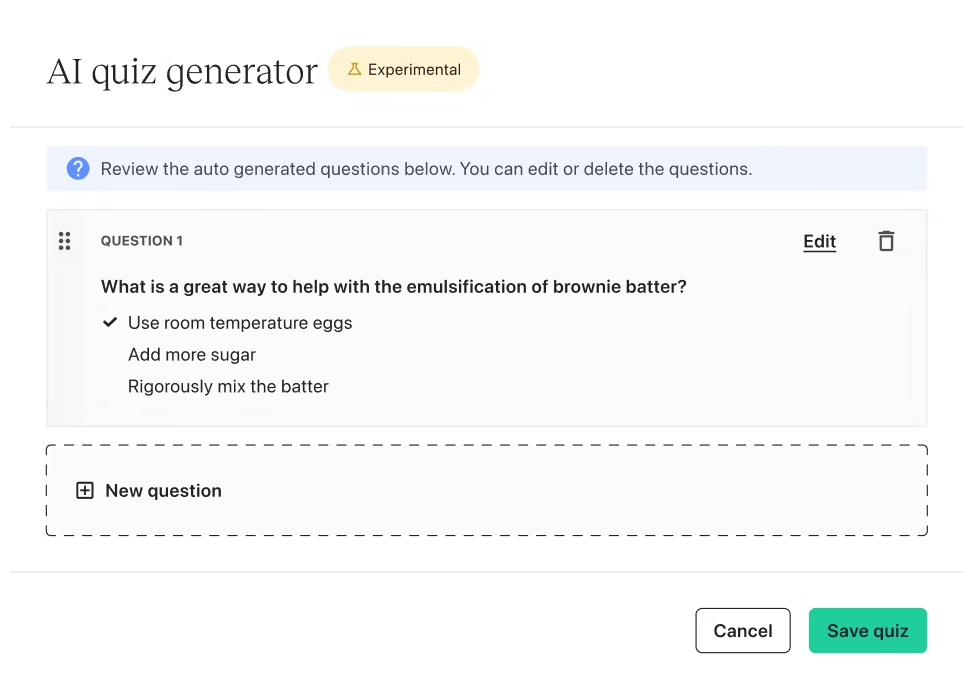
Turning information into transformation means making it interactive.
Teachable’s AI Quiz Generator pulls directly from your lesson text to create:
This not only increases student engagement, it helps your course feel complete.
Think about the last time you took a course and actually remembered what you learned.
Chances are it wasn’t because you watched a video, it’s because you took action.
Here’s how to add a quiz to your course using Teachable’s AI tool:
You now have a built-in feedback loop inside your course. One that turns passive viewers into active learners. That’s how transformation sticks.
You’re closer than you think. At this point, your content is organized, your lessons are built, and your students are waiting.
Time to ship it.
Teachable makes this part easy, too. Their platform:
And if you want to go the extra mile? Their AI Transcript + Subtitles Tool helps you:
This is the point where many creators hesitate. They continue to tweak, stall out, and make excuses for why they haven’t launched yet.
Your course doesn’t need to be flawless to be transformative. Your people need your help now, not six months from now when every slide has been rebranded and re-recorded.
Get it out there. Learn from your sales process and how students respond to it. And get better every time you launch.
The best course creators aren’t magicians. They’re strategists.
They know their best content shouldn’t die on Instagram. Or get buried 46 scrolls deep in their blog. They know it can become something bigger. Something scalable.
Teachable (and AI) just makes that process faster.
So don’t wait until you have a giant list or the "perfect" idea. Take what’s already working, feed it through this reverse-engineering method, and give it new life inside a course that earns every time someone presses play.
Start with your content. Let AI guide the way. And let Teachable do the heavy lifting on the backend.
You’ve already done the hard part: proving your content works.
Now let’s get paid for it.
👉 Want to shortcut this process even more? Join my One-Day Launch Challenge and build + validate this offer fast. Perfect if you want to go from idea to income in a single weekend.
Want more resources like this?