Thank you! Your submission has been received!
Oops! Something went wrong while submitting the form.
MENU
.jpeg)
At Teachable, our motto is simple: if you've lived it, teach it.
But what happens when human experience goes up against an algorithm? Can real-world intuition produce a better business plan than the most advanced AI models available right now?
We decided to find out.
We gave Lia Haberman (Social + Influencer Marketing Consultant) and Jayde I. Powell (Founder & Head of Creative, The Em Dash Co.) three minutes, a whiteboard, and a business prompt they had never seen before. At the same time, three of the most advanced AI models on the market received the exact same prompt.
Then we handed all four blueprints, stripped of any labels, to Anjali Viramgama and Sundas Khalid, two of the internet's most-watched tech influencers, and asked them a single question: which plan would you actually follow?
Nobody told them which entries came from humans and which came from machines.
This is Mental Objects.
The scenario was built to mirror someone right at the edge of a creator business. You are a corporate professional with five years of experience in big tech. You have around 5,000 LinkedIn followers. You have never sold anything online. You want to launch a business in the next six months and can only commit 10 hours a week. Build a plan to generate your first $10,000 in sales.

Lia and Jayde had three minutes each to work alone, then joined forces on a single whiteboard. The AI models produced their entries independently.
Four blueprints. One judge panel. Zero context about who wrote what.
Lia Haberman approached the challenge the way a strategist would. She started by mapping the product, the audience, and the revenue model before anything else, then asked the question most people skip: what am I actually selling, and to whom?
"What is the product I'm selling? Who's the audience I'm selling it to? And what is the business model?" — Lia Haberman, Social + Influencer Marketing Consultant
Jayde I. Powell went in a different direction. No funnels, no complex models. Just a clear product, a clear price, and a direct path between creator and buyer.
"This is my vision for a digital product. It starts with my brain, and then I'm going to share that product with a price point to my audience, and then when they buy it, it puts more money into my bed." — Jayde I. Powell, Founder & Head of Creative, The Em Dash Co.
When they compared notes after the solo round, something interesting happened. Two different thinkers, two different instincts, one shared conclusion about where the real opportunity was.

Anjali and Sundas were not evaluating polish or presentation. They were evaluating one thing: would you actually stake six months of your life on this plan?
The AI entries were not weak. They were well-reasoned, followed clear playbooks, and covered the obvious bases. Some of them would probably work.
But as Anjali and Sundas worked through each entry, one blueprint started pulling ahead for a reason that had nothing to do with how it sounded on paper.
What separated the strongest plan from the field was not the size of the idea or the confidence of the execution. It was something more fundamental: the understanding that failing fast is a feature, not a flaw.
Which brings us to the result.
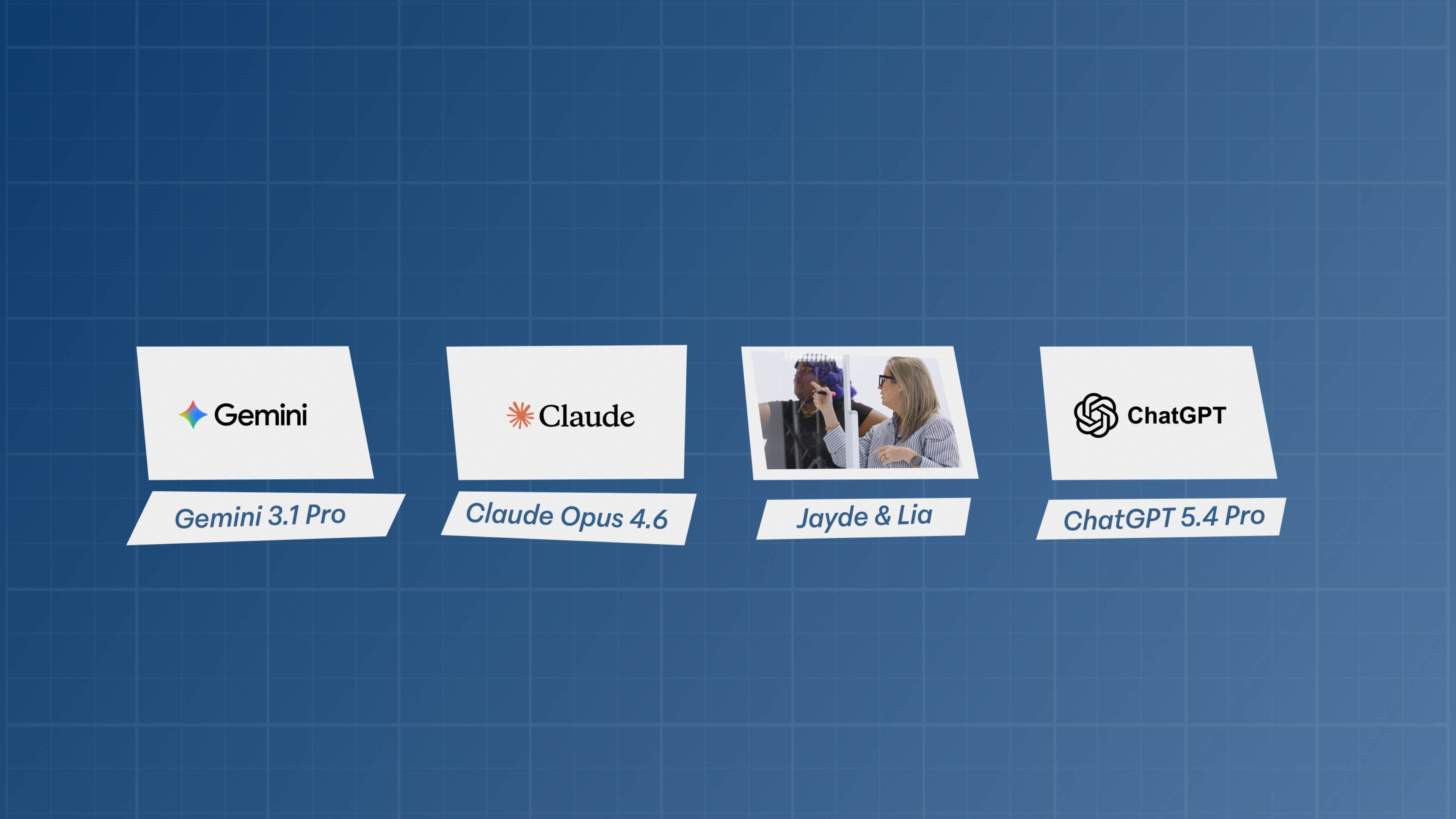
The winning plan, which both judges picked without hesitation, was the one Jayde and Lia built together.
"You are trying two different paths. Compared to the rest of them, they are going all in on one thing. So if you are going to fail, it is going to take you six months to fail. Whereas this plan lets you fail fast, get feedback, and iterate on it." — Anjali Viramgama, content creator and judge
When both judges were asked to name the author of their winning choice, they pointed to the same one. They also correctly guessed which entries came from AI.

Jayde and Lia’s plan worked differently from the AI entries. Instead of choosing between audience monetization and sponsorship revenue, it built for both from the start.
The first path targeted their existing LinkedIn community with a digital product built around a problem already showing up in the comments. The second path positioned brand partnerships as content collaborations, giving sponsors a reason to say yes without requiring a massive following.
The judges pointed to two specific advantages that set the plan apart.

Running two parallel tracks in the early weeks means faster feedback than betting six months on a single product launch. If the digital product gets no traction, the partnership track is still in play. The AI blueprints all asked the creator to go all-in on one direction before they had any signal from the market.
Building a product around what the audience was already asking in the comments was not something the AI blueprints surfaced. It reflects an understanding of how online communities actually behave, the kind of knowledge that comes from time spent inside them. According to the LinkedIn Learning 2024 Workplace Learning Report, 90 percent of organizations are concerned about employee retention, and professional development is now one of the top incentives workers look for when evaluating opportunities.
That same dynamic plays out in creator audiences: the creators who build lasting businesses are the ones who solve specific, real problems for their community, not the ones who follow the cleanest playbook.
The AI entries were not bad. They were clean, well-reasoned, and followed recognizable playbooks. Given the right person and the right execution, some of them would work.
The human entry was better for a different reason. It was designed for the reality of what it is like to be early. Most first-time creators will not nail the product on the first try. Putting two revenue paths in motion early gives you more surface area to learn from, and more chances to find out quickly what is actually working.
A few things worth carrying out of this:
If you are ready to build your first digital product, here is how to get it from idea to sale. If you are still working out your direction, start with finding your niche.
Teachable is the platform for creators who have something real to teach. Start your free trial and see what you can build with the experience you already have.
Watch the full Mental Objects episode on YouTube, or explore how Teachable creators build and sell digital products.