Thank you! Your submission has been received!
Oops! Something went wrong while submitting the form.
MENU
Strategies for improving completion rates, deepening participation, and building a loyal student community.

Every teacher wants to see their students experience success. It’s the reason they decide to teach in the first place. So how do you facilitate online student success? Whether it’s a cohort-based course or a self-paced course, there are several ways you can increase student success in your online courses.
Before we get to discussing the ways to increase online student success, we need to think about what that success is. Student success will differ from course to course and from student to student even. How one student defines success may differ from how another student does, depending on what they’re each looking to get out of their course.
Think about how you currently measure student success for your courses. Decide which measurements are working well, and which you think might need some adjustment or replacing.
Here are a few ways to measure your online student success:
What we mean by this is: create moments within your course that your students can use to make sure they’re on pace. And then they can reach out if they feel behind at some point as well. These moments can take the form of learning objectives listed after each lesson. Or it can look like a homework assignment or a short quiz to check understanding. Or if the course has to do with creating something, it might look like a certain amount of physical progress on the project.
Similar to the point above, you may want to create a final test or quiz for students to take to see that they’ve learned everything from the course that was expected. This way they can know whether they have met their goals. You can also help guide them to the information they should review for any questions they get wrong or happen to struggle with.
One of the most important aspects of online student success is making sure they feel comfortable asking questions. Because students aren’t sitting in a traditional classroom setting, they need to know the best way to ask questions. It’s not quite as simple as raising a hand or staying a few minutes after class. So be sure to make it clear to your students if you have office hours, or drop in conference hours when they can schedule a call or show up to a zoom. Or if you have a certain form for them to fill out to ask questions. No matter how you do it, make sure your students are aware.
When it comes to creating your lessons, keep them short. The shorter they are the easier time your students will have in actually absorbing the material. You can help improve online student success by structuring your content to help. Making your lessons shorter can help keep your students engaged in your course content.
You should constantly be checking on the relevance of your coursework. When a student signs up for your course they’re expecting to get the most up-to-date and useful information. That’s why they’re spending their hard earned money on a course with your expertise in it. Every time you run your course, if it’s cohort-based, or every quarter, if it’s self-paced, check the information in your course. Look for anything out of date, updated statistics or numbers, updated best practices, any language that’s outdated, and general accuracy. This refresh can benefit you and your students. You can also try incorporating any feedback you get from students about what might make your course more useful.
Your course will obviously be the largest resource available to your students. But you have the opportunity to point them to other resources and information that might help them with their educational journey too. This could take the form of a “further reading” section on the syllabus or a final slide for each lesson with online resources or exercises for students to try in their free time. Remember, resources can also come in the form of practices or exercises to try. They aren’t strictly more and more information for them to take in.

A common question that we hear from Teachable creators is how to get coaching clients. It’s a magical feeling when you get your first coaching client. A lot goes into securing those first few sales, but once you have them, it’s easier to grow from there.
We’ve helped many coaches launch and sell their services. To help you get coaching clients, we’ve compiled a list of advice from the Teachable community.
To resonate with your audience, you need to learn more about them. Figure out what pain points your prospective clients have, and how your coaching services will help solve them. Pain points shape how you talk to your clients, whether it’s on your website, marketing, or sales calls.
Here are five questions you should think about when doing client research.
You may think you know how your customers would answer these questions, but it’s best not to assume. Instead, ask your target audience by conducting customer research.
You can add these questions to an Instagram poll or send them in a Typeform or Google Forms survey. If you have current clients or prospects, send an email and ask them for answers. If you don’t, you can post for free in relevant, online communities or Facebook groups or use a service like UserTesting.
Review each response you get, especially those from prospective clients. Then, use those findings to shape how you talk to your audience in your copy, marketing content, and discovery calls. By doing so, you’ll connect with them on a deeper level.
A discovery call helps you—and your prospective client—discover what you need to be successful and if you’re a good fit. You can easily schedule calls with potential clients by using Calendly. Connect it to your calendar, and send them a custom link that updates automatically with your availability and contact details.
The discovery call sets the tone for the rest of your relationship. During it, you want the customer to do most of the talking. You can ask the questions above and dive deeper into what that specific client is looking for in a coach. If they have a specific budget in mind, it can help you assess your rates and pricing.
After a discovery call, you or your prospect may come to the conclusion that it is not a good fit. You might be out of their price range or they may be looking for specialized services outside of what you do. However, if you have a meaningful discussion, they may recommend you to someone else in their network that they think could benefit from your coaching services.
After any exchange with a prospective client—whether you chatted on a discovery call or they submitted a contact form on your site—send a follow-up.
Send an email that thanks them for their time and recaps what you discussed. You’ll also want to outline the next steps. You can outline pricing in the email or direct them to the sales page to enroll in a coaching package.
You can use this checklist when sending a follow-up email
If they don’t respond to your first follow-up after one week, you can send them another email as a check-in. However, if you reach out after three times without a response, it will be considered pushy or spammy.
Some people might not connect with you or won’t find your prices within their budget, and that’s okay. Every interaction with a prospect may not lead to a sale. But, you’ll eventually find that the “no” stings a little less each time. You’ll also get a lot of practice communicating with prospects which will hone your sales skills.
After all this research, it’s time to create a sales page for your coaching product. Your sales page will be the primary way that people learn about your services. In many cases, a prospect may only visit your website. They’ll use your coaching services landing page to determine whether or not to reach out or purchase your packages.
In other words, you’ll either win or lose clients based on how well you craft your landing page. To craft a winning landing page, you need strong sales copy.
First, take the data you’ve gathered and identify what matters most to your audience. Most importantly, highlight the value proposition. You can craft a value proposition by thinking through these questions:
Your coaching sales page should also answer common questions like:
When you are creating sales copy for coaching services, you can start with one package or sales page first. Test out a few variations until you figure out what works best with your audience.
It may seem antithetical to offer something for free when you are trying to get your first paying coaching client. However, offering value without asking for something in return is one of the best ways to establish yourself as a thought leader, and eventually, land prospective clients.
It’s the same principle behind lead magnets and free trials. If you show potential clients what you can do, and how much value they get from a short coaching session, they are more likely to buy.
If you are just starting out as a coach and trying to get clients, you probably don’t have a lot of money to spend on paid advertising. It might not make sense for you anyways. Luckily, you don’t have to spend a lot of money to get coaching clients. If you want to learn how to get coaching clients, test out some of these free to low-cost organic marketing tactics.
For many businesses, the first customers come from within an entrepreneur’s inner circle.
Many entrepreneurs become successful because of the people that they know and how much those people vouch for them. For example, many people attend Ivy League schools, in part, because of the connections they’ll develop with alumni, faculty, and others. In other words, they know that their network influences their success. Of course, this is not the only influence, but a large network is a powerful tool for business owners.
Look for networking events that might be of interest to you and your target audience. For example, if someone coaches aspiring illustrators, they might attend Comicon. A relationship coach might speak at a speed dating event.
You may find your next client in an unexpected place. Perhaps, it will be at an event that has nothing to do with what you coach.
The idea is not to attend networking events with the sole purpose of selling to those in attendance. If you try that, it will feel transactional and disingenuous. People will tune you out. However, you should attend to learn from others and expand your network.
In the same vein as networking events, online communities can help you build your network.
There are tons of industry and professional groups on Facebook, Slack, Reddit, and elsewhere. Some examples of groups include:
Research groups that are relevant to your industry and join. Instead of immediately posting in a group and asking people to buy your coaching service, which never works, provide value.
Many people go to online forums and professional communities to ask others a question that they haven’t found the answer to on Google.
If someone asks a question that you can answer with your unique expertise, then respond. Don’t try to sell them your services. Once you have engaged in a community for a few months and continuously provide value, then you can ask to post your coaching services. Other people in the group may remember your past posts and be more inclined to listen to what you have to offer.
Again, don’t join communities with the intention of self-promoting and selling. Most will ban you for doing just that. Do it to learn from others, expand your network, and share your expertise. In addition, remember the rule of thumb for cultivating any community: give as much as or more than you take.
Social media can help you expand your reach at little to no cost. You can leverage different platforms to build your personal brand and connect with your target audience.
For example, for career coaches, LinkedIn is a must. As a career coach, your target audience is likely people who are thinking about or are currently transitioning to a new job or career path. LinkedIn is where they will be, so it’s where you need to be.
With social media, you need to make yourself discoverable. Post career advice, stories, and other content to increase your visibility on the platform. You can also refer back to the audience research you did for content ideas. What questions were commonly asked? What do they care about?
We recommend focusing on one social platform for at least a month before diversifying. Once the month ends, look at which posts had the most engagement and which didn’t. You can use those insights to plan content for the next month.
No matter which platform you use, include a call-to-action in your profile. For example, share your coaching services in your LinkedIn bio.
When it comes to organic marketing, SEO is one of the most sustainable ways to grow. Unlike social media, you have slightly more control over the types of content you create and how people find you.
For example, SEO focuses on increasing your visibility in search engines, particularly Google.
Let’s say you’re a fitness coach, and you specialize in bodybuilding for women. You may want to appear in search results when your target audience looks up “bodybuilding for women” on Google. But, you also want to target other relevant queries. In this case, you might want to appear in searches for:
Conduct keyword research to identify what words your target audience searches for, and which of those keywords you can possibly rank for in the first two pages of results.
Create blog posts for each keyword you identify and track your rankings. The idea is that as you appear in more top positions, you increase organic traffic to your site. Plus, if one person sees your site after multiple searches, they might remember your name when they are in the market for what you are selling. In this case, they may be more likely to seek out your coaching services for more in-depth and personalized bodybuilding advice.
Getting that first coaching client is the hardest part, but once you have a few, you now have people who can vouch for you. Student referrals are one of the best ways to market a course, and the same goes for coaching.
If a client has a positive experience, make sure to follow up with them and ask if they would share a referral link with their community. You can set up a referral program easily with Teachable.
Figuring out how to get coaching clients won’t happen overnight, but these tips can help you get there faster. If you’re just starting out, it might feel like a lot of hard work to get your first coaching clients. However, it will pay off in the end, and eventually, get easier.
You learn a lot from your early coaching clients from how to set pricing to what activities to include in your sessions. If you take those learnings and apply them to improving your coaching experience, you’ll see improvements throughout your business. If you haven’t created a coaching program yet, it’s easy to get started with Teachable. You can test it out with a free plan or chat with a Teachable expert.

Student engagement is a principal concern for educational organizations and online schools alike. But defining student engagement can be tricky, particularly because engagement can be measured in a number of ways. We’re going to break down how you can define and improve student engagement in your course by considering objectives and examining key course metrics.
Student engagement can vary from school to school and even from course to course. For one, you might define student engagement as how active students are in completing assigned work or taking part in course discussions. For another, you may measure it by the number of online class completions recorded.
So, to define student engagement, first you should try note what “success” for your school or course really means.
To better understand and ensure high levels of student engagement in your courses and community, you first need to figure out how you’ll measure success with your students.
Your success objectives might include:
Take a look at your long-term objectives to determine the right success metrics for your students. For example, are you primarily an educational business where you sell online courses to students? Is there a test or certification for students to earn by the end of a course? If so, you’ve got a built-in measure of engagement and success right there.
More traditional educational organizations like colleges might have different measures of engagement. It could look more like proper attendance, participation in group projects, and completing tests or assignments.
Bottom line: Look at your educational organization and its goals to learn how you can define student engagement for your courses.
Once you’ve identified your goals for student success, you can then consider metrics. Then later on you can move on to revamping engagement copy, changing your class setup, and taking other steps.
One metric you might choose to consider is interaction levels. Interaction is primarily useful for online educational organizations. Usually, online courses platforms have tools that allow you to see how well students engage with the provided materials.
This can be valuable because you can determine:
Interaction levels can be important for online teachers for traditional educational organizations as well. If you’re building an online college course, for example, measuring interaction levels will help you ensure that most of your students respond well to your class materials.
You may also wish to measure the time your students spend on course materials to measure engagement. Be careful when considering student engagement by time because a long time spent on materials can mean:
So take a look at the time spent on materials while also examining other key metrics. Context may provide you with further information you need to define whether students are engaged via time spent on course materials.
Naturally, you can also look at the student success or class completion rate for a given course or program. The more students that complete a course, the better the odds are that those students were at least relatively engaged. Unless the course material was far too easy and students are breezing through it.
You can also look at student success or class completion rates as information about how popular the subject or materials are. For example, if you run an online business selling classes, you might find that the completion rate of certain classes is higher than the completion rate of others.
This could help you determine which classes you should create in the future to drive profits and also provide students with what they want.
Don’t forget to check the reviews and ratings for your online courses. Additionally, you can survey your students at the end of the course. You can check student reviews on social media or on online review sites.
Reviews and ratings can tell you:
This information can help you develop better course materials and improve student engagement. For example, if one class has a certain layout with interactive modules and another is a slideshow presentation, you may not be surprised when the former class has higher ratings than the latter.
Attendance rates are another great measurement of engagement. They may indicate whether students feel compelled to show up if you offer live courses.
If a student feels that they don’t need to attend a course to get the relevant information, they might not. You can easily measure attendance rates through your course platform. And you should be able to get a general idea of how good attendance is during each live class.
Lastly, don’t forget to examine the program completion rate when determining student engagement at your educational organization. The more programs are completed, the greater the likelihood that your students are positively engaged with your school or business. After all, program completion means that students found your materials interesting or engaging enough to get all the way through several classes without dropping out!
As you can see, there are lots of ways you can define student engagement and improve it at your educational organization. The key thing to remember is to check each of these metrics and define student engagement uniquely based on your organization’s goals or business needs.

There are many benefits to being an online creator, most of them involving independence and autonomy—things like having a flexible schedule, location freedom, and therefore the ability to travel, etc. On the flip side of these perks can come feelings of isolation or a lack of community.
While community used to be limited to people that lived nearby, our digital world allows us to be in community with people all over the world. Many creators are catching on to why community is not only an essential support system in their own lives but also an attractive (and lucrative) benefit to offer their audiences.
In this article, we’ll explore why community is so important and how to create it. Even if you don’t think you need community, find out why cultivating connection is important for supporting yourself and the people you serve.
{{buildcommunity-component="/blog-shortcodes/blog-cta"}}
As social creatures, humans are hard-wired to seek out connection for a sense of well-being, happiness, and even survival. In fact, belonging is recognized as a core human need in psychologist Abraham Maslow’s hierarchy of needs. Recent research consistently supports the importance of social relationships and community.
Living in a digital world can really take a hit on our ability to connect with others. Even for those who don’t consider themselves creators, innovative technology designed to bring people together can actually inhibit true connection, as we hide behind our smart devices. In a world where we can work remotely, stay in touch with loved ones via social media platforms, and send gifts without leaving our couch, many of us suffer from a community deficit.
On top of that, creators often walk a road less traveled, as it’s often a path they pave for themselves. Blazing your own trail can be lonely, and many feel like they have to do everything on their own. It can be hard to ask for help, which is why many creatives shy away from community.
Related: How to build an online community
Meanwhile, Western culture is rooted in individualism and loves to glorify the self-made. That, coupled with our own distorted comparison traps, makes it easy to believe people can and must go it alone.
Don’t get me wrong, there is A LOT we can do on our own. But the reality is we can’t do it ALL on our own. There is support that is seen and unseen all around us. Don’t believe me? Consider:
But wait, I’m using AI these days, you might argue. Let’s Zoom out a bit further.
Zooming out even further, consider all the ancestors that came before you, making it possible for you to be here today.
Even though we might feel alone or like to believe we are completely self-sufficient, the reality is we are not alone. And we need each other.
{{buildcommunity-component="/blog-shortcodes/blog-cta"}}
That said, there can be a very real and understandable fear of community. You don’t have to look far back in the past (or even around in the present) to find examples of communities that require you to fit in or conform to avoid rejection. Even when not life-threating, fear can come up because we want to be accepted by others, especially our peers.
Unlike fitting in, Brené Brown recognizes true belonging as “connection to a larger humanity [that] gives people more freedom to express their individuality without fear of jeopardizing belonging.” In her book Atlas of the Heart: Mapping Meaningful Connection and the Language of Human Experience, she writes, “True belonging doesn’t require us to change who we are; it requires us to be who we are.”
Given our culture’s community deficit, along with our human need for true connection and belonging, creators have a great opportunity to offer community to their audiences.
“Alone, we can do so little; together, we can do so much.” –Helen Keller
Related: Engaging your online course community with purpose
Offering community, when done right, can offer the belonging and true connection that humans not only want but need. Brown defines connection as “the energy that exists between people when they feel seen, heard, and valued; when they can give and receive without judgment; and when they derive sustenance and strength from the relationship.”
While creating a community does not automatically make it a safe space, allowing space for members to share with and witness each other can build trust and safety over time. Through sharing and witnessing, members can:
Related: Revive an online community that’s lacking engagement
“Never underestimate the power of being seen,” Brown writes in Braving the Wilderness: The Quest for True Belonging and the Courage to Stand Alone. Before you can ask members of your community to be brave and share vulnerably, lead by example. “You will always belong anywhere you show up as yourself and talk about yourself and your work in a real way.” Modeling vulnerability and authenticity can show members what belonging can look like and encourage them to follow suit.
Truly seeing members of your community might look like:
Holding space for others requires your presence and availability—not to fix or change anything, but to acknowledge where others are at when they share. This is a part of truly seeing someone.
“True belonging is not passive,” Brown continues. “It's not the belonging that comes with just joining a group. It's not fitting in or pretending or selling out because it's safer. It's a practice that requires us to be vulnerable, get uncomfortable, and learn how to be present with people without sacrificing who we are. We want true belonging, but it takes tremendous courage to knowingly walk into hard moments.”
In theory, calling your community a “safe space” sounds great: a space where members of a group feel physically, mentally, and emotionally secure and are free to express themselves without fear. While most have the intention of their community being a safe space, we can’t always guarantee that it feels safe for everyone and shouldn’t assume that it is. We can set a collective intention for the community to be a brave space, but what’s even more responsible, inclusive, and equitable is to offer an accountable space.
At Teachable, we’re making it even easier to create your own community with an even more engaging learning experience.
{{buildcommunity-component="/blog-shortcodes/blog-cta"}}

It's true. You're getting less traffic from major search engines and social platforms. That's where online communities have really stepped up as game-changers, not just for catching up and socializing, but also for learning and building new business ventures.
Think of them as virtual hangouts where we get to connect, foster a growth mindset, and build relationships that aren’t limited by where we live, or by search engine platforms.
Take a look at the numbers—they tell a compelling story. The global EdTech market, valued at $123.40 billion in 2022, just hit $142.37 billion this year. That’s a huge leap. It just goes to show how online communities are becoming a big deal, especially when it comes to education and professional growth.
With that in mind, let’s take a look at how to build an online community, both through real-life success stories and some useful tips.
So, what exactly is an online community? Picture a bunch of people with similar interests or goals, all getting together online to chat, share, and chase those goals. These communities come in all shapes and sizes.
You’ve got groups for just about everything—from hobby enthusiasts to professional networks and platforms like Teachable. The way these communities have evolved is pretty incredible. Remember the early days of the internet with Usenet groups and bare-bones HTML forums?
Fast forward to now, and we’ve got sophisticated platforms loaded with features like webinars, live chats, and all sorts of collaborative projects.
It’s not just about tech getting better; it’s also about how we’ve figured out that these online spaces can create a real sense of community and belonging, just like the real-world ones.

Online communities have become more than just digital meeting spaces; they are dynamic environments where ideas flourish and relationships are nurtured. In these communities, participants from around the world come together, driven by shared interests or goals, to share valuable information and experiences.
The journey of online communities has been a fascinating one. From the early days of simple forums and chat rooms to today’s sophisticated platforms featuring multimedia content, live interactions, and AI-driven personalization, the transformation is striking.
This evolution mirrors the changing needs and expectations of digital audiences. Platforms like Teachable have evolved to offer more than just course content; they provide a complete ecosystem supporting engagement, networking, and continuous learning.
When building an online community, one critical decision is whether to make it public or private. Public communities are open for anyone to join, offering greater exposure and the potential for larger membership. However, they often require more moderation and can be challenging to manage.
On the other hand, private communities offer a controlled environment, which can foster a sense of exclusivity and safety. For course owners, the choice depends on their goals, audience size, and the nature of the content shared.
For course owners, building an online community brings several advantages. It establishes a loyal base of engaged learners who can provide real-time feedback, helping to refine and improve course content.
A vibrant community also encourages repeat enrollments and referrals, driving business growth. It offers an avenue for personal brand development and thought leadership, as course owners can showcase their expertise and connect with like-minded individuals. Finally, fostering engagement and participation will help generate valuable feedback.

Building an online community, as showcased by the experiences of Teachable creators like Jo Franco and Jay Clouse, is an art blended with strategic steps. Let’s walk through the journey they took, which can serve as a guiding path for anyone looking to build a thriving online community.
Jo Franco’s story began with her passion for journaling. Despite her busy life creating content for YouTube and a Netflix series, she always found solace in journaling.
It was this personal interest, fueled by her audience’s encouragement, that led her to start a 30-day journaling challenge. This challenge, initially a month-long venture, surprisingly stretched into a 90-day journey.
Jo pondered, “What if I bring everyone together for a live, global conversation?” This question marked the birth of Jo Club. Here, members could sign up for a membership and engage in live journaling calls.
It started small, with just 12 participants, but over three years, it grew to include not only individuals but also universities and corporate clients.
Choosing the right platform is the biggest step in building an online community. It’s about finding a space that aligns with the needs of your audience and the nature of your content. Look for features that give community members a sense of camaraderie without overwhelming them. Keep in mind that the best platforms are easy to use and create a feeling of fellowship.
Jo’s primary aim was to offer value—something that would genuinely make a difference in people’s lives. The content in Jo Club wasn’t just about journaling prompts; it was about creating a space where people could share their learnings and challenges.
She methodically worked on perfecting the format of her live journaling calls before bringing her 21-day challenges to Teachable.
From Jo Club’s inception, Jo’s motto was clear: “You are building this with me. I build things for you.” This approach wasn’t about selling a course; it was about selling transformation. Her team worked on identifying member archetypes to better serve the diverse needs and experiences within the community.
Meanwhile, Jay Clouse’s journey in community building started in 2017, initially focusing on a membership product and group coaching. His approach to course creation on Teachable was informed by his experiences with coaching and understanding the value of transformation he could offer.
Jay’s journey into course creation began with offering coaching services to creative freelancers. He developed three courses simultaneously—a challenging endeavor he admits was not the most effective strategy initially.
However, his persistence and refinement of the courses led to an evergreen offering on Teachable, which he calls the “Freelancing Masterclass.”
Jay realized early on the importance of continuous interaction in online learning. He created a private Slack channel for his students where they could build relationships and share insights beyond the weekly group coaching sessions.
This understanding of the community’s value played a crucial role in his approach to online education.
Offering exclusive benefits can significantly enhance the appeal of your community. This could include unique content, special experiences, or personalized interactions catering to specific behaviors of your students. If you’re just starting out, simple perks and gifts will do just fine.
But as your online community grows and your course becomes more successful, you’ll have to think about making the funnel a bit more elaborate.
This involves going the extra mile in terms of both presentation and delivery—you can generate documents from templates automatically through your website, use retargeting emails, and even introduce random draws for discounts and other goodies.
For a community to succeed, Jay highlights the importance of having a clear purpose and a well-structured onboarding experience. Reducing the pressure to create perfect content, these communities allow for a more authentic and unpolished access to the creator. Likewise, it’s also important to organize the attendees into groups, as a means of better focusing on each community member.
The role of constructive feedback in community development cannot be overstated. It’s the cornerstone of continuous improvement and adaptation. Doing so regularly ensures that your community remains relevant, engaging, and valuable to its members.
Not too long ago, this would’ve required an entire team of community managers and moderators. However, the advent of widely available AI models changed everything.
Research indicates that 35% of businesses were already leveraging AI in 2022, but that’s no excuse for splurging on useless software that promises everything and the kitchen sink. Be careful when reviewing different platforms and ensure they fit your particular use cases.
Once a creator has established value through a community or membership, Jay recommends moving towards a cohort-based course model. This approach is similar to group coaching with a curriculum—a stepping stone before diving into pre-recorded courses.
Jo and Jay’s journeys in building their online communities reflect a blend of personal passion, strategic planning, and a deep understanding of their audience’s needs. Their stories are testaments to the power and potential of well-crafted online communities in the realm of digital education.
Teachable is a valuable resource for anyone looking to build an online community, especially in the educational sector. It provides a user-friendly platform that simplifies course creation and management, allowing creators to focus on what they do best—accomplishing their goals and engaging with their community.
Teachable’s customizable course options, integrated payment systems, and insightful analytics make it a top choice for creators seeking to foster interactive and thriving online communities.
To begin your journey of building an online community, start by crystallizing your vision. What do you want your community to achieve? Next, get acquainted with our community platform and start thinking of ways to attract and retain new learners.
Finally, craft a content strategy, mix it up with offline marketing, and ensure it resonates with your audience. Because, at the end of the day, it’s not enough to just publish lessons and the occasional social media post. Consistency is the key, and with it, growing your online community is much more straightforward.

Many entrepreneurs and professionals seek out online business coaches because they want personalized advice and guidance. As an online business coach, you can share your expertise and help them grow.
Starting an online coaching business might be easier than you think too, especially if you have previous experience as an entrepreneur. Many entrepreneurs use Teachable to build and sell their coaching services. In this article, we’ll show you how to become an online business coach step-by-step.
Business coaches provide support and guidance to organizations, entrepreneurs, and professionals. Typically, they work with clients to develop personalized, work-focused goals. Then, through coaching sessions, they share actionable advice and build a plan for achieving them.
What you’ll do as a business coach depends on your experience and client goals. One coach might help founders develop their leadership and presentation skills. Another might focus on how to build a growth mindset or overcome imposter syndrome.
In general, business coaches:
There are many reasons why online business coaching is appealing. Here are some of the biggest benefits to consider.
Business coaching is now a $15.2 billion industry. Many business owners understand the value of a coach and are willing to invest money to grow.
With the right expertise, you can build a successful online coaching business and start earning money quickly. For example, the average salary for a business coach is over $81,000 per year, but experienced business coaches make six figures.
Becoming an online business coach doesn’t involve a lot of startup or operating costs. Since you host coaching sessions online, there’s no cost for office space. You also don’t need a college degree or certification. But, experience running a business will give you credibility and first-hand knowledge to share with clients.
Another perk of becoming an online business coach is that you can work from anywhere. You also have the flexibility to set your own schedule. Some do online business coaching part-time while running their own company or caring for their children. How much time you dedicate to coaching is up to you.
Business coaches drive individual and company-wide change. They drive clients toward their goals and work with them to develop the skills and strategies they need to grow.
According to the Institute of Coaching, up to 86% of companies that paid for coaching services recouped their investment and more. As a business coach, you can also make a measurable impact on clients.
Online business coaching is a potentially lucrative and rewarding path. It’s also relatively easy to break into because you don’t need a certification to begin.
If you’re interested in becoming an online business coach, follow these steps to get started.
You may have heard this before, but most successful businesses begin with a niche, an area of focus, and a target audience. Your niche should be more specific than “business coaching,” and your audience should be more specific than “business owners and entrepreneurs.”
Business owners often look for coaches that have experience in their industry. They want someone who has been through similar challenges before and will guide them toward solutions.
To find your niche, start with your expertise. What makes you qualified to coach businesses? Are there any problems that you can help entrepreneurs solve?
For example, let’s say you recently left a position with a small book publishing company. You have insider knowledge of the industry and could work with self-publishing entrepreneurs.
If you’ve run e-commerce businesses, you can narrow your niche down to coaching aspiring e-commerce entrepreneurs. You can go even further and identify parts of the business like product, sales, or marketing.
If one industry isn’t standing out, you can focus more on the goal-setting, transformation, and leadership side of business coaching. Highlight the specific skills you have that help entrepreneurs reach their goals.
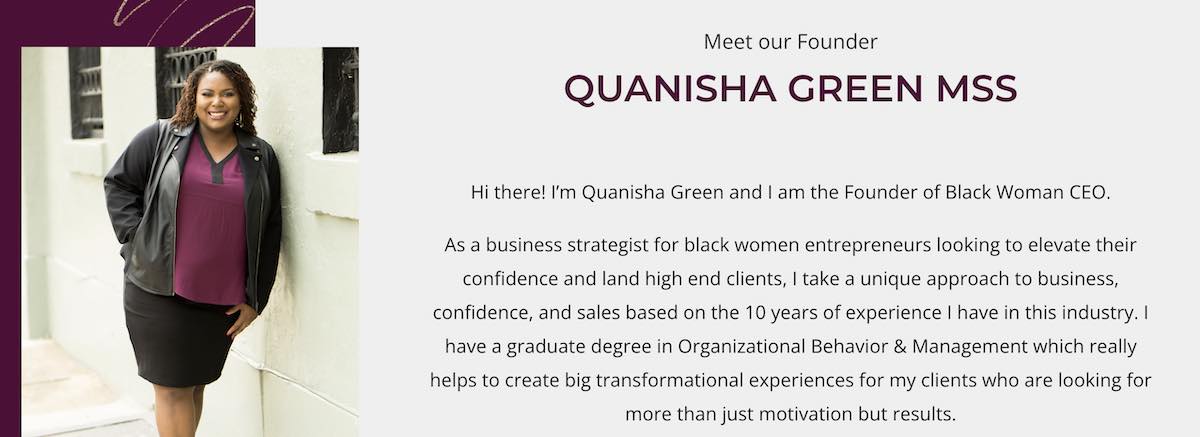
For instance, Quanisha Green, founder of Black Woman CEO, coaches black women entrepreneurs on building confidence and landing high-paying clients.
Once you understand your niche, create an audience profile of your ideal client. Be as specific as possible to focus your energy on speaking to your audience.
There are many types of business coaching. You can specialize in one of these areas:
Planning coaching sessions is similar to building a course curriculum. With a little advance planning, you’ll show clients that you’re credible and care about their experience.
To begin, clearly state your objectives. What do you want clients to gain from your coaching services? Start with common goals and refine them for each client. Then build a loose roadmap of how you’ll get to each goal.
Another approach is to start with a checklist of questions. You’ll build the foundation of your coaching structure with the answers.
Answer questions like:
Coaching is highly personal, especially if you host one-on-one sessions with clients. Preparing ahead will build trust with your first coaching clients, but it shouldn’t feel set in stone. As you coach, you’ll learn more about your clients and their goals. Sometimes, those goals may change. Be open to pivoting your coaching sessions when it will improve their experience and outcomes.
To price your coaching services, start with the base price—what do you need to earn to cover all your expenses (including taxes) and make a comfortable profit? Then, what is your ideal revenue in the first two to three years? What price do you need to get to your revenue goals? How many hours do you want to work each week?
Compare that with industry standards, but view them as benchmarks. The market prices for coaching services don’t always reflect your years of experience or earning potential.
Most coaches start with an hourly or per-session rate. Some new coaches start at a lower price ($75-$100) and increase their rates as they build a client base. However, people will question the quality if your price is too low, so don’t be afraid of higher rates.
Top-earning business coaches charge upwards of $350 per session and earn over $100,000 per year.
You can also sell coaching packages—a bundle of sessions. The advantage of selling bundles is that it increases your average order value, so for each sale, you earn more. Instead of selling a one-time coaching session for $150, you can sell a package of 10 for $1,500.
Putting a price on what you know can be a challenge when starting an online business. Luckily, Teachable has many resources to help. For example, you’ll avoid common pitfalls by reviewing misconceptions about pricing.
Your prospective clients will view your website as a reflection of you. They’ll look at it to form their first impression of you and your business coaching services.
Your website should look professional and reflect your brand, so incorporate branding basics and carry them throughout.
It should also provide all the information potential clients need to make a buying decision, without looking cluttered. At a minimum, include:
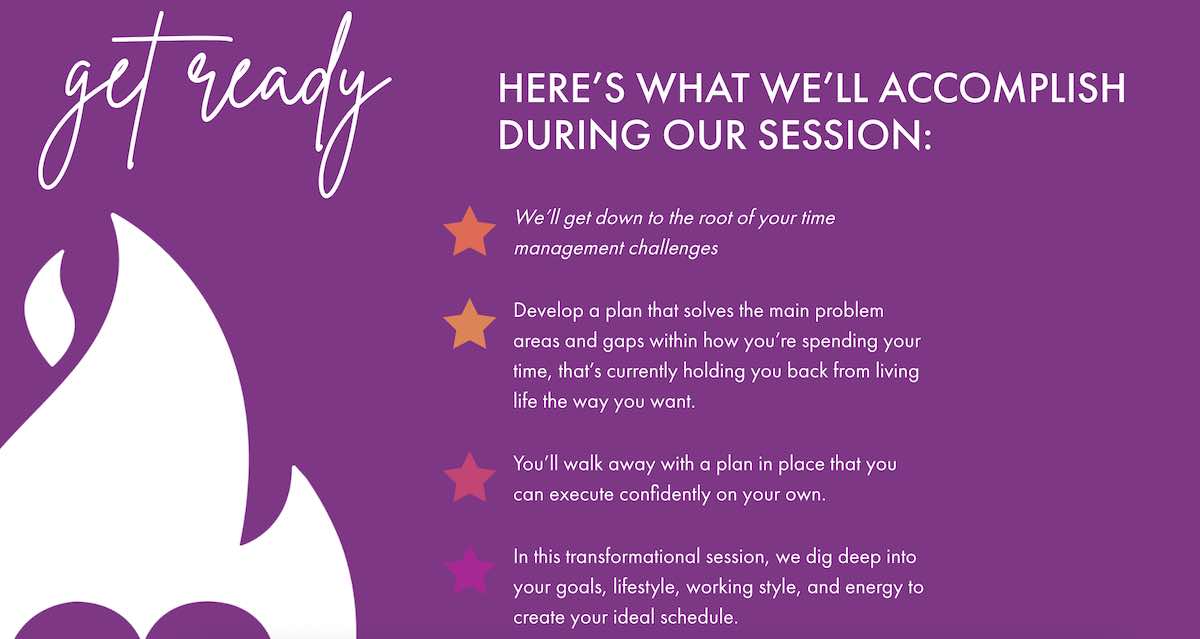
For each service or product you offer, you should have a dedicated landing page, also called a sales page. Founder of Fire Inside Sade Kelly, for example, hosts time management coaching programs.

The landing page speaks to the target audience and includes a preview of what you’ll accomplish in the coaching program.
To launch your online coaching business, you need clients. A well-designed landing page is one piece of the puzzle. However, to get your first coaching clients, you’ll need more.
Here are a few ideas to get coaching clients:
Getting your first few coaching clients can be a challenge, but it gets easier once you have them. In many cases, past clients become a main source of growth. They can be your best advocates to vouch for and refer others to your coaching services through word of mouth.
Teachable makes it easy to start offering your online business coaching services. The code-free platform lets you can build a coaching sales page, schedule sessions, and add other products like online courses and digital downloads. Check out our free or paid plans and launch your online business coaching program today.
You don’t need a degree or certification to become a business coach. Even though you don’t need them, they may be helpful to build credibility.
However, work experience will also go a long way to building trust with coaching clients. No matter what, you’ll need to demonstrate your expertise to your clients, whether with certifications, education, experience, or testimonials.
The average income for online business coaching professionals in the United States is over $81,000 per year. The top 25% of earners in this field make more than $120,000 annually.
Remember, many people in this field offer online business coaching in addition to other services. Others work part-time to earn a side income. Either way, you choose how to spend your working hours.

If you’re passionate about improving lives, relationships, and careers, you might be curious about how to become a life coach.
As a life coach, you can help people and build a profitable and rewarding business. And according to recent reports on how much money life coaches make, the average hourly rate is $231. If you met with five clients for an hour each, you’d earn $1,155. And more experienced coaches can also attract clients at higher hourly rates of $300 to $400 or more.
The life coaching industry is expanding rapidly. The International Coaching Federation (ICF) reported that there were approximately 71,000 coach practitioners globally in 2019, and that number continues to grow.
Many different types of coaches use Teachable—from business to dating and life coaching.
We’ll dive into everything you need to know to become a life coach and show you nine critical steps to start your own coaching business.
{{audience-component="/blog-shortcodes/blog-popup"}}
Simply put, a life coach is a professional who helps individuals with personal growth and development. And life coaches partner closely with clients to help them navigate all aspects of their lives. So this can include supporting relationships, career development, health and wellness, finances, and life planning.
Life coaches are not only great listeners and compassionate humans. But they’re also experts in motivation and goal setting. A life coach helps their clients get from where they are to where they want to be.
This varies but typically, life coaches offer one-on-one or group coaching sessions. And during those sessions, they work to support people in overcoming personal and professional challenges. Their job is to help clients identify their goals in life and teach tangible skills to work towards those goals.
Life coaches use a range of tools and strategies to help clients reach their potential. So depending on their niche, a life coach can specialize in several different areas.
The primary purpose of a life coach is to:
Although life coaches are not required to have specific training, successful life coaches have a broad array of personal and professional skills. These can include:
The short answer is no—you don’t need a professional certification or educational background to become a life coach. And anyone can have a successful life coaching career with the right skills and expertise.
Although coaching is an unregulated industry, becoming a professional certified coach can help build credibility with clients. In the 2022 Global Consumer Awareness Study, 85% of coaching clients said it’s important that their coach holds a certification or credentials.
If you do a life coaching certification program, make sure it has credentials from a reputable association like the International Coach Federation (ICF). And the ICF has a free directory for coaching education programs, which vary widely in cost and length to complete.
Here are a few life coach training programs to consider.
Both life coaches and therapists help people with overall well-being and personal growth. However, there are differences between the two, mainly in their areas of focus.
Therapists support mental health and often focus on healing from past trauma or challenges. Life coaches, on the other hand, are future-oriented with a focus on goal setting and motivation.
Unlike life coaches, therapists are mental health professionals with strict training requirements. And therapists also have regulations around how they treat and diagnose mental health conditions.
So here are the main differences between a life coach and a therapist:
Ready to get your life coaching business off the ground? Below are nine steps to help you start your professional coaching practice.
Coaching is a broad and competitive field. Finding your coaching niche will help you market your services and attract the right clients.
Examples of life coach specialties include:
To find your niche, start by focusing on your skillset and background. Play to your strengths. Then, focus on defining your ideal clients and their needs.
Perhaps you have a past profession as a clinical dietician or nutritionist. Your niche may be busy families that want to make healthy eating choices. For example, Teachable creators Susan Watson and Andrea Hardy offer online training for efficient, healthy meal prep advice.

Once you’ve found your niche and ideal clients, use this to inform your messaging and marketing strategy.
You don’t need life coach certifications or a degree to start working with coaching clients. For example, let’s say you’ve built one or more businesses with million-dollar annual revenues. Since you have first-hand experience as an entrepreneur, you already have the skills you need to help aspiring business owners.
However, if you want to work with companies as a life coach, they may request an accreditation. Again, professional certification can only help build your credibility.
Remember, you don’t need a college degree to be a life coach. If you already have a relevant degree, like psychology, you can use it to boost credibility. Otherwise, lean on your experience or pursue certification, which costs much less.
As you hone in on your coaching niche, you’ll want to decide how to work with your clients. You’ll likely want to offer different services and package options to fit the needs of your ideal clients.
Options for how to deliver your coaching services include:
There are pros and cons to each coaching format in terms of scalability and pricing.
A major advantage of starting a coaching business is the low startup costs, especially for online coaching. Calculating specific costs for your business will depend on your certification needs and coaching format.
The cost to become a certified life coach depends on which program you choose. Programs can cost between $1,000 – $14,000.
If you coach in person, you’ll need to budget for office space, and all that comes with it—furnishing your space, rent, and utilities.
Alternatively, virtual coaching has fewer startup costs. Most will be around software and tech to set up and manage your business, including:
You’ll also want to consider any marketing costs if you hire a marketer or plan to run ads.
You may become a life coach to change lives, but it’s also a business endeavor. And in order to grow your coaching business and revenue, you need to accurately price your services.
Pricing for life coaches depends on experience and how you work with clients. Generally, the level of effort and price will be higher for one-on-one services than group coaching services.
To figure out your pricing, start by considering each of your services. How much time, energy, and cost will you dedicate to them? From there, you can set an hourly rate that reflects your experience level and the value you bring to your clients.
Researching other life coaches in a similar niche can be a helpful starting point in setting your prices.
Before you accept coaching clients, you’ll need to determine your business entity. Then, you’ll register your life coaching business with your state. Registering your business helps to limit your liability and can also offer tax benefits.
Registering as a Limited Liability Company, or LLC, is a popular option for life coaches. And registration fees are specific to each state and typically cost around $300.
A well-designed website or coaching platform is one of your greatest assets as a life coach. Because a website is the first place potential customers go to learn more about you and your services.
It builds your coaching credibility and creates a seamless way for clients to interact with you.
Here are a few quick tips to help you build your coaching website:
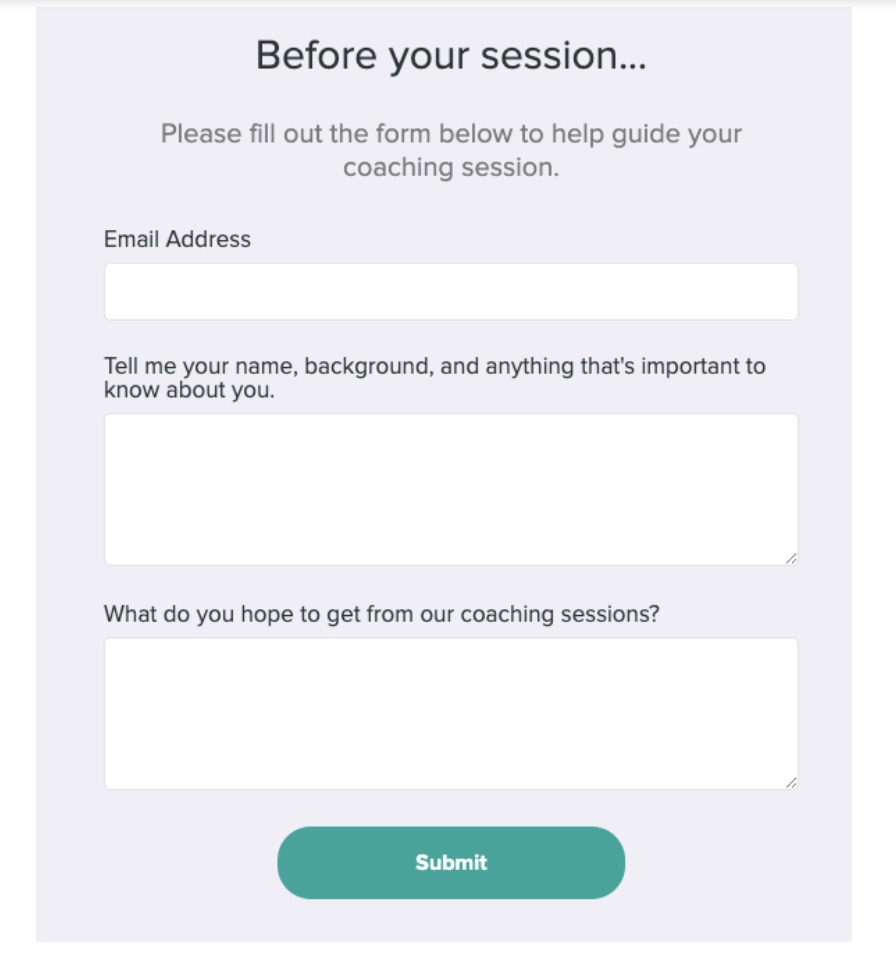
An online coaching platform is a great addition or substitute for a traditional website. And Teachable for coaches allows you to create sales pages, communicate with clients, accept payments, and integrate coaching with courses. You can also design intake forms to learn more about your potential client and prepare for their first coaching session.
A marketing plan can help you attract potential clients and grow your life coaching business. So tailor your marketing plan to your target audience and include a content strategy with specific, measurable goals.
These steps will help you create an effective marketing plan for your life coaching business:
Testimonials can attract new clients to your coaching business. And positive client reviews are valuable as social proof—they establish credibility in your abilities as a coach and build trust with potential clients. This can be especially powerful for coaches who are starting out or working in competitive niches.
Add testimonials to your website and leverage them in your marketing efforts as a cost-effective way to reach new potential clients.
And you can establish a referral program for clients who have had a positive experience working with you. Referrals are one of the best ways to get coaching clients and grow your business.
So we know that becoming a life coach takes time, energy, and passion. But by implementing these step-by-step strategies, you’ll be on your way to growing a successful life coaching business. Getting started is easy too. You can begin with a free account with Teachable, set up your sales page, and offer a coaching package.

Transforming your interest in health and wellness into a thriving business may seem like a dream. But health coaching is on the rise, and learning how to become a health coach is easier than you think.
Hundreds of coaches have built successful health coaching businesses, and many use Teachable to create and sell their coaching services.
The health coaching industry is growing at 7.4% year-over-year and could be worth $34 billion by 2031. If you’re interested in how to become a health coach, this blog will cover everything you need to know.
A health coach guides and empowers individuals to achieve better health and well-being. Your primary responsibility is to provide clients with personalized support, motivation, and education. The goal is for clients to make sustainable lifestyle changes they can maintain independently.
Health coaches perform assessments, create unique action plans, and offer ongoing guidance to keep clients accountable. In addition, you connect with clients through online or in-person meetings.
As a coach, you get to impact your clients’ lives positively. You’ll also enjoy a flexible work schedule while exploring various career paths and opportunities. Health coaches can specialize in nutrition, weight management, stress reduction, or another area.
If you don’t have an area of specialization in mind already, here are some fields you can explore:

As a health coach, you get to help your clients achieve meaningful goals that could potentially transform their lives for the better. However, there are more reasons than that to become a health coach. Here are a few to consider:
To help you get started, we’ve compiled eight steps to become a health coach.
You don’t need any specific degrees or certifications to become a health coach. Some health coaches transition into coaching after they’ve had a career in a health field like:
So, they may have a Bachelor’s degree and licenses from their previous work experience. A degree may help give you a deeper understanding of human anatomy, physiology, and nutrition principles to use as a coach. However, it’s not a dealbreaker.
Many successful health coaches build their expertise (and business) through certifications, workshops, and practical experience.
Health coach training programs may also help you learn coaching skills. There are countless coaching certification and training programs, and they can be expensive to enroll in. If you do a certificate program, make sure it is accredited.
The International Coaching Federation (ICF) and National Board for Health and Wellness Coaching (NBHWC) accredit programs. To start, you can search for approved coaching programs on their website. Also look at reviews, networking opportunities, and additional resources each offers, before committing to a certification.

Keep in mind that you can forego certification, especially if you’re only getting started or have previous experience. When it comes to health coaching, clients tend to trust coaches with credentials and real experience.
If you go the certification route, you’ll need to meet these requirements. You can apply for certification from the ICF or NBHWC. For the ICF, there are four steps for a health coach to apply for accreditation:
The steps to apply for certification through the NBHWC differ slightly from the ICF. To apply for certification, you’ll need to complete these steps:
All health coaching programs aren’t created equal. When searching for a program, there are several factors to look out for:
Here are three popular accredited health coaching programs:
Running a successful coaching business starts with landing your first paying client. Then, you’ll need to build and maintain a steady client base
Follow these steps to attract health coaching clients:
Before offering your services, write down what prospective clients need to know to sign up. This will act as a rough draft for your website and sales page copy. For health coaching, for example, you’ll want to answer these questions:
It will also help you identify the products and services that you’ll offer clients. For example, Rachel Jesien teaches online yoga courses but also offers private coaching sessions.

To book clients, you’ll need to create a sales page for your services. With Teachable, you don’t need to worry about coding or any of the technical aspects of creating a webpage for your coaching services.
After you sign up for Teachable, all you need to do is click “Coaching” and add basic information like:
Once you’re happy with your health coaching page, hit Publish. Remember, it doesn’t need to be perfect to go live. Most coaches revise their website and sales pages continuously to reflect their experience, client results, value, and more.

The journey to becoming a successful health coach doesn’t end with certification or after you have a few clients on your roster.
The health and wellness field constantly evolves, and you need to change with it. Adopt a growth mindset and continue to educate yourself on health and coaching to improve your client’s overall experience.
Here are a few ways to do it:
You can diversify your coaching income by offering online courses, digital downloads, and more.

Packaging your expertise into an online course allows you to sell your knowledge to a wider audience.
Here’s how to do it:
As a health coach, you can impact your clients’ lives positively. Launching your coaching career is easier with tools like Teachable.
Teachable makes it simple to create and sell coaching services as well as other digital products. You can start with the free plan or chat with a Teachable expert to see how it can benefit your business.
According to the U.S. Bureau of Labor Statistics, the average salary for a health coach in the United States is $48,860 annually.
Earnings vary widely depending on specialization, experience, and pricing strategy. However, certified, experienced health coaches often earn more than beginners in the field.
You can price your services in various ways. For example, some coaches charge clients per hour, while others charge per session. You can also create and sell online courses for a one-time fee that your client pays upfront.
Consider your experience, niche, and target market when determining the price of your services.
The time it takes to become a health coach can vary depending on the program and level of education. For example, certification programs can take anywhere from three to 24 months, while bachelor programs can take up to four years.
There is no specific degree required to become a health coach. However, you can complete health coaching programs approved by the National Board for Health and Wellness Coaching (NBHWC). This will establish you as a certified health coach in the field.
You can get coaching clients by offering discovery calls or using social media to promote your services. You can also attend networking events or perform client research to identify your ideal clients.

Have you wondered what it takes to become a financial coach? The requirements for how to become a financial coach are not set in stone. Teachable coaches have diverse backgrounds and experience. If you want to help others find more financial freedom, you may have a career in financial coaching.
According to a recent survey, nearly all Americans (90%) say that they stress over money. Now more than ever, people are eager to find solutions to their financial worries. As a financial coach, you can help people minimize stress, manage their finances, and reach their financial goals.
In this article, we’ll cover how to become a financial coach with expert advice and tools to help you grow your coaching business.
A financial coach is an expert in money management and personal finance. Financial coaches help people improve their financial literacy by educating them on fundamental financial concepts like saving, budgeting, and debt management. They work with people who want to develop and maintain a healthier relationship with money.
Financial coaches can specialize in a specific area or focus more generally on day-to-day money management. Ultimately, a financial coach provides expert guidance and accountability to help people establish and reach their financial goals.
Financial coaches offer one-on-one or group coaching services to support people in developing healthier financial habits and behaviors. They take a holistic approach to finances—tackling both the emotional and practical side of financial management.
A fitness coach helps you understand your relationship with exercise and create a personalized plan to achieve your fitness goals. Financial coaches do the same, but with money.
Financial coaches utilize a variety of processes and tools to help people improve their relationship with money. These money management strategies can include things like:
Both financial coaches and advisors help people with their personal finances. However, there are important distinctions between their approaches and qualifications.
A financial coach provides a more hands-on approach, helping clients change their behaviors and habits around money.
For example, a financial coach may help someone adjust their spending habits by teaching them how to create a monthly budget. Financial coaches often meet with their clients on a weekly or monthly basis. There are no formal education or certification requirements for how to become a financial coach. Unlike advisors, financial coaches cannot sell any financial products (e.g., investments, mutual funds, etc.)
A financial advisor helps people create personalized financial plans, including investments, tax strategies, and retirement savings. They take a more hands-off approach, typically meeting with clients quarterly or annually. Financial advisors must register with the Securities and Exchange Commission (SEC) to sell financial products. They must also pass securities exams, such as the Series 7 exam.
Think of a financial coach as someone who helps people change their behaviors. Conversely, an advisor helps people make financial decisions.
There is a growing demand for qualified financial coaches. People are looking for experts to help them navigate the economic uncertainties brought on by the pandemic and rising inflation. If you have some financial expertise and are passionate about helping others, it is an excellent time to become a financial coach.
In addition to helping others, there are several benefits to starting a coaching business. Whether you are looking to replace your 9 to 5 job or start a side hustle, a coaching business can increase your overall earning potential. Full-time coaches also have more flexibility and freedom with their schedules. Best of all, you’ll have the opportunity to pursue a purpose-driven career and positively impact people’s lives.
The average salary for a financial coach in the United States is $58,628. Financial coaches typically charge anywhere from $100 – $300/hour.
The exact amount you can earn as a financial coach depends on several factors, including your niche, experience, and pricing structure. Coaches with certifications and more experience are more likely to earn higher wages than a coach just starting their business.
As a financial coach, you can price your services in one of several ways. You may charge by the hour, set a monthly retainer, or price by package or service type. Since financial coaches do not sell any financial products, they don’t typically generate income from commissions or asset management fees.
While pricing structures and salaries may vary, financial coaches have high earning potential.
Although you don’t need specific certifications or credentials to become a financial coach, you can take a few steps to increase your success.
Below you’ll find eight steps to help you become a more credible financial coach and land your first coaching client.
Financial literacy is the foundation of our relationship with money. It refers to the ability to understand and use various skills to manage financial resources effectively. As a coach, you’ll be responsible for helping people improve their financial literacy.
At a minimum, you’ll need to understand the basic concepts:
Once you’ve mastered these concepts, you’ll need to be confident in teaching these concepts to others. If you’re unfamiliar with how to teach these concepts, consider one of the certification programs below to improve your coaching skills.
In addition to the core concepts of financial literacy, you’ll need to develop and hone other interpersonal and professional skills like:
Business administration skills – To grow your business, you’ll need basic administrative skills like organization, calendar management, time management, and excellent customer service. You’ll also want to learn how to automate business processes like capturing new leads or scheduling sessions to save time.
Communication – You’ll need to showcase your professional written and verbal communication skills to attract and land new clients. During each coaching session, you’ll also need to listen carefully, ask pointed questions, and communicate your guidance effectively.
Emotional intelligence – Empathy and motivation are vital to any coaching business. These skills build a deeper connection with your clients and demonstrate your commitment to their well-being.
There are no licensing or education requirements to become a financial coach. Your financial skills and knowledge are enough. However, experts recommend looking into licensing programs or certifications to expand your knowledge base and increase your marketability to potential clients.
Here are a few examples of certifications available for financial coaches:
Financial coaching is competitive. Defining your niche can help you stand out and attract the right type of clients.
Start by identifying your ideal coaching client:
Dive into specifics like:
Reflect on your financial experience and expertise. Then, select an audience in an area where you are both knowledgeable and passionate.
Determine what your audience needs. What financial problems are they facing? What are their pain points, frustrations, and obstacles? Figure out how you can relate to their struggles. Then, outline how your coaching services will help them overcome those obstacles and improve their life.
As adults, most of us have experience dealing with money. However, your coaching clients will be looking for something more. Your clients want to know that you understand and can relate to their struggles or challenges. Leveraging your experience in certain financial situations will also help you prove your value and credibility.
Your experience is your asset. Ask yourself what:
Use this information to craft your business story. Share specific examples, like how you first learned to follow a budget or how you got out of credit card debt. Explain the circumstances and experiences that drove you to become a financial coach. Tell your audience why this profession matters to you.
Not only will this help you relate and build credibility, but your relevant experiences will make it easier to attract your ideal coaching clients.
Most people (76%) look for a business online before making a purchase. A well-designed website increases your online presence and boosts credibility. Your website is the place where you can tell your story and showcase your services. It is also how you generate and convert leads into paying clients.
At a minimum, your website should include:
To increase traffic, perform keyword research and strategically place keywords throughout your site. Check that your site is easy to navigate on all devices, including mobile. Take time to create and refine your website copy, so it aligns with your target audience and their needs.
There are several different types of coaching platforms out there. Choosing the right coaching platform can significantly impact your day-to-day operations and client experience.
You want to select a coaching platform that allows you to:
Ideally, your coaching platform should handle most, if not all, of your business technology needs. With Teachable coaching, you’ll find everything you need to start and grow your coaching business.
Teachable’s coaching service was designed specifically for coaches. With it, you can:
Whether you’re just starting out or looking to build a more streamlined tech stack, our coaching feature has the tools you need. You can create, sell, and manage your coaching services in less time.
Once you’ve selected your coaching platform, it’s time to tell the world what you have to offer. Use your website, Teachable course homepage, and social media to present your value to potential customers. Help them visualize what it’s like to work with you and how you can help them achieve more financial freedom.
You can highlight your value and expertise by:
One of the most common questions we get from Teachable creators is how to get coaching clients. Luckily, there are several easy, cost-effective ways to launch and sell your services.
Building a successful financial coaching business doesn’t happen overnight, but the tips and strategies in this article can help you get started. Interested in learning how other successful creators share their knowledge with Teachable? Click here to view examples of thriving knowledge businesses like Jillian Johnsrud’s Money Coach School. If you haven’t selected your coaching platform, test Teachable coaching for free today.