Thank you! Your submission has been received!
Oops! Something went wrong while submitting the form.
MENU
A closer look at the educators, programs, and communities that got their start right here on the platform.

Iwant to take 3 seconds of your time to ask one thing: what defines you?
Is it your career, your family, your hobbies or passions? And if you have an answer that comes to your head immediately, are you sharing it?
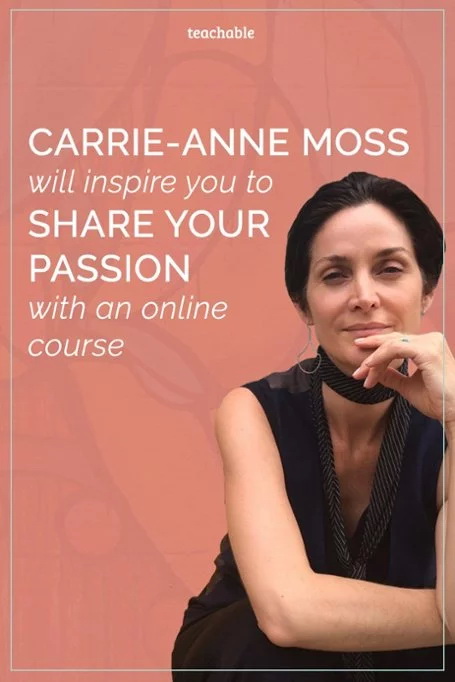
This is a question Carrie-Anne Moss would undoubtedly have an answer to.
You may know Carrie-Anne as Jeri from Jessica Jones or Trinity from The Matrix Trilogy, but as a mother of three, wife and woman she felt a burning passion to share what she has learned. She since started a blog – Annapurna Living – and has built not only one, but multiple online courses.
Sitting down in one of the most heartwarming and authentic interviews of my life, Carrie-Anne tells how she shares her passion and knowledge through her online courses and how and why you can too.
It’s a Teachable motto that we all have a course inside of us. We all have unique experiences, skills and passions that we not only can – but should – share with the world.
For Angela Fehr, a talented artist, she’s brought together a community to learn how to watercolor paint. For Nat Eliason and Justin Mares, it’s their skills with technical marketing that help people advance their careers. For Jon Haws, it’s alleviating the pain of nursing school and making it easy for student to pass their licensing exam.
By launching their course and sharing their knowledge all of these people were, yes, able to make money to support their families BUT ALSO help help a huge number of students in a way that isn’t possible with traditional teaching.
Courses allow you to “scale yourself”, to share your knowledge with more people than ever before. This is inspiring.
“I had this yearning…in my heart that I wanted to create this platform, where I could share some of the things that I was learning around motherhood, around well-being, around consciousness, around meditation, yoga, in the ground. Simple ideas of thinking that I wanted to share,” says Carrie-Anne about why she started to blog and create.

If you’re struggling with creativity, check out this post for 10 Steps to Bring Creativity Into Your Life by Carrie-Anne.
“Well, I think the trickiest thing for someone like me and there’s a lot of people like me that has something that they’re offering. It’s like; how do you offer it? I couldn’t find the platform. Originally, these courses that I do, I was doing them in 10-day email courses. I enjoyed that, it was great. But I really couldn’t figure out like how can I create a container. What container can hold this for me?” Carrie-Anne said.
It’s a problem. When we want to share something, we all want to find the best way to put our voice into the world and be heard, but with an overload of “content” and streams of social media this can be incredibly hard, not to mention, you want a platform that matches your vision.
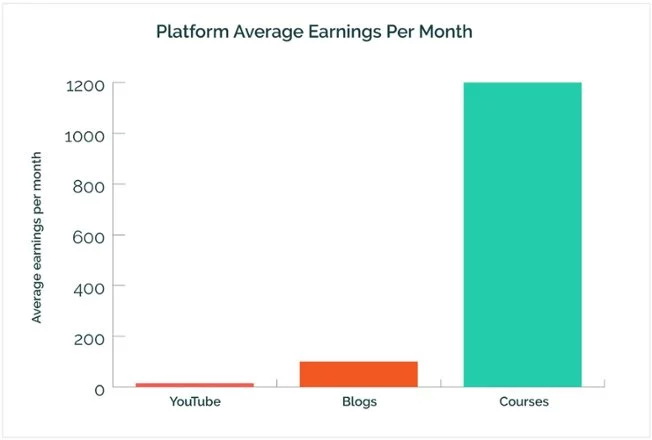
That’s the beauty behind courses – they’re a content medium that people both value and engage with. The average instructor on Teachable make $5K on their online course.
By contrast, 81% of “bloggers” never make even $100. An author makes only 8-15 cents on every dollar made on their book. The “average” YouTuber with 5K views per month makes just $15/month.
And while money is a big incentivator for some creators, others simply want to share their voice and find a a platform that helps them bring their vision to life.
As Carrie-Anne says, “[Mariah Coz] recommended Teachable and I’m just thrilled. It’s exactly what I imagined when I would think about how I wanted to [share my idea].”
Our dev team is delighted 🙂
However, one of the best things about an online course is how often you interact with your audience. This isn’t like a blog where you write a post, put it into the world and hope to get a few comments. You’re sharing videos, getting and giving feedback and your audience will start to help each other. It’s much more of a two-way interactive street between you and your students.
In our interview, Carrie-Anne talked about how she wanted to create and cultivate a community – but she was having a hard time doing that with an email course. She was able to do it with her Teachable school.
Maybe this makes me a nerd, but the first time I got into the Teachable platform, it was fun. Yes, fun. Like someone handed me a new box of digital crayons with which I could create anything – everything.
I’ve always been a sucker for new projects, exploring and seeing what I could create. Challenging myself to write, design and customize to make new projects more beautiful than the last. I’m pretty sure this is how some people feel when they solve a sudoku, but for a creative, a new creation platform has the same feeling.
Which is why it was thrilling to hear Carrie-Anne say the same, “It’s just been so fulfilling for me to actually have a place that I get to bring myself to in a way that isn’t controlled by say a movie or a television show, or a PR world. Like it’s all me. I found that to be pretty exciting that we live in a time right now, where we can create what we want to share.”
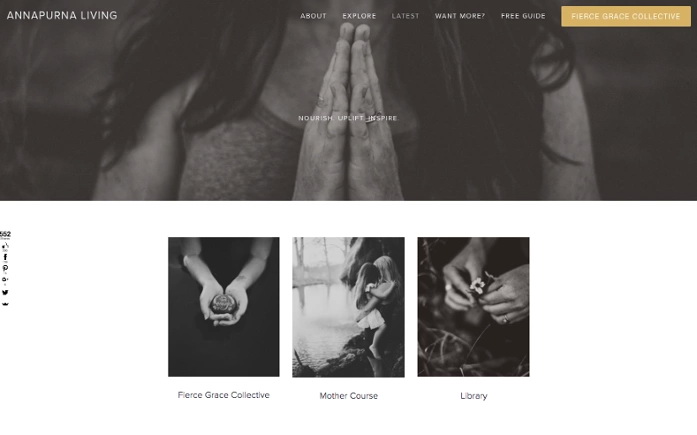
Annapurna Living: Carrie-Anne’s Blog
And that’s true. Creating online gives us a creative outlet not always found at our day jobs. Your persona can be anyone and the more personalized the better. You’re teach as an individual to individuals. You’re not a company or a brand and our best course creators are the ones who let their voices shine through.
So when you’re thinking of starting to turn your passion into a course, you’ve got to pinpoint your course topic.
You’re a foodie, but a course on food is too broad – you’ve got to hone in on the specifics. The best way to find your course idea is
But then we’ve got to take it one step farther. Even if we’re passionate about dance and have taught it before, what aspect of dance are people struggling with that they would PAY to learn about?
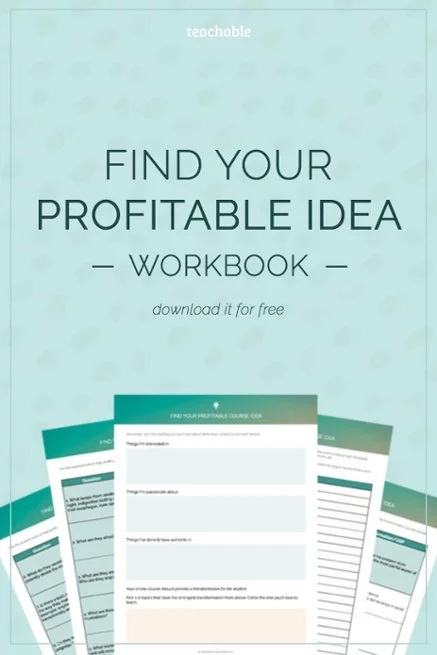
Rather than just guessing, you can look online and research your potential topics to help you find your idea and make sure people are interested in it.
We’ve actually created a small workbook just for this process. Download our Profitable Course Idea Worksheets to
Carrie-Anne knew exactly what she wanted to teach – she had a passion and has bravely shared it.
“I want to share that with women…a simple three-minute meditation, that has the power to transform their entire lives. Because when you get out of the thinking mind and the manic craziness of your mind, you make good choices.
You know what to do. You know what relationships to have. What jobs to take, what to eat….you become more prosperous, because you understand what’s important in your life. As you can tell I’m pretty passionate about what I’m doing.”
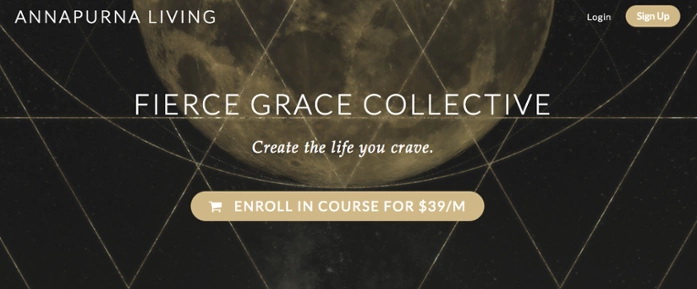
Click here to enroll in the Fierce Grace Collective course.
What I loved about speaking with Carrie-Anne is that she was confident that she stumbled on something could change people’s lives and felt passionate and a sense of obligation to share it.
And she has. Through both her courses and blog posts, like this one which is a simple and sincere meditation practice.
I’ve personally spoken with hundreds of people who have a course idea they’re passionate about, they spend hundreds of hours a week learning more about the topic and yet, when I suggest they make a course they say 3 things: 1. I’m not an expert. 2. I don’t know how to create a course 3. I don’t have the time.
I understand these fears, but you won’t get sympathy from me for hiding your light from the world. As we said at the start of this post, we all have something we’re able to teach and if our knowledge can help people’s lives we have an obligation to share it.
Hearing Carrie-Anne speak about her idea she said, “But it’s really giving women the tools to uplift and inspire their lives without having to buy anything. Without buying into this cultural advertising of that, you need to buy XYZ in order to be beautiful, valuable. All of these things. It’s like women have been so distracted from their true grace and their true beauty by cosmetic companies, by dieting, by tabloids, by reality television.
All of those things have distorted what it means to be a woman in such a major way. For me I’m at this place where I’m like enough is enough. I’m not buying into any of that. I don’t want my daughter to have to buy into it. I don’t want anyone to have to buy into it. We are enough. We are so creative and so beautiful and graceful and amazing. When we stand in our center and we aren’t looking outside of ourselves to give ourselves value.”
There’s passion in those words and a desire to change something, which is exactly what you can do teaching online.
So the first thing we hear when someone wants to teach online and the biggest mental hurdle is the Expert Myth – or the idea that you have to be an “expert” to teach online.
“I want to empower other women. Listen, I need it to. It’s not like I’m super confident all the time. I’m teaching what I need. It’s like in Kundalini Yoga, it’s like if you want to master something. Teach it. I’m only teaching what I need. I’m not an expert. I don’t know it all. We have these circles where I talk, where we have this conversation, people ride in,” says Carrie-Anne.
And that’s exactly it.
The dictionary definition of an expert is:
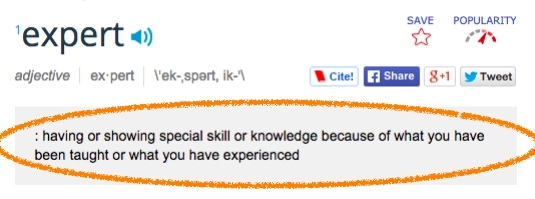
A person just one step ahead of you. In fact, at Teachable, we think the best instructors are sometimes the people who have just learned a topic – not the masters.
Think about it, when you needed help in Calculus 123 in college, who was better to learn from? Your friend who got in A in it last semester or the professor. More often than not experts forget the issues beginners struggle with and alienate them with theory and advanced concepts.
This is often reflected in how people price their course where they constantly undervalue and underprice it. Don’t do that!
Carrie-Anne talked about this, “There’s energy in money, there is an energy. I think it’s very important to have that exchange happen and I think you’re totally right.
You have to know your value and put it out there in a way that you’re content with, and that feels good to you. So yeah, I totally agree and I have a generous inclination. I really would love to give it away to everybody, but I know that’s not the right thing. Whenever I’ve given it away, people don’t do it.”
I know it’s hard to do, but think about owning your worth and what happens to your course if you don’t price based on it’s value.
You don’t have to know everything on your topic to teach it.
“I’m not answering questions. I’m having a conversation. I don’t have the answers, but you have the answers for you. I have the answers for me,” Carrie-Anne says.
There’s also a technical obstacle to sharing your passion online and that’s the fear that you don’t know what you’re doing or how to do it.
A course does NOT need to be fancy. It doesn’t need professional videographers, microphones, a script writer or designer.
“I’m literally creating this content at my kitchen’s table, on my bedroom floor making videos. I don’t have a production office. I don’t have staff… it’s a labor of love, it’s a lot of work and I love it. But I wasn’t ready until I got to Teachable,” Carrie- Anne says.
The biggest thing to remember is that done is better than perfect. Between the Teachable blog, our community of creators in The Teachable Tribe and our live workshops – all the resources you need are free at at your fingertips.
{{coursecurriculum-component="/blog-shortcodes/blog-popup"}}
When I’m working with our potential course creators, they are saying, “I just can’t that first step. I have been pushing that off. I like signed up and here I am many days later and haven’t done it.” So I asked Carrie-Anne, what would you tell those people who are passionate about something, but haven’t taken that first step?
There is a way through every block. There is another saying that says, “Start and the pressure will come off of you.” When you feel the pressure start and it will come off. I think a lot of us get stuck in that feeling of like it’s too much, it’s too much. But yet if you just do that first step, you end up feeling like this release of the pressure. It’s in the resistance that all the pressure comes.
So I say start, have a very manageable kind of steps that you can actually take to make what you want happen. Because sitting around and talking about it is valuable, because you’re cultivating the idea. You’re finding it. But you have to do it. You have to put it into action. It has to be important to you. If there is fear that’s getting in the way, this is the thing I’m kind of exploring right now in my courses. Because I created my courses every month, has a different theme. It’s like that fear that gets us.
One of the best ways to take the first step is to set deadlines. Maybe it’s 1 module per week. Maybe is an outline one week and all the video content in two weekends. Whatever it is, don’t let fear hold you back.
“…ultimately the biggest fear lies within us. You’ve got to confront that. Just got to come, move through it. You got to do it. You just have to do it. If what you’re doing is truly something that it’s been so true to you, you got to express it. You have to do it. It’s like your gift and not doing it is actually just not okay. It’s so simple,” Carrie-Anne said.
While we are all afraid to put ourselves out there, or as Pat Flynn of Smart Passive Income says,“ A lot of people have ideas, but they don’t want to execute because they’re not sure whether or not that thing that they are going to be working on is actually worth that time and effort.
And those what-ifs, which are initially ‘What if this works’, ‘What if this is the one’, those end up turning into ‘What if I fail’, ‘What if I let my family down’ and ‘What if it was all for nothing.’ And they don’t do anything – they are much more comfortable being complacent with where they are than potentially failing.”
Everyone feels like they’re putting their reputation on the line, but for an actress like Carrie-Anne the stakes are undoubtedly higher, but that didn’t for a second stop her.
“I’m an actress. People see me in a certain way. I’m very private. It was like, literally, that moment when you publish your website or whatever…I was like, “I don’t think I can do it. I can’t do it. I’m too afraid.” [My friend] was like, “Well, what are you afraid of?” I said, “What people will think of me. People will judge me and think, ‘Who does she think she is?’ All of the voices.”
She said to me, “Where are you right now?” I said, “I’m in my kitchen.” She goes, “Imagine the people you imagine would make fun of you sitting at your kitchen table. See them.” I said, “Okay. I saw a couple of people that I thought making fun of me.” And she goes, “Do you really care what they think of you?” I was like, “No.” Who cares? Who cares?
People are rooting for you, people are rooting after you. And that’s what you have to believe.”
And it’s true. When I interviewed Jon Haws of NRSNG he described this same fear – a fear so lingering that he compiled a list of compliments from students so when the “bad ones came” he’d have something to lean on, but the complaints never came and Jon has continue to build his course into a school into a business.
“I didn’t know that I would eventually be making videos with my laptop, no lighting, no hair and makeup, no editing, just like display, just me,” Carrie-Anne said. “I would have never in a million years would have imagined that it would go down like that. That I could feel that comfortable creating what I’m creating. But at first, the blog felt a little arm’s length. I think the information was still the writing was all there and all of that. But slowly it became, “Okay. Am I really willing to put myself out there and to share authentically and from a truth?”
What do you think? Are you inspired? I know I was. What kind words do you have for future course creators?

The following is a guest feature from Carlynn Greene, Teachable creator, scholarship guru, and graduate-school student. Her courses help individuals find, apply for, and win scholarship money. She’s got four courses in her Scholarship Guru school for students to choose from and spoke with Teachable about what it means to be a Black entrepreneur, creator, and scholarship guru.
I am currently a public relations student in grad school, and a content creator and influencer primarily on TikTok and YouTube. I specialize in giving students scholarship advice because I personally have won 30 scholarships for my own education. I’m debt-free for both degrees in undergraduate and grad school. And I’m just doing my part to teach others how to emulate my results and graduate debt-free too.
So what inspired me to create my online course? Well, first, let me break down what my online course looks like. It’s titled “The Scholarship Algorithm” and is broken up into four parts. The first part talks about how to find scholarships you’re more likely to win. The second part is optimization and organization, so you can speed up the process and be more organized. The third part talks about writing your scholarship essay, which is the most important part of your application. And then the fourth part is actually filling out the overall application. How to use psychology to win, aceing scholarship interviews and recommendation letters, all these different elements that go into a winning application. So that’s what the course has, and [it] also has some other bonuses and handouts and printouts that you can use to really help with your process.
As far as creating this course, I really wanted to create something that had a step-by-step guide and process on how to win scholarships. Because if you went to high school that was like mine, they didn’t really teach me how to go about scholarships. They taught me about college admissions and the FAFSA, but never about scholarships.
So I really wanted to create something specifically for this. And the students who I’ve been able to mentor over the years, who have won millions of dollars in scholarships, many of which also have full rides, they also went to high schools that did not teach them about scholarships. So I’m just trying to bridge the gap there.
When I was a senior in high school, I won a scholarship from a hospital that I had been volunteering at for years. And my mom saw that I won. And she had a very emotional reaction to it, because she had this preconceived notion that she was going to have to take out some parent loans. And I would take out some student loans just to pay for my education. But all these scholarship checks kept coming in the mail, back to back to back. And so upon seeing her emotional reaction to that, I was like, “You know what, let me just go ahead and create a platform to teach others how to emulate my results so that they too, can be debt free.”
Now, as far as what motivated me to become a creator, I already have a background in media arts and broadcast journalism, that’s what I studied during undergrad. And right now I’m studying public relations. So I always wanted to create content. I always wanted to be in front of the camera, editing videos, doing all that. So integrating that with what I do to help people with financial aid is right up my alley.
As far as what it means to me to be a Black entrepreneur, it’s so important. [There are] socio-economic disparities that exist between the Black community, the white community and other communities, where Black people simply do not make as much money. So I’m trying to bridge the gap.
Black women now hold the highest percentage of higher degrees in education [as a demographic]. However, at the same time, we also owe the most student loan debt.
So I’m really trying to lessen that by helping people with scholarships. Not only for the Black community but also other communities. I have helped students across the globe from various backgrounds. The very first student I helped win a scholarship was actually an international student from the DR Congo in Africa. [I’ve helped] some other international students like students from India, and another one from Singapore, Germany, and various other demographics across the U.S. So what I do is all encompassing and can help just about anyone no matter where you’re from—and even no matter your study concentration. I studied, media arts or Liberal Arts category. But students who are down the STEM path or accounting, law, medicine, they have also been able to win using my tips.
Teachable actually chose me. They reached out to me via email saying, “Hey, would you like to put your online course on our platform?” and my online course was already on another channel. However, there wasn’t as much communication going on [with that other platform.] And because of that I wasn’t really that motivated to really promote it. I actually felt kind of self-conscious to promote it because I didn’t like the idea of charging people all this money just to enroll in my online course. But Teachable really helped with building my confidence and has been there every step of the way.
Shout out to Monique again, she is amazing. She really helped with this process, giving personalized sessions and tips and all that. My favorite feature on Teachable I would say [is] how they partner with Discover. I’ve had two webinars with Discover which were very successful. I had several people enroll in my online courses after those free webinars. So that was a great experience.
{{coursecurriculum-component="/blog-shortcodes/blog-popup"}}

The following is a guest feature from Carlene Woods, a Black entrepreneur and pastry chef. Once Carlene decided she wanted to be known for her baking, there was no stopping her. The Teachable creator and Black entrepreneur has been baking for over a decade and launched her online school last year. She now offers coaching and a home baker’s course to help bakers who are looking to learn online. We caught up with Carlene about her creator story for Black History Month.
I started baking a little bit over 10 years ago. In high school, I was voted most likely to succeed. But when I got to college, I was pregnant with my first daughter. So I was a cheerleader and I was pregnant and life hit me hard.
By the age of 21, I had two daughters, I was depressed; I was in a dark place. I was living at home with my parents. And I was just sitting on the couch every day just taking care of babies. And I was watching my friends walk across the stage, graduating. I’m like, “Oh my God, that’s supposed to be me.”
So what happened was, I started watching the Food Network. And I told myself, I said, “God, this can’t end like this. This is not who you called me to be. I know, there’s more. I know there’s greater.” So for Christmas, what I decided was to surprise my parents and go back to school.
And I remember someone told me when I was in college at Florida A&M, he said, “You’re not going to finish school the way that you think you’re going to finish school, but you will finish.” So I ended up going to culinary school. I went to culinary school for nine months, and I was so grateful.
I ended up working with this woman at an externship. When you’re in culinary school, you don’t learn everything. It’s when you get into the field, you actually learn everything. When I finished working with her, I immediately launched my business, and people were just supporting me. And I was like, I want to be known as “The Cake Lady!” And so to this day, I’m “The Cake Lady.”To make a long story short, in August, I kept feeling like God wants me to produce something. I keep feeling like this overwhelming feeling of “produce something.” So I’m in Sam’s Club, I literally hear something that says, “teach.” And I’m like, “teach?”
For years, people have asked me “Carlene, can you teach me how to bake?” And I said, “You know what? That’s what I’m gonna do.”
Teachable is absolutely amazing. I figured it out, I launched my courses. I have a home baker’s course that I offer that has four courses where you learn how to cupcakes, cakes, icings, and brownies. And so I launched that as well in November. So all of this I was launching at the same time.
When the Lord told me to do it, I got depressed, I got discouraged, y’all. So I know for me, it hits me harder when I don’t do something. And every day, I would just sit there like, “What am I supposed to be doing?” And it will hit me like you need to finish your courses, you need to do what you’re supposed to do. And I’m so grateful that I’m here now able to teach.
When I originally did all of my videos, I actually rented out the kitchen to do them, because I really wanted them to look really professional in everything, the whole nine yards.
It was me, my two kids, and I had a cameraman. I was actually stretching myself from a comfortable place. So I’m talking and trying to do the videos. I’ve never done this before. It was it was “Wow.” What I thought was gonna take like four to five hours, you really need like a whole day to literally create this content. Because you have to wash dishes, and do this, and move around, and bake and all of these things.
But it was an amazing experience because I challenged myself. And many times if you don’t challenge yourself, you can’t change yourself. And so I’m grateful that I did challenge myself.
I just keep my worship music going and I’m praying. When I bake, a lot of people don’t know this about me, [but] I’m typically praying for the person and their families to be healed, their to be families reunited, you know, things of that nature.
Because love is food. When people eat, they want to feel the love. When you first walk in the door at a wedding, the first thing you see is the cake at the reception. And so that’s what makes me feel good: to be able to bring together a masterpiece.
A lot of times, cakes are a lot like life, you know? People see the beauty of it when it’s put together, but they don’t see the layers [and] what it takes to build the cake. And so it reminds me a lot of life.
God gave me a gift. When you have a trade, you’ll always make money when you can use your hands. The Bible says that I’ll bless the work of your hands. So when I go to sleep with no money in my bank account, God forbid, but I can get up in the morning and bake a cupcake I have $2, because somebody is going to buy it. And you can’t allow that dream to die. And a lot of times, we allow dreams to die. Because we feel like we’re too old now. We feel like we’ve missed that moment. We feel like time has passed us by.
A lot of times we feel like our friends, family, and friendship support us. But a lot of times, it’s the strangers that are going to support you more than your family and your friends. So you can’t worry about who doesn’t support you in the neighborhood. When there’s a nation waiting on you. There’s somebody waiting to hear your voice. There’s somebody right [now] ready to buy your course. There’s somebody who’s ready to buy your coaching. There’s somebody ready to see what it is that you have. What you ask yourself is: What do you have to offer? What do you have to offer that nobody else can do? And I believe that that will change your life.
It means everything. My grandfather, he’s the president of the SCLC, the Southern Christian Leadership Conference. He walked with Dr. Martin Luther King Jr. My grandfather now has a statue in Birmingham, Alabama.
And it is an honor you know? Because we didn’t see this growing up. We thought we were supposed to go to college, get married, have children, and live life. But then again, you know, just being a Black entrepreneur is such an honor and a blessing. To let other women and other men know that this can be you. The world is waiting on you. And I want to encourage people: You are not alone. You are not alone in this journey.
This feature was reported by Nina Godlewski and edited for clarity.
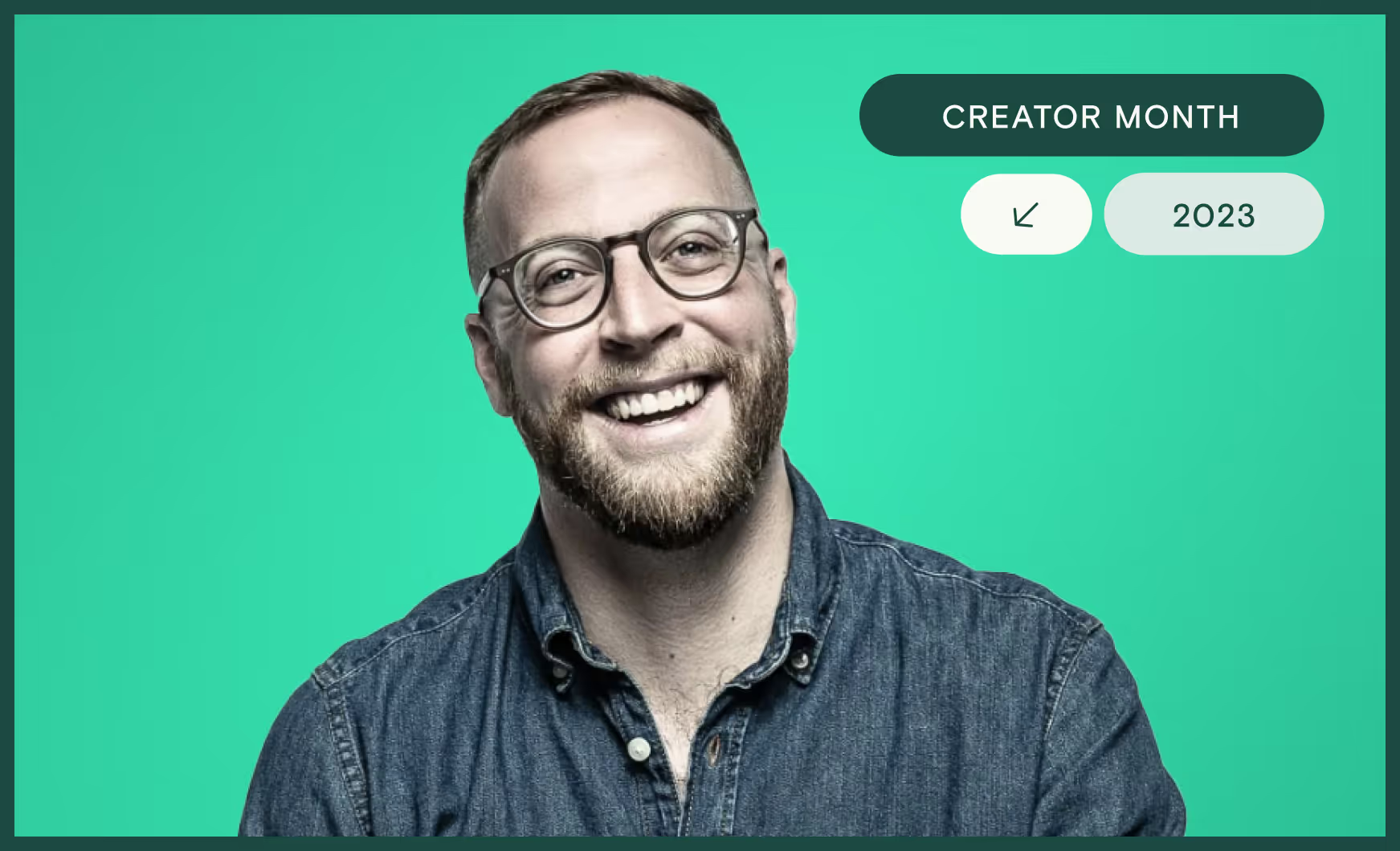
We’re sharing the story of Jay Clouse, a multi-faceted creator who is in the game of helping people become professional creators. As a podcaster, newsletter writer, and course creator, Jay embodies the word “impact.” Everyday his content reaches those looking to create and make an impact of their own.
Today, he is the founder of Creative Companion and host of Creative Elements, a narrative-interview podcast exploring how today’s top creators make a living with their art and creativity. He previously led the Community Experience team for Pat Flynn and Smart Passive Income, designing their paid membership community and cohort-based course programs.
Teachable’s very own Jonah sat down with Jay to learn about the power of building a community for thriving students. Watch the full video and see our summary of the interview below.
As a professional creator with a podcast, newsletter, and course creation business, Jay knows how to build a successful community for his students. His story goes back to 2017, when he started building a membership product in 2017. This led to creating courses with LinkedIn Learning in 2018 before eventually bringing his courses to Teachable.
His experience with coaching and group coaching helped him structure his courses independently and showed the value of the transformation he could offer—all before creating his first course.
Jay shares that he was able to offer coaching services to creative freelancers, leveraging their expertise in business and content creation. Eventually, he was able to create three courses.
“I actually developed three courses all at once, which I wouldn’t recommend doing,” Jay says. “It’s all combined into one course on Teachable actually, I call it the Freelancing Masterclass. But originally, I developed it as three separate courses: Business for Freelancers, Selling for Freelancers, and Marketing for Freelancers, because I saw them as three different activities.”
Jay explains it was a 48-video, 48-lesson mega course broken into three courses. While he was able to put out great content, Jay notes it was a lot of work to develop three courses and release them simultaneously.
“I was really developing for a long time,” he says. “And I wasn’t getting market feedback as much as I should have along the way. So it wasn’t my most successful launch. By any stretch, it was actually my least successful launch!”
However, by refining the courses and changing the launch strategy, Jay was able to improve sales and make these courses an evergreen offering.
“If you think back to 2017, online community wasn’t a thing,” recalls Jay. “In 2017, as I was doing this group coaching exercises, I just recognized that if we’re meeting once a week, there are things I want to say to them and things that they probably want to share with each other between those seven days. And so I needed a way for them to communicate.”
This led Jay to create a private Slack channel for his students. He explains people were getting more value out of continuing to build relationships with their group members.
Today, Jay believes that creating a private membership community as a separate product can be a good option for course creators who want to provide additional support to their students.
Takeaway: Offering a separate paid membership community for students who have purchased a course can provide a higher priced product and allow creators to support students better. It’s also a great way to fuel sales.
A membership can be a good starting point for creators without a full curriculum, as it allows them to showcase their expertise and build a following.
As far as a community, clear purpose and onboarding experience are crucial for community success. What’s more, a community reduces the pressure to create perfect content and allows for unpolished access to the creator. Once a creator has shown value through a community or membership, Jay suggests that a lightweight cohort-based course (think: group coaching with curriculum) could be the next step before creating a pre-recorded course.
Takeaway: Show up, offer value, and be real to build a thriving community.
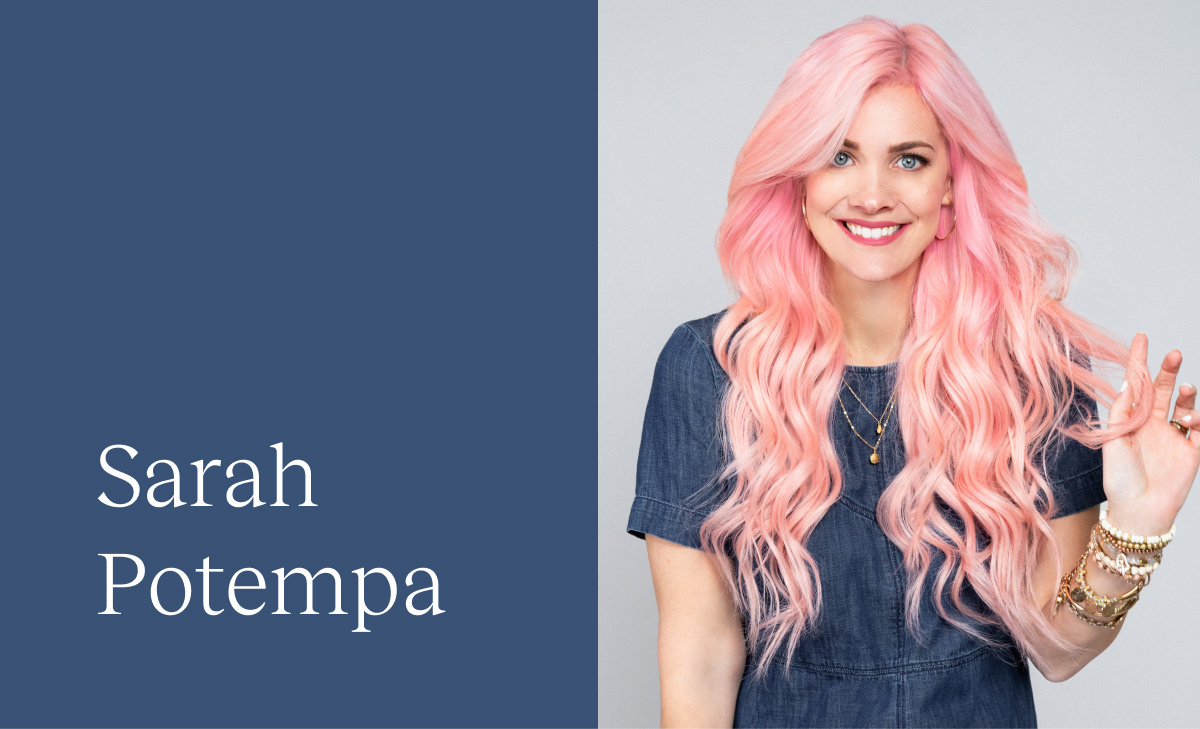
Creators on Teachable have any and every background. And we believe everyone has a passion they can transition into a business. For Teachable creator and co-founder of Beachwaver Sarah Potempa, her background involved red carpets, A-list celebrities, braids, and an idea to make hairstyling more accessible to all.
There’s no way around it: Sarah’s resume is an impressive one. It includes working backstage at New York Fashion Week and Victoria’s Secret Fashion Show, training with legendary hairstylists such as Bob Recine, and creating looks for celebrity clients like Reese Witherspoon, Busy Phillipps, Camila Cabello, and Emily Blunt.
But, it wasn’t until the creation of Beachwaver that her life as an entrepreneur really took off. Although The Beachwaver Co. is now a full-fledged haircare brand, it started out with one idea: a rotating curling iron. Today, Sarah runs the synonymous hair brand that she founded with her two sisters and business partners Erin Potempa-Wall, a lawyer and The Beachwaver Co. president, and Emily Potempa, a photographer and brand creative director.
We sat down with Sarah to learn about her free courses on Teachable, as well how she went from celebrity hairstylist to viral phenomenon to entrepreneur and now online course creator. Read on to see more about how Sarah and the Beachwaver team is making the jump from commerce to courses.
As a celebrity hairstylist who worked with media on the regular, Sarah was used to giving instructions on how to recreate red carpet or TV hairstyles. Her how-tos to beauty editors involved descriptions of how to hold your curling iron, how to maneuver your hands—a process that perhaps wasn’t as simple as it could be.
Sarah recounted the moment she dreamed up the Beachwaver:
“It was really interesting because after saying the same thing over and over again, I was actually on the phone with a beauty editor and she was like, ‘I’m so confused. What do you mean by upside down? And wrapping the hair which way?’ And she was like, ‘One side looks good, the other doesn’t.’ So, I sketched out the idea for the Beachwaver. It has a left and a right button based on the side you’re curling and a go button. And honestly it was kind of one of those things. I got off the phone with her, sketched out the idea, and had this thought of, ‘OK, how could you make it to create this perfect beach-y wave?’ And that’s how the Beachwaver came to life.”
Part of what helped Sarah and Beachwaver grow so quickly was a little boost from social media long before “content creation” was in our everyday vocabulary.
“When I very first started to think about going on social media, my agent and team were like, ‘Hmm, not a good idea. Let’s be careful because you work with a lot of high-profile people. It’s not really mainstream right now.’” But Sarah couldn’t help but think she could take her same passion for teaching hairstyling to Instagram.
“I think that idea of finding a way to utilize social media is what really drove me,” she noted. “I love styling hair. So, I remember going in and talking to Ali, my agent and saying, ‘What about if I just did Twitter and this thing called Instagram? And what if I just did hairstyling? What if I just did the same thing I do with the beauty editors where I’m just showing styles or creating something they could learn from.’ And she was like, ‘OK, that’s interesting!’”
From there, Sarah jumped into creating a series of different hairstyles, which she posted on Instagram using #100daysofhair. Following her first “content” success, she aimed higher the next year: #365daysofbraids.
Although sharing content is mainstream now, six years ago when Sarah took on the challenge, many of her clients and friends laughed at the idea of posting every single day. But as it turns out, Sarah was ahead of the curve. “That hashtag turned into so many opportunities because people started to see that I was committed to it and I was doing it. And it wasn’t even the best content!”

It was that commitment to sharing her craft and her instinct to tap into a burgeoning social media platform that opened up a world of opportunities. Soon major media outlets like Brides, POPSUGAR, and The Today Show would come knocking, asking for braid content.
Of course, Sarah still had her celebrity clients on top of her viral fame. After a chance mention of her challenge backstage to client Reese Witherspoon, who insisted upon being a braid challenge recipient, #365daysofbraids content exploded.
“That was the moment where I was like, ‘Oh wow.’ We just literally turned my job as part of the crew into a content creation moment where Reese was willing to let me do a really unique braid,” she said. Soon more celebrities such as Emily Blunt and Busy Phillips were asking for braids. Sarah’s simple idea to create the content she loved went viral.
People were fascinated by her shareable content and the idea of “doing it on your own.” But Sarah noted that none of her early viral success and audience growth would’ve happened without her decision to jump into creating content simply because she wanted to.
“Any concept that you enjoy doing, you can create your own version of an artistic portfolio through social media,” added Sarah. “You’ll be amazed at what opportunities come, but you have to take the step.”
Sarah’s love of doing hair and teaching others to style hair started at a young age thanks to her sisters and sports teammates. This love of her craft is also how Sarah connected with her now large audience.
She “got” the teenager trying a new look in her bathroom. She understood the desire to recreate a red carpet style. It’s that connection to her followers that led Sarah to continue to emphasize and grow her audience through Instagram, the 700-strong Ambassador Program, and the Beachwaver Campus Wave Program—a college ambassador program where Sarah delivers monthly webinars to each semester.
“What I love about Instagram and social and our Campus Wave Program is that you actually get feedback, and you can connect with that audience,” Sarah added. “You feel like it’s mutually beneficial because sometimes I forget that I’ve had all these amazing experiences that maybe not everyone has experienced. But at heart, I still feel like a kid who just loves to braid hair.”
Sarah added, “Those programs, for me, have been really incredible because I think members learn about us as female founders of a women-owned business. They learn about the ingredients in our hair care, why they’re vegan products, what an active strengthener is. So, it’s like I’m educating the fans of the brand and then they become friends of the brand!”
Like many small business owners, team Beachwaver shifted how they ran business in 2020. One major area Sarah and the team concentrated on was driving customers to their e-commerce site now that in-store shopping had all but shuttered. The team got to work building out a digital strategy, solving logistical concerns, and getting their product to consumers.
In addition, the brand looked to other brands they could partner with and expand their reach. The brand just had their first collaboration with makeup brand Stila. “I feel like that’s what the last year has been about—connecting to your audience, finding the collaborations you really want to partner with, taking the time to plan, rebuild, and focus on the true meaning of your business. Why are you doing what you’re doing?” Sarah said.
That transition to online and e-commerce also helped Sarah and the team make the decision to pivot toward content creation again.
“We really had to shift much faster than we wanted to e-com,” she said. “But, then when you do that, opportunities come—like getting back to what we love, making content, and teaching people how to do their hair. That’s why we started the business. And I think stories kind of come from there.”
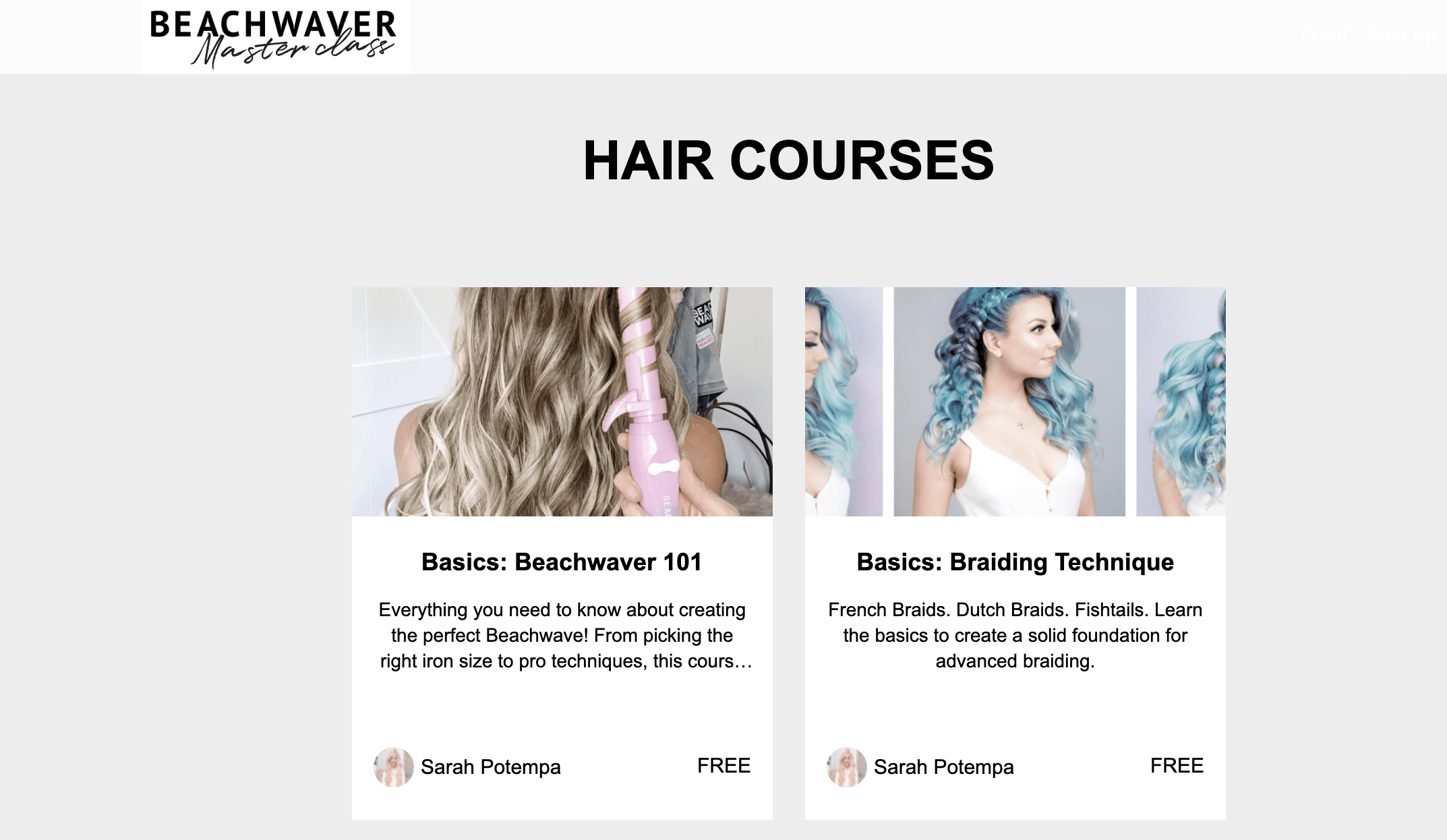
Now, the Beachwaver team is continuing their mission to teach and make hairstyling accessible to all with online courses. In their new free series, Beachwaver Master Class, Sarah recreates and teaches her most viral hairstyle videos that have propelled her and her business to success.
In the series, Sarah breaks down each look so students can learn how to master styles such as braids, space buns, Dutch fishtails, and of course, beach waves with the Beachwaver. Beyond that, Sarah reveals the tips she used to create these viral videos that earned 60 million views in a matter of 48 hours.
“I’m going to talk about how hairdressing, which is my element and what I love, how that kind of connects to viral content and video creation and how you could really take that concept and put it out there,” Sarah explained.
And this is only the beginning for Sarah and her sisters.

“I think the other exciting thing is talking about growing a business because we have gone through a lot of shifts and adapting,” she said. “Being in business for over 10 years with my family, my sisters, it’s a really exciting process. And I think that what we’ve learned too is to really find people that believe in your vision too and share it. I know it’s a lot and it’s challenging, but I think that’s what I’m excited to share on Teachable. All of the things that we’ve learned and the mistakes we’ve made and the positive things that we’ve learned from all of the different retail situations, logistics, and shipping—and how to run a business.”
The following is a guest post from creator Andrea Head. She teaches others how to make passive income from selling digital products online. She started selling downloads on Etsy to make a little extra money each month and it ended up replacing her full-time income. Now she also is helping others learn to do the same.
Entrepreneurship is the process of creating, developing, and managing a new business venture in order to make a profit. And while it’s often considered a male-dominated field, women are increasingly making their mark in the business world. In fact, a recent study found that women entrepreneurs are starting businesses at a faster rate than men.
As a female entrepreneur, I know firsthand the challenges and opportunities of starting a business. I started my online business selling digital products on Etsy in 2019 after my full-time job wasn’t cutting it. The financial freedom it’s offered me has been life-changing, and now I teach others to start their own businesses too. But as a woman, there are still unique challenges I face.
One of the biggest challenges faced by new business owners, and female entrepreneurs especially is funding. Despite the fact that women-owned businesses are growing fast they still receive significantly less funding than their male counterparts. According to a study by the National Women’s Business Council, women entrepreneurs receive only 2% of all venture capital funding. Luckily, for a business of online digital downloads, you don’t need much (if any) startup funding. It’s a great way to break into owning your own business that doesn’t require major capital upfront.
Unfortunately, female entrepreneurs still sometimes face gender bias when working in the male-dominated business world. That bias can present itself in many ways, like women not being taken as seriously as men or even discrimination when it comes to hiring, funding, and other business opportunities.
And those are just the external challenges. Just like any entrepreneur women also face the internal barriers of self-doubt and imposter syndrome. Reports show that women experience imposture syndrome at a higher rate than their male counterparts. As a result of that is that women can feel like they are not qualified or experienced enough to start a business, even if they have the necessary skills and knowledge.
Even with the challenges female entrepreneurs face it doesn’t come without its advantages too.
One of the biggest advantages of being a female entrepreneur is simply being female and being able to bring a unique perspective to the business world. Different life experiences and perspectives can be valuable and help women better understand their customer base. Plus, being a woman offers the opportunity to connect to communities of other women that have similar experiences. This mentorship and sisterhood are unique and special and one of the best parts of being a female entrepreneur.
The supportive and collaborative work environment women create with one another can be one of a kind. Women often prioritize the well-being of their employees and are more likely to create a workplace culture that is supportive and nurturing.
If you are a female entrepreneur or interested in becoming one, I have a few tips that might help you succeed. First: believe in yourself and your abilities. Don’t let self-doubt hold you back from pursuing your dreams. If you want something, go after it.
My second tip is to take advantage of the resources available to you. Join a networking group, and seek out mentorship from other successful female entrepreneurs. Take the course to help you get there, or spend the time researching what you want to pursue. Then jump in. There are so online resources available, from webinars to podcasts, that can help you get there.
Next, remember that you will have to take some risks, and you might experience some failures. Starting a business is never easy, and there will be setbacks along the way. It’s important to be willing to take risks and learn from your mistakes.
Finally, especially if you’re starting a business to free yourself from a 9-5 job, prioritize self-care and a work-life balance. It’s all too tempting to become consumed by your business. But if you push too hard you can burn out fast. Prioritize your mental and physical health, and make time for hobbies, exercise, and spending time with the people who energize you.
Entrepreneurship is an exciting and challenging journey, but it doesn’t come without its challenges. There are certainly obstacles to overcome, but at the same time there are also many advantages to being a female entrepreneur. Remember the importance of believing in yourself, taking advantage of resources, embracing risk and failure, and prioritizing self-care. With that, you can succeed as a female entrepreneur and make your mark.

Meet Aliza Kelly, a celebrity astrologer, author, host, and Teachable creator.
Aliza is a New York-based professional astrologer, best-selling author, and your new witchy bestie. She’s worked with thousands of individuals to help inspire, illuminate, and actualize their limitless potential. She shares her insight through social media and her powerful astrological courses.
And she’s ready to help you start your journey to freedom.
Remember: You have something important to say and people want to learn from you! If you’ve been thinking about building your very own mystical business, consider this a sign. Sign up for a free plan below.
The following is a guest post from founder of The Virtual Savvy, Abbey Ashley. She helps aspiring virtual assistants launch and grow their own at-home business from scratch using her courses, The SavvySystem & The SavvyVault. Abbey started her virtual assistant business in 2015 and doubled her salary from her full-time corporate job working only 20 hours a week. It’s now her passion to help others start their own VA business.
The majority of my childhood was spent in the ’90s. And let me tell you—I was all in. From JNCO brand jeans to crying my eyes out at *NSYNC concerts, I was the first to jump on any fad the 1990s would throw at me. The thing about fads, though, is that sometimes you look back and say, “What was I thinking?” (After all, there were the chunks of blue I tried to put in my hair that turned green.) Other times, you look back and say, “That truly was magical.” (I mean, I still listen to *NSYNC, so there you go.) If there’s one fad I’m noticing in the online space, it’s deciding to create a membership site.
So—is the verdict really out? Are membership sites really all they seem cut out to be? In this post, I’m going to break down why I chose to create a membership site on Teachable, why it was the best decision I have made to date in my business, and how you can do the same.
You’ve probably participated in a membership before. If you haven’t, you’re likely at least familiar with the framework. In terms of a membership model, think of a subscription service like Netflix or Hulu. Subscribers pay a monthly fee in order to get the content these services offer behind their payment gateway. They consistently switch up their content every month to keep things fresh.
The same is true for an online memberships. The course creator generates fresh content on a monthly basis in order to warrant the monthly fee for the site. Memberships usually offer access to all content for a monthly fee, which can make course creators resistant to create this type of course. However, I’ve found my students will generally continue to pay the monthly fee for access to three things: the existing content, the fresh monthly content, and our community.
The payment benefits of a membership are mutual for both the students and the course creator.
The students usually pay a much lower monthly fee for the content in a membership than they would for a typical course that provides lifetime access. The lower price point doesn’t mean the content is sub-par, of course. It simply means more students are able to not only afford the content, but to continue to afford it on a regular basis.
The students benefit short-term by being able to access all content in the membership site and to begin learning from the existing content immediately, at a much lower price point than a traditional course.
The course creator benefits in the long-term from a monthly membership model, as a student’s monthly subscription adds up to more revenue over time than a one-time fee course generates.
The course creator also benefits by being able to plan and produce the content at a much slower pace than creating a traditional course, with the additional benefit of getting paid to do so (create the content). They have another advantage—the ability to survey existing members to find out what their audience wants to learn most about, in order to generate content on a monthly basis.
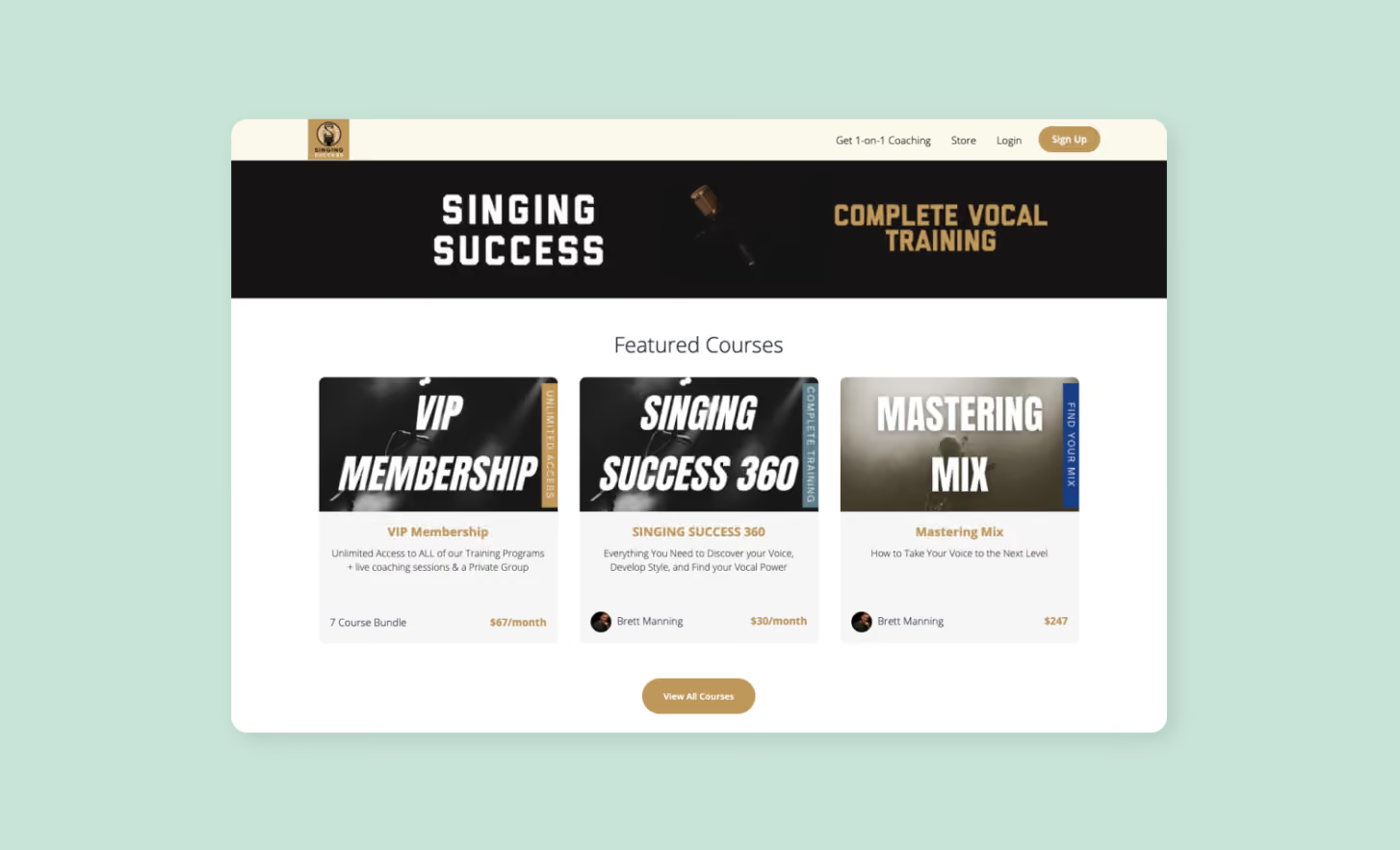
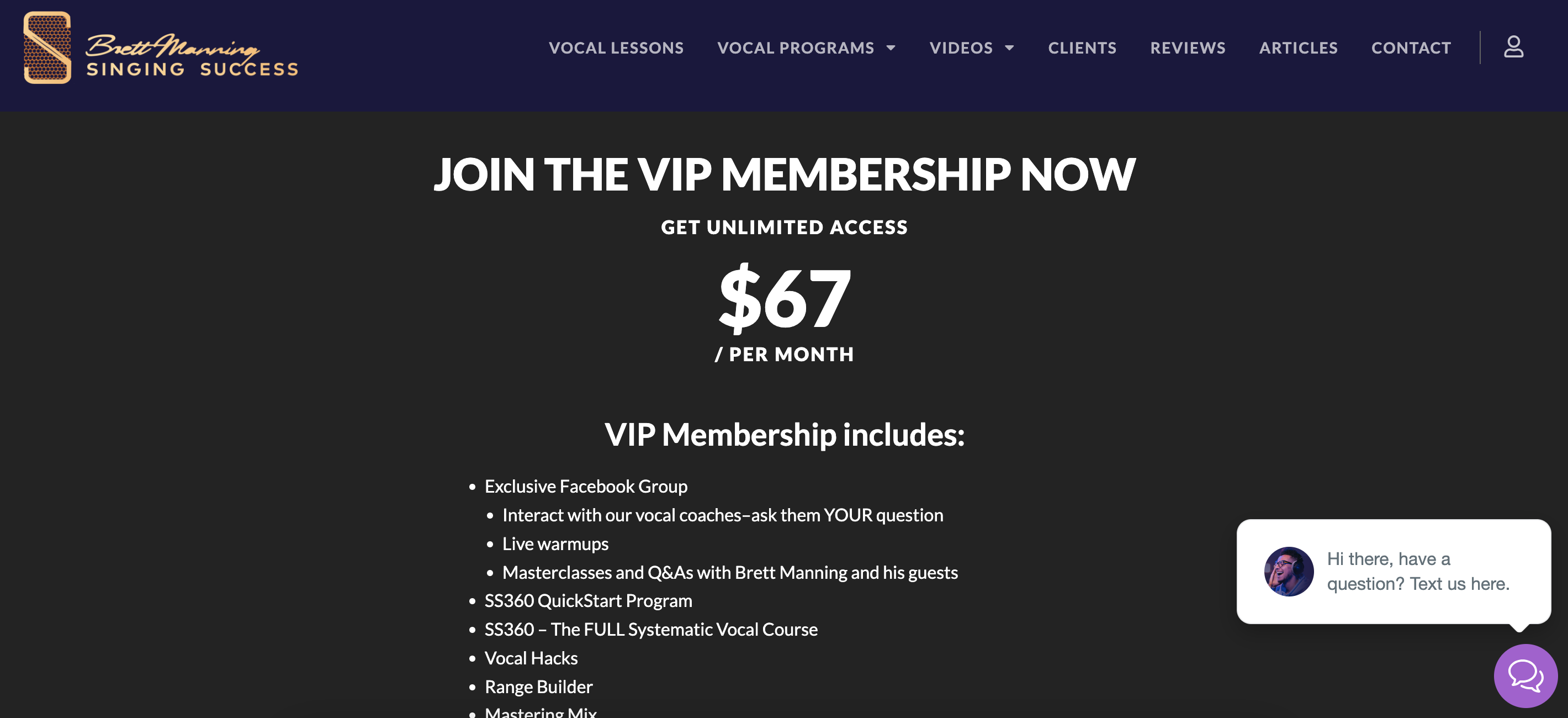
Vocal training (with lots of tiers)
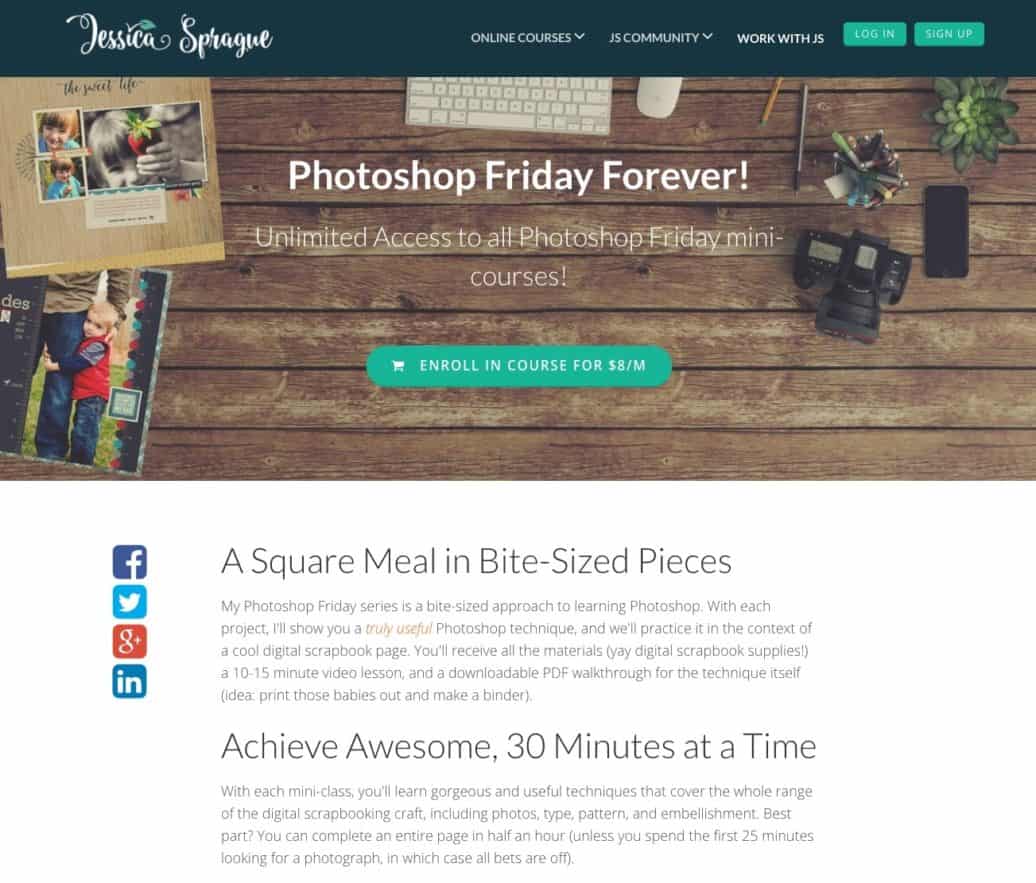
Weekly Photoshop tutorials for just $8/month
My business is The Virtual Savvy, and I help aspiring virtual assistants launch and grow their business from scratch. In the fall of 2016, I made $40K with my first course launch through Teachable. That $40,000 course launch through Teachable was when I first sold my signature Virtual Assistant Training program. I now open that class for enrollment twice a year and consistently make six figures from each launch. (It’s a one-time payment model.)
In 2017, I decided to add a monthly membership site to The Virtual Savvy’s line of products. The biggest reason why I decided to create a membership site? I saw a real need in my community. (Hint: Listen to your audience!) Virtual Assistants wanted to grow their tech skills, but most YouTube videos are outdated, and it is difficult to piece together random information from all over the internet when it comes to tech. My current students also wanted one place they could go to learn the ins and outs of the assorted technology found in the online world.
I brainstormed how I could solve this problem for my students and give them a valuable course they could use and learn from. Thus, the SavvyVault was born.
Here’s how the membership site works for us. Savvy Tech is a $47 monthly membership model with 40 tech trainings and counting. We add at least one new tech training every month.
Students are billed every month to have access to all of the courses. They can also cancel anytime. Because we are delivering new and valuable content every month, most of our students are staying for six months or more. That’s an average of $282 profit for each student.
There are an unlimited amount of new tech tools we could teach on, so it’s easy to decide what courses we should create. Here’s a sample of some of the courses included in our membership site so far:
The three secret weapons that have contributed the most to the membership site’s prolonged success are:
When it comes to membership sites, I’ve heard people say, “Students come for the content, and stay for the community.” While I personally believe that you should add some piece of new content to a membership site every month, what’s even more important is the community you are building around that site.
Our SavvyVault community is a private Facebook group for current, paid members only. We have a ton of organic engagement as people work through various tech and business challenges together.
We also provide weekly Facebook Live streams. The first monthly Live is when we launch that month’s new courses that will be added into the SavvyVault. Other Live streams include Q&A sessions where we answer various questions that students have about using tech in their business, and expert interviews where we bring in other course contributors and industry experts to chat live with the community.
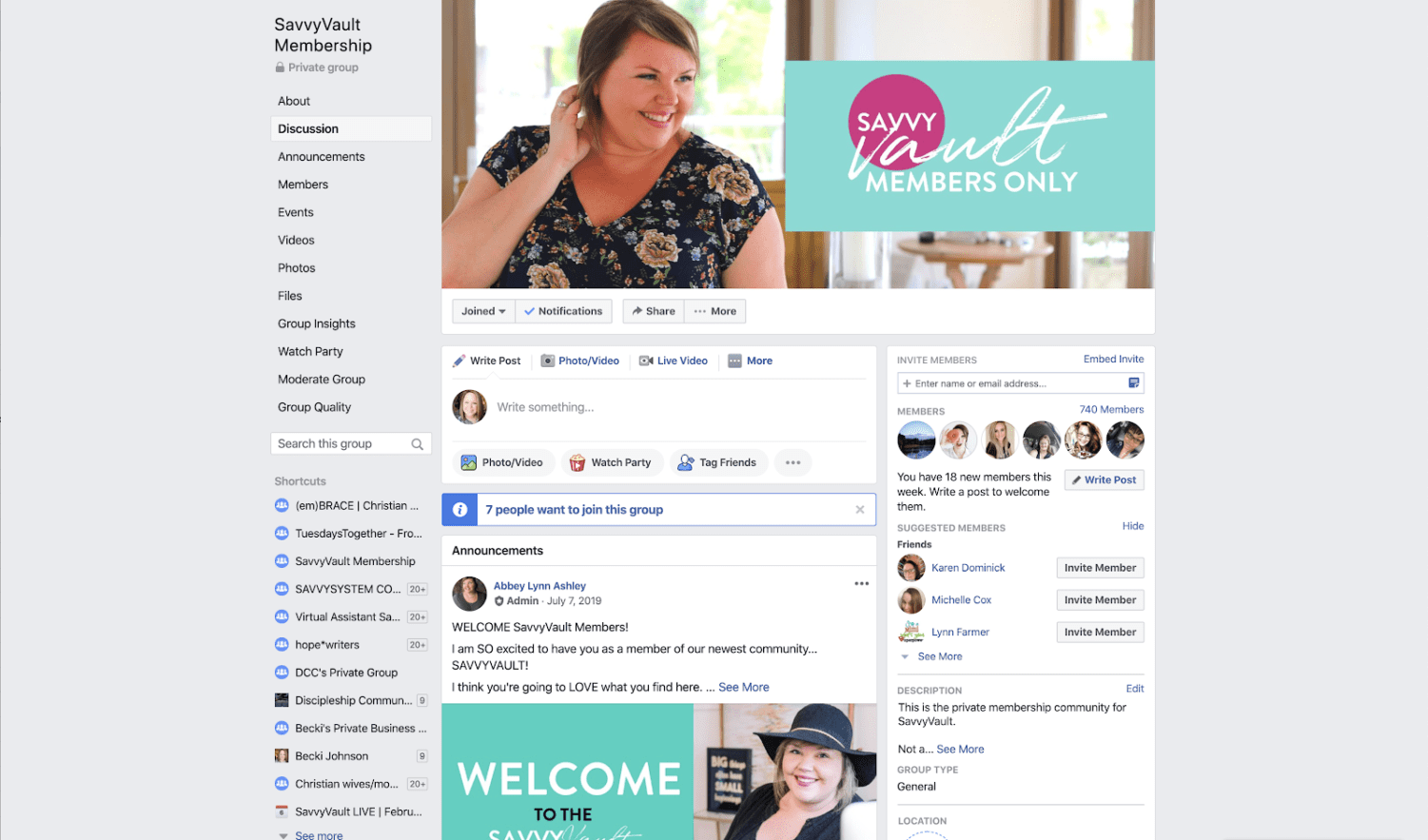
Now, it may stress you out to think you have to create new content every month for your community. But here is the real power of a membership site: You don’t have to do all of the work.
One of the best ways you can add value to your community is to have guest experts come in, which is exactly what we did for our membership site. We still create our own content every few months, but oftentimes we have others come in to teach.
Specifically, we partner with tech companies to provide trainings for us. For example: Infusionsoft, Ontraport, and Tailwind all agreed to give us their training videos for our students to access through our site. After all, it helps get the word out about their software company, and our virtual assistants get trained on how to use it.
For several of our courses, we receive private training videos directly from the company. Additionally, they often enable us to interview an expert one-on-one to receive insider info and tips on best practices for their tech. Our membership community is able to attend the interviews live through our private Facebook community in order to ask questions of their own.
These partnerships are invaluable and contribute to the success of our course. For example, Infusionsoft gave us sandbox access to their software. We also have a tutorial of Teachable.
For the sake of transparency, the SavvyVault wasn’t the first course I ever tried to launch. I created other courses in the past, but they were on self-hosted platforms. I spent so much time with just the tech of everything. I was frustrated, and the tech of the course consumed a ton of my time.
When the SavvyVault started coming together, using Teachable as the host for the course was 100% a no-brainer for me. If my students need me to teach them something, it’s so easy to drag and drop a lesson into the course. I can manage my students, see the dashboard on my sales, and everything is so simple.
Teachable simplified the tech part of the course so much that I’ve been able to focus on marketing and providing the best value possible to my audience in order to grow sales.
With the combination of my two courses, my monthly revenue is currently $80,000-$100,000. I attribute this financial success of my business mainly to Teachable’s awesome course creation platform! I truly believe I would not be as successful in my course without it.
This is a critical step, so please do not skip it. If you haven’t started building an email list, start now. Today. Reach out to your friends and family members and ask if you can add them to your business email list. Start producing content on your blog, and use your social media channels to your advantage. Refer your followers back to your opt-in through your profile and posts in order to collect email addresses and build your audience.
This step has to be done after you have an audience. (I’d recommend launching your membership site to no less than 1,000 people.) Engage with your audience through email and social media. Listen to your audience’s pain points. Ask them what they would like to learn from you when it comes to a membership site.
Once you have several ideas in your pocket, brainstorm which topic would most help your audience that you also enjoy teaching on. Narrow it down (but don’t get too specific!), and keep asking questions throughout the whole process.
Once you have your topic and are very clear on 1) who you are serving, and 2) what you’re bringing to the topic conversation, start brainstorming a list of courses and features to be added monthly. I recommend a list of no less than 25 viable topics (at least two years’ worth) to start.
We use ClickUp to plan out our course content:
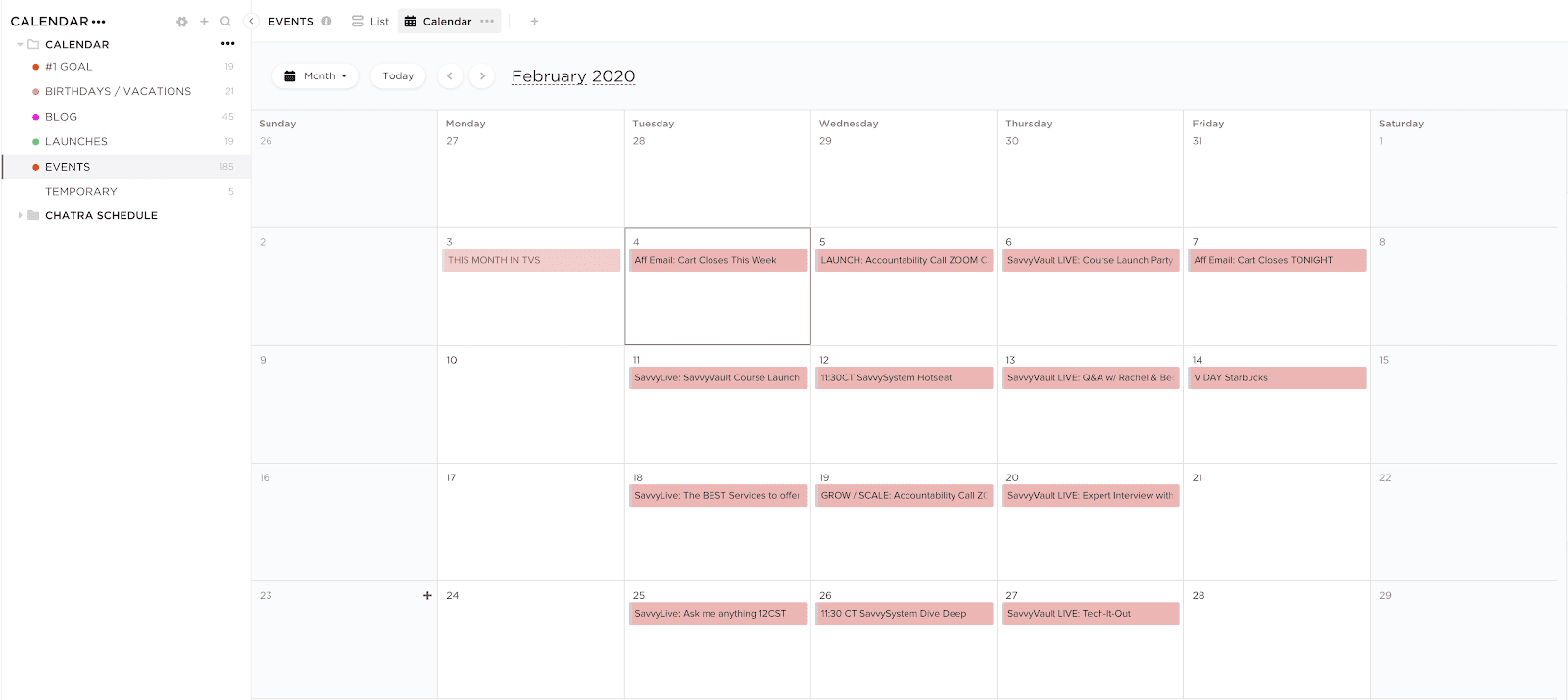
Again, this is a great way to involve your audience. What do they want to learn about?
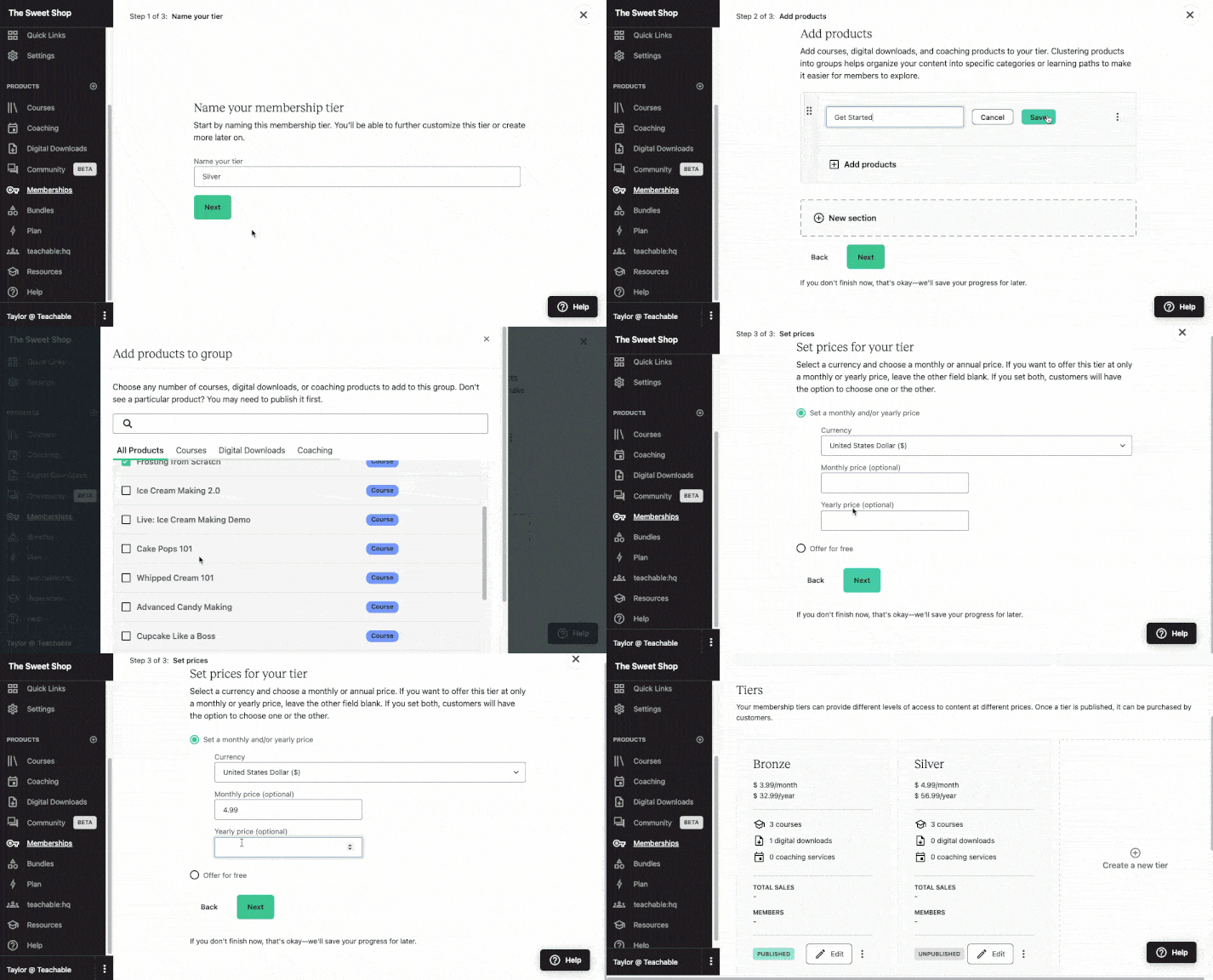
If you’re on a paid plan at Teachable, you can take advantage of the Membership product immediately in just a few steps. We’ll walk you through it below.
To create a membership tier:
You can add additional tiers to your membership to offer additional levels of access to products and services by navigating to the Membership page and clicking Create a new tier. Available to those on the Pro plan and up.
Pro tip: It’s always nice to have a welcome video in the parent course along with helpful information for the course, especially if it won’t contain other information. Some useful info for students might include how to change your payment method or manage your subscription.
Just like my JNCO jeans, blue (green?) hair, and the popular days of boy bands are gone as fast as they started, some business bandwagons aren’t worth jumping onto. It can be tough to gauge whether a new social media platform or marketing funnel model will really work for a business long-term, or whether it’s just another passing fad that will suck time and money away from the focused goal of your business.
However, I truly don’t believe this is the case with membership sites. While membership sites are trending, they’re also here to stay. They are worthy of consideration for most online businesses. The membership site model is mutually beneficial for both the students and the teacher-creator, and I am a big advocate here.
The following is a Q&A of Teachable creator Terry Rice of Terry Rice Coaching and Consulting hosted by Brittany Barnhart of Powerhouse Brand Studio.Terry Rice is a Business Development Consultant and Staff Writer at Entrepreneur magazine. He’s also the host of Launch Your Business, a podcast that helps entrepreneurs start their business, save time, and avoid burnout. After leaving the corporate world – which included roles at Adobe and Facebook – he started his own business in order to spend more time with his family. Unfortunately, he quickly realized there’s a big difference between being good at your job and being good at running a business. Frustrated and confused he spent the next 18 months discovering the actions, tools and mindset needed to succeed as a solopreneur. He now shares that guidance with other emerging business owners so they can scale their business without sacrificing their health or personal life.
Terry is also an instructor at New York University, speaks at business development events on behalf of Amazon and Google, and has been featured as a subject matter expert by Good Morning America and the Wall Street Journal. Based in Brooklyn, he is a husband and father of four children. Listen to the conversation between Terry and Brittany that’s part of our Creator Month to learn more about how you can find your zone of genius and use it to launch your business successfully.
{{profitable-component="/blog-shortcodes/blog-popup"}}
Brittany Barnhart: Hi, I’m Brittany, of Powerhouse Brand Studio and I help entrepreneurs build brands that attract and convert their audiences. Terry, what do you do?
Terry Rice: Yeah, my name is Terry Rice, and I’m a business development consultant. And that normally involves helping solopreneurs build their brand and revenue. I’m also a staff writer at Entrepreneur Magazine, and the host of the podcast, launch your business.
Brittany: That’s amazing. So we know that a ton of people are starting their businesses. Right now, there’s a huge influx and people wanting to be their own bosses. So what do you feel are some common reasons that people don’t start a business? Like what are some things that are keeping them back from actually starting?
Terry: Yeah, even if you want to start a business for one reason or another, there are normally three things that hold you back, I call them the three C’s. It’s lack of clarity, lack of cash, or lack of confidence, and actually put together this model that helps you get rid of all those excuses because the way you’re going to grow your business is based on the skills you already have. So pretend you worked as a marketing manager at some company, and you’re really loved email marketing. Great, then you go sell that as a service provider, and you’re on your merry way. So it actually democratizes access to entrepreneurship for people, because you can just follow this simple model.
Brittany: Yeah, I love that. A lot of times when my clients come to me to help kind of develop those branding aspects, a lot of times, it’s a lot of lack of clarity. And so we go through this process to help them figure out: Why are you starting in the first place? And really, what’s the impact that you want to have to help them figure out those actions? So on your end of things, what do you think are some initial steps that business owners should take, as are first starting out?
Terry: You want to start by doing some deep internal work, because the major problem I see with people who are looking to start a business is they seek external validation. And they’ll read all these blogs, or watch all these videos like “Here’s 55 ways to start a business, here’s 17 ways to start a business.” That’s confusing, it’s not helpful.
So what I would say is, first of all, get very clear on your zone of genius, and your zone of genius. I’m borrowing this from the book, The Big Leap by Gay Hendricks. What you want to do is think to yourself is, “Okay, what are all the tasks I’ve done at various jobs over my career, what it was actually good at and enjoyed?” There you go, that was one of genius. Like I said before, maybe it’s email marketing. And then once you identify that, and of course, that walks through it, once you identify that there are several ways you can monetize your knowledge. And I’ll walk through this acronym as well as ACTION. The first is audits. So but then again, you’re really good at email marketing, you can offer audits to other companies to help them identify areas of optimization, and maybe we’re this messing up, right, so you’re doing these audits. The next thing is consulting. So, you’re going to consult companies on how to get better at email marketing, based on their industry and your expertise. The next step is training. Maybe after you’re consulting them, they’re like, “Look, you guys actually need training, like I’m telling you how to do this stuff, but you don’t have the skills to do it. So I will teach you and your team how to implement these various tactics that are recommended.” And after that, the “I” stands for implementation, right? So they have the consulting, they have the training, they don’t know how to actually implement the tools, right, they’re using a different tool for this use different tool for that, whatever it is, you’re going to help them do. So based on your knowledge. We’re still going here, the next letter is “O” and it stands for ongoing retainers. And I love getting these because you get paid on a regular basis to offer your zone of genius, your skill set, but you don’t have necessarily projects due every week or every month, you’re just there to answer questions as they come up. And the last, the end stands for new opportunities. What is that? I don’t know what’s new, you come up with it based on their area of need, and what you excel it. So maybe pretend it’s they have this agency and you’re teaching them how to do email marketing, you can say, “Hey, you know what, also work with your clients to help them better understand email marketing, therefore, you’re both integrated on your understanding of how this works. And you can move forward better.” So A C T I O N, pick one, pick them all, pick something, but all you have to do is identify your zone of genius. And which one of those lanes you want to swim in?
Brittany: Yeah, I absolutely love that model. Because it really just helps people at like, even just different phases of their business. So if you’re just starting out, you can easily follow that plan exactly. Or down the road. If you need to audit, like things aren’t working, or I’m pivoting to a new audience. That’s such an easy model to actually follow. So with that in mind, how do we get clients? How do we actually start getting clients in the door?
Terry: Here’s the thing. I mean, I think people initially think they have to do cold emails or cold sales calls or post all day on social media or DM people, begging them to give them the time of the day. But I’ve interviewed thousands of entrepreneurs and helped many more actually grow their business. The number one way that you’re going to get clients initially is through your network. That’s how you get clients. So right now you either know someone or know someone who knows your first client. So, therefore, once you get clear on what you do, I help e-commerce companies leverage email marketing so they can grow their list and make more money. That’s all you have to say. And then reach out and say, “Hey, Omar, do you know someone who needs my help?” So please start there. Think of ex co-workers, friends, family colleagues, or maybe you’re a member of some kind of community, reach out to those people first and say, “Do you know someone who might need my help?” And then after that, yeah, sure, go on social media start posting content. But I think if I’m just starting out building my brand, the easiest thing to do is just think of 10 questions that your audience might have. In this case, it’s about email marketing, but it’s about whatever your zone of genius is, and then answer them with content. Right? So someone might say, “How often should I email people?” I don’t know. I’m not an expert. But right, the answer to that, there you go. That’s your content. So start with the audience, your network, though, because that’s where we’re gonna get your first “Yes.” And then sure, eventually go ahead and start creating content to bring in, you know, cold leads. But don’t start there. Because you’ll get frustrated very quickly. And you’re taking the worst approach to it, because it’s way too hard.
Brittany: Yeah, absolutely. I feel like in the beginning, I talked to a lot of new business owners, and we often try to prioritize those revenue-generating opportunities for them. So it’s like, where should you strategically be spending your time so that you can start making money, getting that experience, and then figuring out who you want to work with, because a lot of times, like you said, they start with trying to figure out who your ideal client is trying to just like, start completely from scratch. But if you could find opportunities within your own network, or find ways to partner with another business that’s complementary to you, that’s super beneficial for any new business owner to start gaining traction. So on your end, how do you think people can continue to learn more about their audience as they’re just getting started?
Terry: Yeah, well, I’m you’re on I know, you’re an expert here. So I’m gonna flip it on you tell me how you help your clients do your research. I’m curious.
Brittany: Yeah. So a lot of time, I’ll have them do a mix of either audience research or a little bit of social listening. And so the audience resource can take a couple of different forms. And so this can either be through a series of Instagram Stories, if they have like an engaged audience there, either through a Google Form to send to people or through like one-on-one interviews with those people that you have that established relationship with. And we usually try to identify roughly like five questions that are really beneficial to the business owner to know so that they can take better action moving forward. And so that’s usually how I guide my clients just to obtain more audience research in a branding perspective.
Terry: Yeah, so do all that stuff. This, I mean, one way that I got very clear on what my audience wanted and actually want to buy, is by doing free workshops, live webinars in-person events, because that’s how you test out your new content to make sure it’s a landing. In this case, maybe it’s the process you use to help people through email marketing, and you’ll get real feedback. So it’s the same thing comedians do like before comedian has a big Netflix special, they usually go to dive bars in like Buffalo or something, and if it doesn’t hit, it’s like, okay, by Buffalo. See you next time, right, I’m gonna go tweak that before I go to Syracuse. That’s the way you do it. And that’s really a big concern of mine. If someone has a business they want to launch, and they’ve not tested whatsoever in front of a live audience and gotten real feedback. And that’s an issue. So you’re better off offering a free workshop webinar, or whatever it is, and getting that feedback. But also, if no one signs up, good. Because if someone does not want it for free, they damn sure aren’t going to pay for it. Right. So it’s a good way to prequalify that you have a good service offering and make some tweaks there. But you’ll also get feedback from the audience to say, “Hey, you know, would you learn? Would you appreciate so and so forth? Great.” Now you have testimonials that you can put on your website, on LinkedIn, wherever you want, what you read this third-party validation to actually help other people feel more comfortable working with you.
Brittany: Yeah, absolutely. And that’s just such a great conversation starter as well. It’s just like, there are questions when people attend those free webinars that they’re going to have that you’re like, I didn’t even know that people needed to know that, you know, so it’s such a great opportunity to just not only like test out material but figure out what are the next steps that people are looking towards past that so that you can better create content and services really just help your audience. So that kind of leads me into like some blind spots. You know, a lot of my clients tend to start their businesses assuming that they have to spend all this money are going these directions that aren’t beneficial to them when they kind of just have their blinders on. So what do you think are some other blind spots that entrepreneurs kind of have as they’re first starting out?
Terry: I’ll just expose my own ignorance, it’s easier because there’s a lot of that, when I first started out, I thought I needed a bunch of fancy expensive tools, like “Oh, if I buy this, if I buy that, I’ll be great, I’ll be in a good spot.” And that’s not true whatsoever. You want to have a good understanding of what you’re doing, where you’re doing it for, and how you help them. And if there are tools around that help you amplify the impact of that great, but you don’t need to spend a lot of money or even hire a big team. I mean, look at all the low-code or no-code options available, right? If you want to have great-looking social media content, cool, go to Canva there’s a free version, and you’re gonna look like a brilliant graphic designer and email marketer. Right, you’re gonna land pretty well. But I think it’s almost like people confusing action with progress. Like, “Oh, look, I have this tool for this, this tool for that, this tool for that so and so forth.” Like, that’s not progress. That’s you confusing this action with progress. So that’s really the number one thing I see people mess up on. But I’m gonna keep on pushing it back to you. I know you’re the expert when it comes to workflow stuff. So like, help me out here, like, what, what challenges are you seeing?
Brittany: Yeah, it’s a lot of that, honestly, yesterday with the client, I was discussing her own workflows. And so we’re talking about like, strategic steps that we can take to build her business. And she kind of came back with like, “What platform should I be using on my website?” And I was like, “Well, I don’t think that’s really the question that we need to be asking right now. Like, use what you have that actually works, and then move forward with that there shouldn’t be the question of what tool will help me get there. It’s like, how can we effectively communicate what you’re doing, who you’re helping, and then what tools are necessary or helpful to actually helping you do that thing.” And so that’s usually where my clients also mess up us trying to buy more trainings when maybe they don’t actually need it, or just investing in all these tools that aren’t really necessary, because they don’t really know how to use them yet. So, from your perspective, what else can people do to get started? Because building a business is hard. So what do you recommend to people?
Terry: I mean, the first thing is look for the free resources available. So go to my website, just also go on YouTube, how to start a business like this, look for all the free stuff before we invest in coaching consultants, any of that stuff. Because if you do that, you’ll be able to have a more informed conversation or more informed decision if you do want to buy something. But you can get started with zero dollars. Right? Just go back to what I said, What’s your zone of genius? Who do you want to help? Who can help you spread the word, and then from there, you’ll get some initial input, but don’t spend a lot of time on it. Sorry, don’t spend a lot of money on it, spend a lot of time thinking about your next steps. So that’s the biggest piece of advice I can give. The second one is find someone to hold you accountable. Someone within your community, your network, whatever it is, someone that’s going to encourage you not just tell you why you shouldn’t do it, right? Because there’s gonna be a lot of naysayers. That’s part of it. But that’s why you want to surround yourself with people who accept you for who you are, but also encourage you to keep on ascending and become the best version of yourself. So that’s what I would do.
Brittany: Yeah, having that crew of people or just even just one person can be so beneficial and really helping make progress in your business because being an entrepreneur is lonely, like we’re all solopreneurs just behind a computer, you know, so I feel like having that one person to hold you accountable and just be almost be that support system and help push you farther. It’s just so beneficial. But Terry, where else can people find you?
Terry: Yeah, my website is TerryRice.co not .com, some photographer in Indiana has that, so if you want photos go to.com. If you want me go to .co and also on social media. It’s at its @itsterryrice.
Brittany: Amazing and if anybody wants to find out where I’m at on Instagram, you can find me at powerhouse brand studio, and my website is powerhousebrandstudio.com
Awesome. Thanks. This is great. I appreciate it. Yeah, of course.