Thank you! Your submission has been received!
Oops! Something went wrong while submitting the form.
MENU
In-depth looks at the creators, schools, and organizations turning their expertise into thriving businesses.

Sabrin Hietanen was broke in Japan when she bought a secondhand laptop with a Japanese keyboard from a thrift shop.
She had no students, no teaching experience, and no clear path forward. All she knew was that she needed a job she could do while traveling the world.
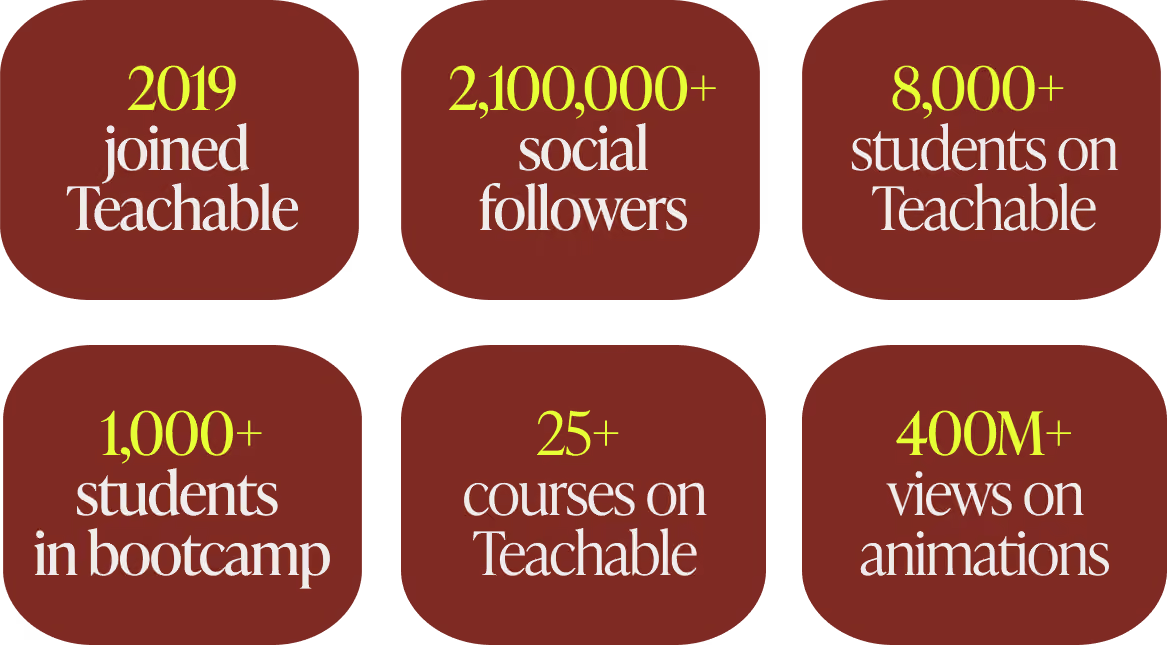
Six years later, she's taught over 8,000 one-on-one Finnish lessons, built a following of 32,000+ on Instagram, and created multiple courses that reach students while she backpacks through Croatia or cat-sits in Helsinki.
The secret wasn't just teaching Finnish. Sabrin noticed a problem nobody else was solving: students could study the language for a decade and still struggle to have a basic conversation with native speakers. Finnish textbooks teach written Finnish, but Finns don't actually speak that way. The gap between classroom Finnish and real Finnish was leaving learners stranded.
Sabrin built her business by filling that gap, teaching the spoken Finnish that textbooks ignore.
I had some students who had been learning Finnish for like 10 years and they still could not understand anything I was saying. I knew this needed to change." --Sabrin Hietanen, Sabrin The Finnish Teacher

Before becoming a Finnish teacher, Sabrin had held more than 20 different jobs. Taxi driver. Soccer coach. Housekeeper. Nanny. Each position was just something to fund her next trip, another temporary stop in a life built around travel.
"I've done so many jobs because I was traveling so much. Everywhere I went, I needed a new job. And then that's actually how I started teaching Finnish, because I was traveling and I needed an online job." -Sabrin Hietanen, Sabrin The Finnish Teacher
Her ex-boyfriend, a Japanese teacher, mentioned a platform called italki where anyone could sign up to teach languages. Sabrin was skeptical but desperate. With almost no money and a keyboard she couldn't read, she signed up at $6 per hour just to get some students.
The first few lessons were terrifying. Sabrin had no curriculum, no structure, and no idea where to begin with students. A breakthrough came when one student showed up with a textbook and asked her to teach from it. That student saved her from paralysis. Suddenly she had a framework.
But teaching from that textbook revealed something troubling. Students who had studied Finnish for years couldn't understand her when she spoke normally. The written Finnish they'd learned was essentially a different language from what Finns actually use in conversation.
"These poor students are wasting their time learning a Finnish in a way that nobody speaks." -Sabrin Hietanen, Sabrin The Finnish Teacher
By 2022, Sabrin's calendar was fully booked. Every slot she opened filled immediately. The success created a new problem: she was burning out from back-to-back lessons and couldn't scale beyond the hours in her day.
"Relying on 1:1 lessons was so stressful that I felt like every minute that I have is spent on these students. And I really didn't want to say no. But I also didn't want to get burnt out. So I thought, 'what can I do so these people can still keep learning with me while I still have my sanity?'" -Sabrin Hietanen, Sabrin The Finnish Teacher
The idea of creating courses had been floating around, but the catalyst came from an unexpected place. A company that helps creators build courses booked a fake lesson with Sabrin to pitch their services. They'd handle marketing, they said, in exchange for 50% of her revenue. And she'd need to post four times a day on Instagram.
"If I have to do all the work anyway, why would I give you 50%?" -Sabrin Hietanen, Sabrin The Finnish Teacher
That conversation was the push Sabrin needed. The same day she rejected the offer, she filmed her first Instagram reel and started building her audience. Teachable gave her a way to host her courses without surrendering half her income or spending hours a day on marketing someone else required.
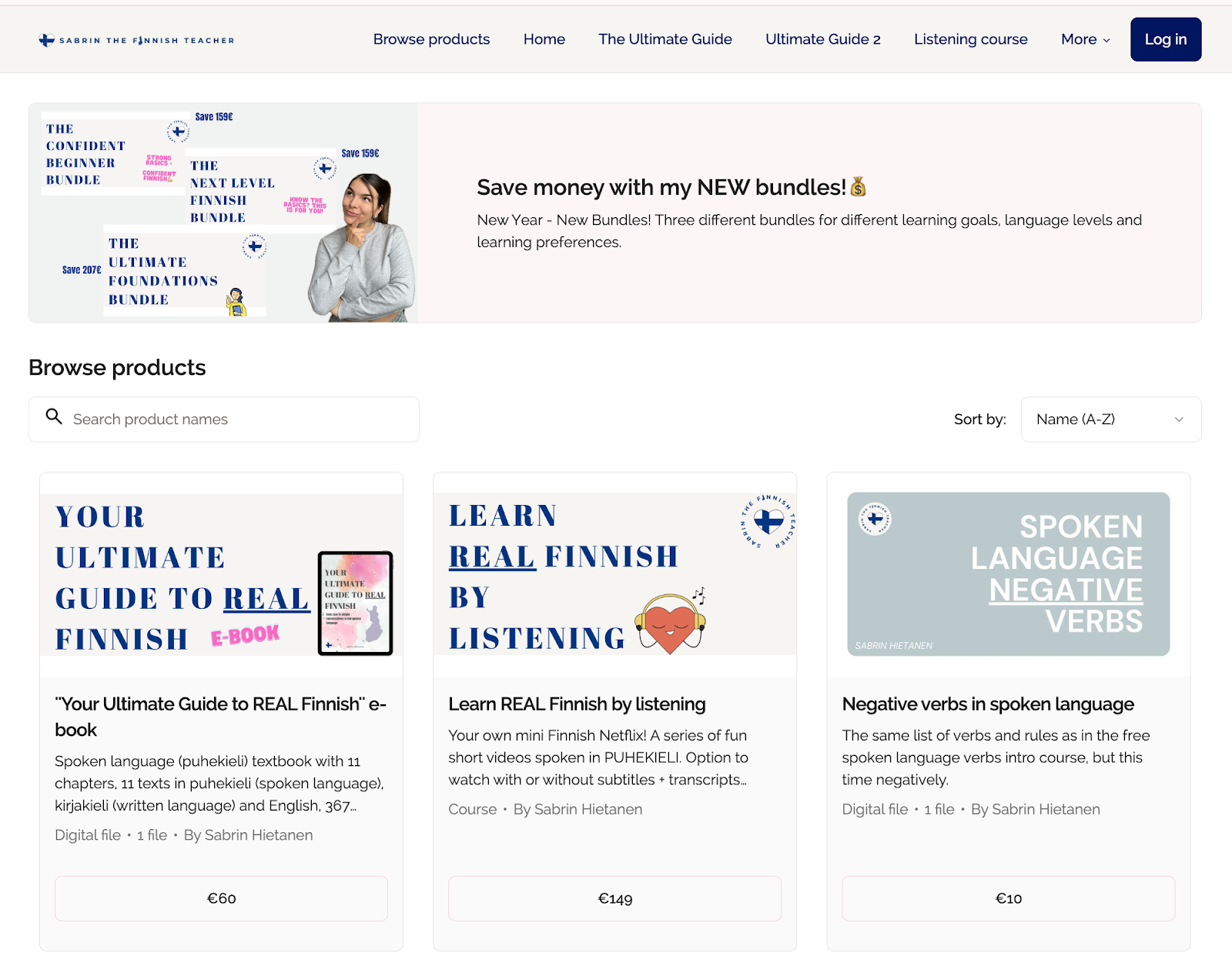
Sabrin spent a year and a half writing her spoken Finnish textbook before filming any courses. The content came directly from thousands of hours teaching one-on-one students and observing where they got stuck.
"I really wanted to be different... I really wanted to publish a book, not just some quick PDF material." -Sabrin Hietanen, Sabrin The Finnish Teacher
That book became the foundation for her courses. The first course covers the first six chapters (15 hours of content for total beginners), and the second covers the remaining five chapters for students who know the basics. Students who purchase the courses get the book as course material.
Take action: Before creating a course, spend time documenting the patterns you see in one-on-one work. Your best course material comes from real student struggles, not what you think they should learn.
Many course creators want to eliminate one-on-one work entirely. Sabrin chose a different approach. She reduced her lesson load from 150-200 lessons per month at peak to around 60-80 now, keeping individual teaching as part of her income mix.
Take action: Consider keeping a reduced schedule of direct student interaction. Live teaching provides a feedback loop that makes your courses better and breaks up isolated course creation work.
Sabrin kept her Instagram account private for the first three months because she was embarrassed. When she finally went public, she committed to posting every single day. That sprint from 100 to 10,000 followers took roughly six weeks.
"I knew that I need to do focus on social media content at some point be making sales. This is the way for me to find my customers, so I have to do this. I didn't even think about it." -Sabrin Hietanen, Sabrin The Finnish Teacher
The daily posting pace was unsustainable. After two months she scaled back to two or three posts per week. But the initial intensity established her presence and built momentum she could maintain with less effort.
Take action: When launching on social media, consider an intense sprint to establish presence, then settle into a sustainable rhythm. Building audience before you have products to sell removes the pressure of immediate conversion.
Sabrin started at $6 per hour to get her first students. As demand grew, she used price increases strategically to control her workload and reclaim time for course creation.
"Whenever I felt like I was getting too many students, I just raised my prices. So then I always lost some, but then I was happy with more time." -Sabrin Hietanen, Sabrin The Finnish Teacher
Take action: If you're overwhelmed with demand, raise prices before burning out. Losing some customers to gain time for product development is often the right trade.
Finnish presents a unique challenge that most language learners don't expect. The written form taught in textbooks differs dramatically from the spoken language used in daily conversation. Students can master grammar rules and vocabulary but still struggle to understand native speakers.
"In Finnish there's a really big difference between written Finnish, which is the official Finnish, but nobody actually speaks that way, and then the spoken Finnish, how people actually speak... most students don't know any of the spoken Finnish. So they cannot actually speak with Finns at all because they don't understand us at all." -Sabrin Hietanen, Sabrin The Finnish Teacher
Sabrin's approach addresses this gap directly. Rather than teaching textbook rules and then noting the real-world exceptions, she teaches spoken Finnish alongside the formal grammar so students can actually use what they learn.
Her third course, "Learn Real Finnish by Listening," extends this philosophy by focusing on audio comprehension. Students hear natural speech patterns rather than the artificially slow pronunciation common in traditional courses.
Sabrin's immediate focus is refining her marketing approach. After initially hitting her goal of three course sales per month with minimal promotion, she recognized that passive income requires active work.
The travel lifestyle continues. During her interview, Sabrin was cat-sitting for a student in Helsinki while planning a backpacking trip through the Balkans with a friend. Her apartment in northern Finland sits on Airbnb when she's away. Teaching Finnish online means she can work from anywhere with wifi.
Explore Sabrin’s courses: Visit Sabrin’s website and Teachable school to explore her courses. Want to learn Finnish? Check out Sabrin’s Ultimate Guide, Ultimate Guide 2, and Listening course.
Connect with Sabrin: Instagram | TikTok | italki
Try Teachable today: Begin turning your expertise into a profitable online education business with Teachable. Start your free Teachable trial and launch your first course in minutes.
Erin Booth has been teaching virtual assistants how to build profitable businesses since before most people knew what a VA was.
She launched her own VA business in 2012, back when there were no standards, no established training programs, no roadmaps.
Erin figured it out through trial and error, building her business entirely through LinkedIn connections without even having a website for the first six years.
By 2018, aspiring VAs kept asking her the same questions:
Erin started making YouTube videos to answer them. The response was overwhelming.
Today, Erin runs a multi-program education business on Teachable with courses ranging from her free VA Launchpad to her premium VA Business Blueprint and Skills programs.
Her students log in almost daily, post wins in her community, and keep asking about her next programs before she has finished building them.
"You should never have anyone dictating the prices you charge for your content. With Teachable, you get full control. You can talk to your students, match their learning styles, and build real relationships instead of going through third parties." –Erin Booth, Virtual Assistant Coach
Erin's path to course creation started with exhaustion.
After six years working grueling schedules in the New Orleans film industry, she was burned out. The creativity and problem-solving were rewarding, but the demanding hours were unsustainable. She thought her answer was an in-person concierge business for busy film professionals who did not have time to run errands.
The market research looked promising. Everyone said yes, they would use this service. When launch day came? Almost no one actually wanted to pay.
Then a producer she had been helping said something that changed everything: "You would make so much more money if you did this virtually."
That was the light bulb moment. Virtual work meant no cap on hours, no geographic restrictions, and the ability to scale beyond what one person could physically accomplish in a day.
For years, Erin built her VA business quietly through LinkedIn. When she started getting constant questions from aspiring VAs in 2018, she launched YouTube videos to answer them. The teaching side took off.
"I do not like to gatekeep any information. I do not believe that you should only have helpful information if you pay for my courses. The info on YouTube has really grown into its own. And then my flagship program is for the people who want to learn how to run their businesses in order from start to finish." –Erin Booth, Virtual Assistant Coach
Erin initially explored platforms like Udemy. The reach was appealing, but the tradeoffs were not. Limited control over pricing. No direct student relationships. Revenue sharing that cut into her earnings. The platform stood between her and the people she was trying to help.
Once Erin started researching, the decision was obvious. Teachable offered:

Erin spent years building trust on YouTube and LinkedIn before launching premium programs. Her free content establishes credibility with people who may not be ready to commit financially. Some cannot afford a full program. Others are not ready. Either way, she wants them starting their businesses with correct information.
This approach creates a natural funnel. Students who have spent months learning from Erin's free videos already trust her teaching style. When they are ready to go deeper, the paid courses are not a hard sell. They are the logical next step.
Take action: Calculate how much free value you genuinely provide to potential students. If your free content is not good enough to build real trust, your paid courses will always feel like a harder sell than they need to be.
Most course creators launch a product and hope students complete it. Erin takes a different approach. She monitors her student progress dashboards regularly, watching for engagement patterns that signal someone might be falling behind.
When a student has not logged in for seven to ten days, they get a personalized check-in. When students hit major milestones, they get celebration emails. The result: students who log in "almost daily" and actively post wins in her community.
"Most importantly, people are launching their businesses and they are landing clients." –Erin Booth, Virtual Assistant Coach
Take action: Set a recurring calendar reminder to check your student progress dashboard weekly. Create an email template for re-engagement that feels personal, not automated.
Instead of selling courses as one-time transactions, Erin gives students lifetime access. When she updates content, and she does regularly, students automatically get the new material. Her 2025 VA Business Blueprint relaunch gave existing students access to completely refreshed content at no extra cost.
This model builds fierce loyalty. Students who took her course years ago on other platforms do not have access to her latest updates. Teachable students get the benefit of her evolving expertise forever, especially critical as AI transforms the VA industry.
Take action: Schedule a content audit every six to twelve months. Ask your students what is working, what is outdated, and what they wish you had covered. Use their feedback to guide your updates.
Erin does not have one course. She has built a full curriculum ecosystem where students can grow with her business rather than completing one program and leaving.
Her program ladder includes the VA Launchpad ($9.99) for getting started, the VA Business Blueprint ($297) for complete business foundation, Premium VA Skills ($397) for advanced hard and soft skills training, and a bundle option ($544) for students who want everything. Students who complete her foundation program are already asking about the additional programs she is developing.
Take action: Map out your "what's next" for students who complete your core program. Even if you have not built it yet, knowing what is coming next helps you plant seeds throughout your current content.
Unlike many coaches who leave their original profession behind, Erin maintains two active VA clients. This keeps her grounded in the reality her students face, especially as AI transforms the industry.
"I maintain two VA clients to stay updated on industry changes." –Erin Booth, Virtual Assistant Coach
Her students are not learning from someone who used to be a VA five years ago. They are learning from someone billing clients right now, navigating the same challenges they will face, and integrating AI as a tool rather than viewing it as a threat.
Take action: Do not completely abandon your practitioner work as you build your education business. The credibility and current knowledge are invaluable teaching assets.
Erin's teaching philosophy centers on something she calls "foundation first." Before students worry about advanced skills or the latest AI tools, they need rock-solid systems, boundaries, and confidence.
Since 2012, she has been helping people swap "Someday I will start" for "Wow, this is my business." Her students are not just learning how to be VAs. They are learning how to escape jobs they hate, work from anywhere, choose their own clients, and build businesses that do not require physical offices or grueling schedules.
The ripple effect extends beyond individual students. Erin is helping professionalize the virtual assistant industry itself. By creating standardized training in a field that had none, she is setting benchmarks for what excellent VA work looks like. Her students work with clients across coaching, e-commerce, real estate, healthcare, and dozens of other industries.
Erin is simultaneously developing new programs while students are "already asking about those next programs." Building for confirmed demand rather than guessing what might work.
Her vision: creating the definitive VA training institution. Students start with foundational skills, build their business infrastructure, level up with premium skills, specialize in high-demand niches, and stay current through ongoing access to updated content.
As Erin scales, Teachable's infrastructure becomes even more critical. The platform handles payments, taxes, and enrollments across international students, logistics that would be what she calls "a nightmare" otherwise. She can focus on teaching and curriculum development while Teachable manages the operational complexity of a growing education business.
"It automatically takes care of payments, taxes, and enrollments, freeing me from administrative tasks so I can fully focus on the creative side of my job." –Erin Booth, Virtual Assistant Coach
Explore Erin's programs: Visit Erin’s website or Teachable school to see how Erin structures her VA training. Start with the VA Launchpad for basics, dive deeper with the VA Business Blueprint, or master advanced skills with Premium VA Skills.
Connect with Erin: YouTube | LinkedIn | Udemy
Try Teachable yourself: Ready to build your own education business with the same control, community features, and growth tools Erin uses? Start your free Teachable trial and launch your first course in minutes.
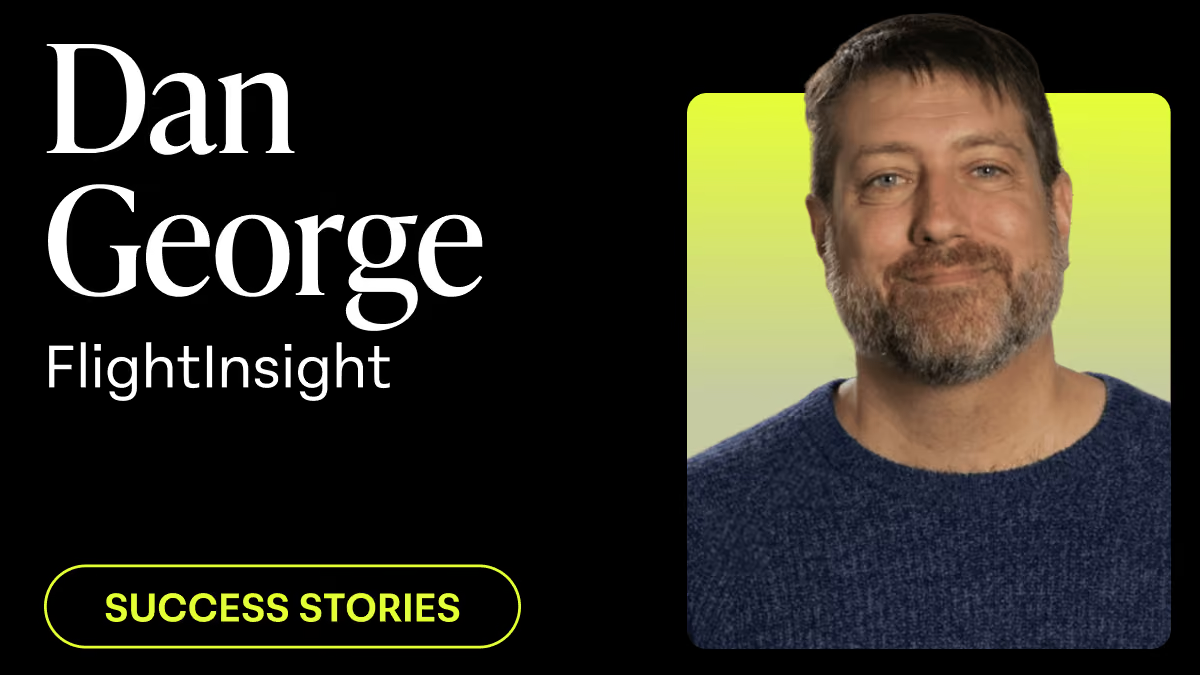
Dan George was a professional pilot and flight instructor who hit a wall.
He taught ground school theory to aspiring aviators one-on-one and in small classroom settings.
His work covered regulations, weather theory, aircraft systems, and more. Everything pilots need on the ground to be able to fly planes safely.
There was just one problem. The aviation industry was starved for more quality training, but Dan could only reach local students who showed up in person.
At any given time, he had maybe a few dozen students. Dan needed a more scalable model to be able to reach and impact the aviation industry with his expertise.
That's not a business model you can use to serve an entire industry.
Related: How to make money selling courses right now

Dan created his first course on Teachable in 2019, but he didn't push it seriously for almost two years. It existed more as a side project than a real business.
The pandemic changed everything. With commercial flying disrupted and more time on his hands, Dan decided to get serious about online education in 2021.
"You could almost argue that that's when the business started was 2021, even though the relationship with Teachable has gone back to 2019." -Dan George, Founder and CEO at FlightInsight
Dan chose Teachable because he needed something simple that would let him focus on teaching rather than technology. He'd seen other successful creators on the platform and noticed they all followed a similar playbook: build your audience first, then convert that trust into course sales.
"The first thing that I learned about Teachable creators who have had success is that we all kind of have the same model. You build up your following and then you leverage that to start bringing people into a course." -Dan George, Founder and CEO at FlightInsight
Dan didn't reinvent online education. He just did the fundamentals really well. His approach was methodical: Build trust first, deliver real value, and never stop showing up.
While other creators chased quick wins, Dan played the long game. Here's how he turned consistent effort into a business that serves thousands of pilots worldwide.
Dan spent six months in 2021 creating valuable YouTube content without promoting his courses at all. He established a rigid publishing schedule that he's maintained for four straight years.
Twice a week, every Tuesday and Friday, without fail.
"It's been the same cadence for four years now. Twice a week, Tuesdays and Fridays." -Dan George, Founder and CEO at FlightInsight
His content strategy was simple: teach what pilots actually need to know. He covered instrument approaches, aircraft setup procedures, and regulatory updates. Real instructional content that people were already searching for.
The secret was consistency over mass appeal. Dan didn't try to go viral or chase trending topics. He focused on being genuinely useful to his specific audience before asking them to buy anything.
"It was just a matter of just doing it, right? Just commit to two videos a week, make it very formulaic, get good at what you do and sort of stay in that box." -Dan George, Founder and CEO at FlightInsight
Take action: Pick a content schedule you can maintain for years, not months. Dan's success came from showing up consistently with valuable content before asking for anything in return.
Dan had a big advantage: he knew exactly what pilots needed to learn because aviation training requirements are standardized by the FAA. But he put his own spin on the material to make it actually stick.
He developed two main content approaches that set him apart from existing training materials. First was what he calls "advanced whiteboard" - taking dry regulatory charts and bringing them to life with animations.
"We'll take like a figure on a publication like a chart and we'll impose it onto either another chart or onto something that's situational in an aircraft to say okay this is where this is coming from so that the user can track where a principle comes from point to point to point." -Dan George, Founder and CEO at FlightInsight
His second approach used flight simulator footage to create controlled learning environments. Instead of filming in actual aircraft with all the distractions, he could control every variable in the simulator.
"Rather than actually showing people what it looks like in an aircraft and having to film in an aircraft and deal with all the distractions that that does, we control the environment by being in the simulator. You can control the weather, you can control the position, everything about the aircraft." -Dan George, Founder and CEO at FlightInsight
Take action: If you're teaching standardized material, find ways to make it more visual and connected. Show how different concepts link together rather than teaching them in isolation.
Dan's biggest frustration with existing aviation training materials became his competitive advantage: they didn't go deep enough.
"It just didn't go in depth enough." -Dan George, Founder and CEO at FlightInsight
His paid courses go significantly deeper than his free content, providing comprehensive training that prepares students for real-world flying situations, not just passing tests.
When he launched his third course, something important happened that validated his approach: massive repeat business.
"One of the first sort of great little pieces of data that we got when we launched our third course was that we got so much repeat business. There are ways you can optimize that with lifetime value by giving people upgrade offers to get all our courses and things like that." -Dan George, Founder and CEO at FlightInsight
Students who completed one course immediately enrolled in the next level, creating a natural progression path through different aviation ratings.
Take action: Don't just create courses that check boxes. Go deeper than your competitors to create genuine expertise and transformation in your students.
Dan considered offering one-on-one coaching but made a deliberate choice to focus on self-paced courses instead.
"I've toyed with doing coaching. I just don't know that it scales like a course scales." -Dan George, Founder and CEO at FlightInsight
His courses work around the clock without him being present. Students from different time zones can learn whenever they want. Adding more students doesn't automatically mean more work for Dan.
The key is to create course content enriching and in-depth enough to empower students to learn on their own, rather than requiring back and forth with an instructor for needed information.
This decision freed him from the time-for-money trap that had limited his in-person instruction business.
Take action: If you want true scale, design your courses to work without your constant involvement. Include everything students need to succeed independently.
Dan tested paid advertising but quickly discovered it didn’t compare to the value his organic reach was providing.
"We turn on ads and they kind of run, maybe they break even, maybe they're a little bit profitable, but you realize that organic is your main bread." -Dan George, Founder and CEO at FlightInsight
This makes perfect sense for aviation. Pilots research thoroughly before investing in training. They trust instructors they've followed over time much more than random advertisements.
Dan's organic approach had an unexpected bonus: it attracted flight schools who wanted to partner with him. His social media presence became a powerful business development tool.
Take action: In specialized markets, consistent valuable content often beats paid advertising. Focus on building genuine trust and authority in your field.
Dan's transformation shows what happens when you combine deep subject matter expertise with the right online education platform and consistent execution.
Starting with just a few dozen local students, he now serves over 10,000 pilots worldwide through eight Teachable courses. His four main ground school courses cover private, instrument, commercial, and flight instructor ratings, each priced at $229 for lifetime access.
"We have eight courses. There are four what is called ground schools. So that would be private, instrument, commercial and flight instructor. Those are $229 each for lifetime access." -Dan George, Founder and CEO at FlightInsight
The smaller ancillary courses cover specific skills like radio communications, landing techniques, and advanced avionics, ranging from $129 to $197.
His growth is particularly impressive considering aviation's limited market size. With only 400,000 pilots in the United States, Dan's school now serves a significant portion of the entire industry.
Dan's systematic teaching approach helps pilots understand not just the "what" but the "why" behind aviation procedures. His visual methods make complex concepts finally click for students who struggled with traditional textbook-based instruction.
The ripple effect extends throughout the aviation industry. Better-prepared pilots mean safer flights, more efficient training programs, and higher success rates on official FAA examinations.
His courses particularly help international students who struggle with American aviation procedures and FAA regulations, providing clear explanations that bridge language and cultural gaps.
Dan's main focus is what he calls growing his "funnel" - continuing to build his audience and convert that trust into course enrollments.
"That's basically what my job is now is to just kind of try to make that funnel bigger." -Dan George, Founder and CEO at FlightInsight
As the aviation industry evolves, Dan sees opportunities to create courses on emerging topics while maintaining the depth and quality that built his reputation.
Check out FlightInsight's aviation ground school courses on Teachable. Dan's systematic approach is helping create safer, more competent pilots worldwide.
Try Teachable yourself: Ready to scale your expertise like Dan? Start your free Teachable trial today and join the creators who use Teachable to build successful online education businesses.
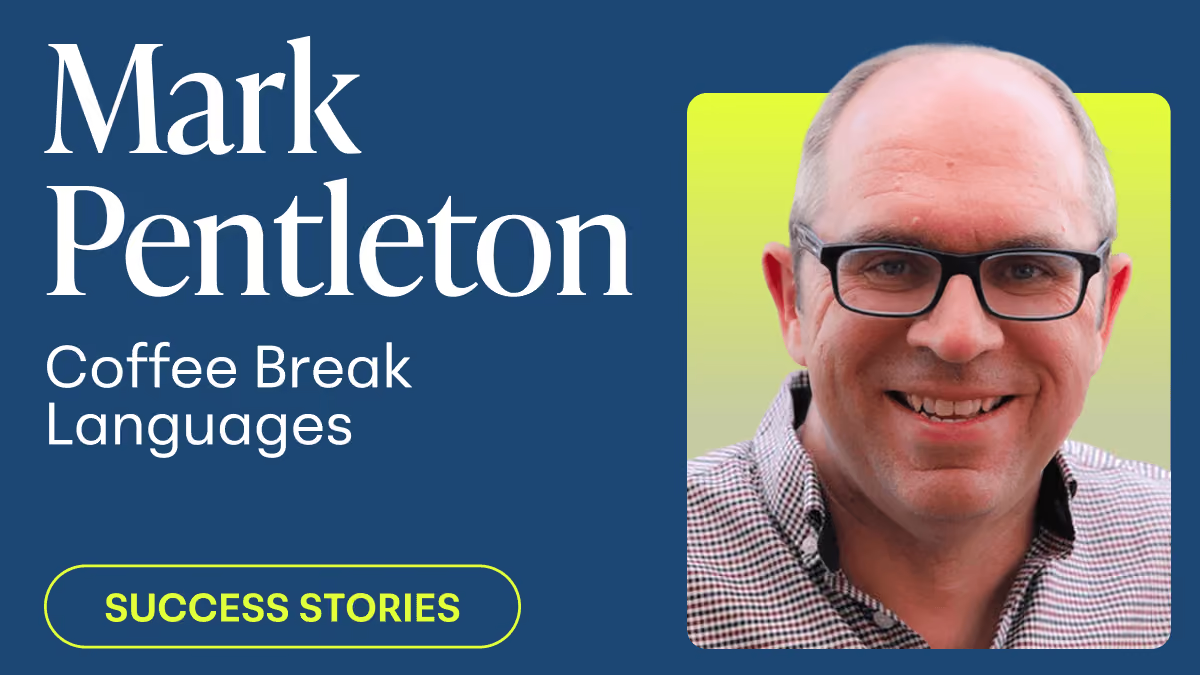
Mark Pentleton was a high school languages teacher in Scotland with a side project that wouldn't stay small.
In 2006, he launched Coffee Break Spanish from his spare bedroom. The concept was simple: teach Spanish in relaxed, 20-minute episodes that fit into a coffee break. No intimidating textbooks. No pressure to cram for hours.
The podcast hit #1 on iTunes Education charts in both the UK and US within weeks. At one point, it bumped Oprah Winfrey from the overall top spot in America.
Mark kept his teaching job for two more years while the audience grew. By summer 2008, the numbers made the decision obvious. He gave up his day job to run Coffee Break Languages full-time.
19 years later, Coffee Break Languages delivers over 2 million free lessons every month. The podcasts have been downloaded more than 400 million times. And the Coffee Break Academy on Teachable hosts over 300 courses across 10 languages, reaching learners in 196 countries.
"Teachable makes it possible to scale globally without losing that personal coffee break touch that defines everything we do." —Mark Pentleton, Founder of Coffee Break Languages

Coffee Break started as a podcast experiment. Mark saw an opportunity in the early days of iTunes to create something different from the dry language tapes that dominated the market.
"Most people think that fluency comes from hours of study every day memorizing endless lists of words and grammar rules. But it's not about how much time you spend. It's about how you use it." —Mark Pentleton, Founder of Coffee Break Languages
The format worked because it respected how busy people actually learn. Twenty minutes during a commute. A lesson while walking the dog. Language practice that fits around life instead of demanding life rearrange around it.
As the podcast audience grew into the millions, Mark needed somewhere to host structured courses for learners who wanted to go deeper. Teachable gave him a platform that could handle payments from over 100 countries while he focused on what he does best: teaching languages in a way that actually sticks.
"Because we have learners in over 100 countries, managing payments and international taxes could have been a nightmare. But Teachable takes care of all that from VAT and sales tax compliance to secure payments." —Mark Pentleton, Founder of Coffee Break Languages
Mark didn't chase viral moments or quick wins. He built Coffee Break Languages the same way he teaches languages: consistent practice, compounding progress, and genuine human connection.
Here's how he turned a bedroom podcast into a company reaching learners on every continent.
Most creators worry about giving away too much for free. Mark took the opposite approach. Coffee Break delivers over 2 million free podcast lessons every single month.
"It's no longer a case of having to go out to a conversation class on a cold Tuesday evening in November: you can learn a language where and when it suits you." —Mark Pentleton, Founder of Coffee Break Languages
The free content builds trust at scale. Learners spend weeks or months with Coffee Break before ever considering a paid course. By then, they know Mark's teaching style works for them. The paid courses aren't a hard sell; they're the natural next step for students who want structured progression.
Every minute of every day, over 50 new learners start a Coffee Break episode somewhere in the world. That's 50 potential course students entering the top of the funnel, without a dollar spent on advertising.
Take action: Calculate how much free value you're genuinely providing to potential students. If your free content isn't good enough to build real trust, your paid courses will always feel like a harder sell than they need to be.
AI language tools are everywhere now. Chatbots can correct your grammar. Apps can generate practice conversations. Mark's response? Lean harder into what technology can't replicate.
"We're finding that learners are craving authentic human connection. They don't just want content. They want to feel like they're learning from someone who understands them, someone who brings empathy, encouragement, and experience to the table." —Mark Pentleton, Founder of Coffee Break Languages
Coffee Break courses deliberately include elements that AI wouldn't think to add. Cultural context that comes from living in a French or Spanish-speaking country. Encouragement that lands differently when it comes from a real teacher who remembers struggling with the subjunctive. The "coffee break with a friend" feeling that makes learning feel less like work.
"AI can generate content, but educators can bring the experience. It's a little bit like a coffee without a cake." —Mark Pentleton, Founder of Coffee Break Languages
Take action: Identify what makes your teaching genuinely human. What do you bring that a chatbot never could? Build your courses around those irreplaceable elements.
With learners in 196 countries, Coffee Break faces payment and tax complications that would bury most small businesses. Mark's solution: let Teachable's BackOffice handle all of it.
"My favorite Teachable feature is perhaps not the most exciting one. It is taxes because Teachable deals with all of our taxes. Paying international taxes can be a real challenge. But we know that Teachable with the BackOffice feature are doing all of that so we can know that we're doing the right thing." —Mark Pentleton, Founder of Coffee Break Languages
The BackOffice feature handles VAT compliance, sales tax calculations, and payment processing across currencies. Instead of hiring accountants who specialize in international tax law, Mark's team creates more courses.
This matters more than most creators realize. Global reach sounds exciting until you're drowning in compliance paperwork. The right platform makes worldwide scale actually possible.
Take action: If you're spending more than a few hours per month on payment and tax administration, you're probably leaving courses uncreated. Audit where your time actually goes.
Mark's biggest early mistake was thinking he could do everything himself. He loved every aspect of course creation: filming, recording, writing notes, editing. The problem was that loving the work and having time to do all of it are different things.
"Something I did early on was think I could do everything myself. And part of the reason for that was because I loved doing each of the individual aspects of course creation. But it quickly became something that I really needed some help with. Building a team, very gradually, was really important for us." —Mark Pentleton, Founder of Coffee Break Languages
Today, Coffee Break has 19 employees including native speakers and teachers from around the world. The company has been recognized as a Great Place to Work, with 95% of employees saying it's a great workplace. They even implemented a four-day work week that won a national award for flexible working.
The key word is "gradually." Mark didn't hire a full team overnight. He added help strategically as revenue grew, keeping the company sustainable while expanding capacity.
Take action: Write down every task you do in a typical week. Circle the ones that only you can do. Everything else is a candidate for delegation when the time is right.
Coffee Break isn't a single product. It's an interconnected system of podcasts, courses, books, and video content that meets learners wherever they are.
Podcasts attract new learners who've never heard of Coffee Break. YouTube videos reach visual learners searching for grammar explanations. Books (Amazon bestsellers) serve people who prefer reading. The Coffee Break Academy on Teachable provides structured progression for serious students. And Coffee Break TV offers an on-demand video library for ongoing practice.
Each piece feeds the others. A podcast listener becomes a YouTube subscriber becomes a course student becomes a book buyer. The ecosystem creates multiple entry points and multiple revenue streams from the same core expertise.
Take action: Map out how learners currently discover you and what happens next. Where are the gaps? What format might reach people you're currently missing?
The numbers tell a story of compound growth over 19 years of consistent effort.
Coffee Break podcasts have been downloaded over 400 million times, with 2+ million new downloads happening every month. The Coffee Break Academy hosts over 300 courses across 10 languages: Spanish, French, German, Italian, Chinese, Swedish, Portuguese, Gaelic, Japanese, and English.
Learners span 196 countries, with the largest audiences in the United States (41%) and United Kingdom (12%). The team has grown from Mark working solo in his spare bedroom to 19 full-time employees operating from purpose-built studios in Ayr, Scotland.
Student testimonials show the method works. One learner reported going from absolute beginner to B2 level (upper intermediate) in under a year using Coffee Break Spanish. Another wrote to Mark during a trip to Italy, sharing how he helped an Italian grandmother who didn't speak English find her way through the city. He used Italian he'd learned from Coffee Break. After returning home, he enrolled in the intermediate course.
"Stories like that are what it's all about for us. Real people using their language skills to connect with others and feel part of a culture." —Mark Pentleton, Founder of Coffee Break Languages
Mark's teaching philosophy challenges the assumption that language learning requires suffering. The "coffee break" concept isn't just branding. It's a pedagogical choice.
Twenty minutes of focused, consistent practice beats hours of sporadic cramming. When learning becomes a pleasant daily ritual instead of a chore, students actually stick with it. And consistency over months matters more than intensity over weeks.
The ripple effect extends beyond individual learners. Coffee Break has helped older adults connect with grandchildren who speak other languages. It's prepared travelers to engage with cultures instead of just observing them. And it's given millions of people confidence that yes, they actually can learn a language, even without living abroad or returning to school.
Coffee Break continues expanding its language offerings while deepening the courses in its core languages. New seasons of podcasts release regularly. The Coffee Break TV video library grows weekly.
Mark sees the rise of AI as an opportunity rather than a threat. As automated tools handle more of the mechanical aspects of language practice, human teachers become more valuable for what they uniquely provide: cultural insight, emotional encouragement, and the feeling that someone is genuinely invested in your success.
The team recently launched Coffee Break Japanese and continues adding languages based on learner demand. Each new language follows the same proven model: free podcasts to build audience, paid courses for structured progression, and that distinctive Coffee Break warmth throughout.
Explore Coffee Break Languages: Visit the Coffee Break Academy to see how Mark structures courses across 10 languages. Whether you're interested in Spanish, French, Italian, German, or something else entirely, there's a coffee-break-sized lesson waiting for you.
Try Teachable yourself: Ready to build your own global education business? Start your free Teachable trial today. Mark's story shows what's possible when you combine real expertise with a platform built to handle scale.
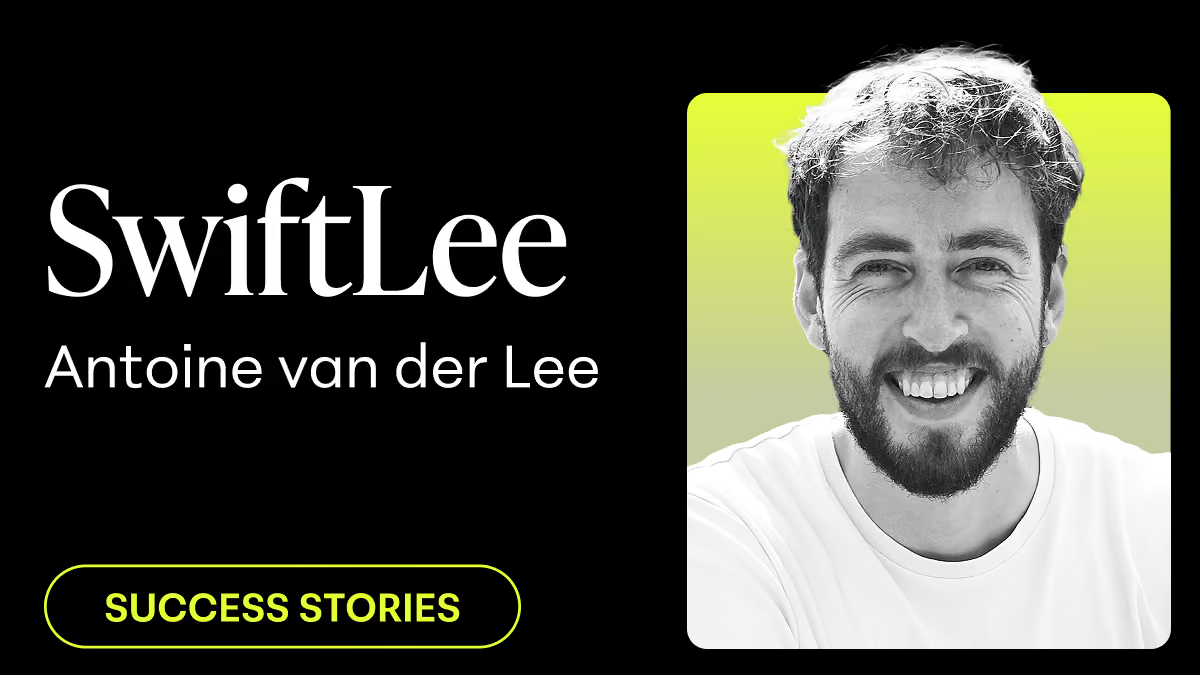
Every Tuesday since May 2017, iOS developers around the world have known they could count on one thing: a new article from SwiftLee, Antoine van der Lee's technical blog about Swift and iOS development.
This is the story of how Antoine went from frustrated conference reject to thriving independent creator. And how Teachable became the platform that let him monetize years of expertise without giving up control of his audience.

The moment that changed everything for Antoine happened in 2023, during an ordinary performance review at WeTransfer.
After six years with the company, Antoine received feedback that made his future path suddenly clear: his growth trajectory had flatlined.
Most people would have accepted it. Found comfort in the stability of a paycheck from a well-known tech company. Antoine did something different.
He negotiated an unusual arrangement: work four days a week at WeTransfer, and dedicate one full day to his side business.
"The impact of that single day was insane. I could see such a lift up in conversions. I could develop larger features for my Mac app because I had more dedicated time for development." –Antoine van der Lee, Founder of SwiftLee
Since 2017, Antoine had been writing one article every Tuesday. Building an audience while working full-time meant squeezing deep work into scattered evenings and weekends. Half an hour here. An hour there. Never enough time to tackle substantial projects.
One dedicated day changed the equation entirely.
He could finally build features for RocketSim that required sustained focus. Content strategies could span weeks instead of days. He could respond to his growing audience with the attention they deserved.
The business metrics reflected the shift immediately. Conversions increased. Product development accelerated. Revenue grew. Most importantly, Antoine saw proof that his constraint had been time, not market demand.
By early 2024, the math became undeniable. He'd originally planned to go independent in 2026—a cautious timeline that gave him margin for error. The results from that single day per week proved he was already prepared to make the leap.
In March 2024, the same month his second son was born, Antoine left WeTransfer entirely.
When Antoine went independent, he had already validated three revenue streams through years of consistent work.
Courses represented a fourth opportunity, but only with the right platform.
The decision came down to control and ownership.
Many platforms position themselves as audience builders with promises to bring you students, handle your marketing, and manage your distribution channels. In exchange, they take 50-60% of your revenue as their fee.
Antoine had spent seven years building his audience with dedication and consistency. He needed infrastructure and delivery capabilities, not acquisition services.
"Teachable ticked all those boxes for me. It's flexible, it integrates with all the tools I already use, and they're super respectful to creators. They offer a fixed fee." –Antoine van der Lee, Founder of SwiftLee
Three factors made the choice clear for him:
A fixed platform fee instead of percentage-based revenue shares that would eat into his margins. After years of audience building through consistent Tuesday posts and genuine relationship cultivation, giving away half his earnings to a platform made absolutely no sense.
Complete control over student data and communications meant he could export his entire student list, connect it seamlessly to ConvertKit for email nurturing, and maintain the relationships he'd cultivated over years of consistent content creation.
His entire tech ecosystem worked together without friction or complicated workarounds. ConvertKit handled email sequences and automation. Teachable handled course delivery and student progress tracking. RocketSim served the same audience with complementary tools. Everything connected smoothly without requiring technical expertise or custom development.
Teachable aligned with how Antoine thinks about business: build trust first through consistent value delivery, monetize second when that trust is established. Own the relationship with your audience. Control the experience they have with your content.
When he launched his first course in 2024, the audience was already there waiting for him. Teachable provided the delivery mechanism that let him finally monetize years of expertise.
$40,000 in his first launch proved the strategy worked.
Antoine developed five strategies that turn consistent content into predictable course revenue. Each one challenges conventional wisdom about course creation.
Most creators agonize over whether their content measures up. Someone else already covered the topic, they think. Publishing gets delayed until everything feels perfect.
Antoine reframed the premise entirely.
"I'm building my personal knowledge base, but I decide to make it public so everybody can read it. If they don't like it or don't find it good enough, that's their problem. It's my personal knowledge base." –Antoine van der Lee, Founder of SwiftLee
This mindset shift eliminated friction. He publishes articles within an hour of finishing them.
The approach extends to his courses. He creates content on topics he wants to master. His Swift Concurrency course is highly technical—a Swift UI course would probably sell better to a broader audience. But he loves building it because he genuinely cares about the topic.
"If you don't have that intrinsic motivation, it becomes really hard to finish that course in the first place. Try to stick to something that you can do every day, and that will make it much easier to create a course that people will love." –Antoine van der Lee, Founder of SwiftLee
Students feel that authentic interest radiating through every lesson. A teacher passionate about the material guides them through challenges.
Take action:
Antoine calls himself "addicted to measuring." Data drives a continuous loop: measurement reveals results, results create achievement, achievement generates momentum.
When he started weekly blogging in 2017, Google Analytics showed him the hockey stick growth curve. That visible progress kept him consistent when individual articles felt insignificant.
What he tracks:
Vanity metrics hold no interest for him. Tracking happens for leverage, finding the points where small changes create outsized returns.
"I'm constantly seeking improvements. I want to quit the day at 3:00 PM and enjoy the day with my kids. So whatever works for me to still have that most impactful growth while having time with the family, that's something that will resonate with me." –Antoine van der Lee, Founder of SwiftLee
Three weeks before our interview, he launched a free 5-day email course—his "playbook" lead magnet. It produced the strongest growth he'd seen in six years of serious creator work.
The data proved it worked.
Doubling down happened immediately. LinkedIn profile optimization came first. Twitter bio updates followed close behind. YouTube content creation rounded out the strategy. Everything directed traffic to that playbook landing page.
Take action:
Antoine obsesses over compound systems where one action creates accelerating returns. His most powerful flywheel sits built directly into Teachable's certificate feature.
The certificate flywheel works in six steps:
Each cycle multiplies the previous one.
"If a certificate multiplies to two students, the growth goes even faster. That is a flywheel effect that I actually see working great for Teachable. If you're using Teachable, you want to implement this for sure." –Antoine van der Lee, Founder of SwiftLee
Beyond certificates, every piece of content serves multiple objectives across his business. Blog posts attract iOS developers searching for solutions. That same audience needs his newsletter for ongoing tips and updates. Those readers use his RocketSim tool to work more efficiently on their projects. Many of them eventually enroll in his courses for deeper learning and skill development.
A single piece of content compounds across four distinct revenue streams.
Unlike creators splitting attention across different audiences in different niches, Antoine ensures every hour of work resonates with his entire business ecosystem. Each effort reinforces the others naturally.
Take action:
Creating comprehensive courses while working full-time demands consistent momentum. Antoine maintains it through "purposeful deadlines" that create external pressure.
When building his Swift Concurrency course, hard constraints threatened to derail progress. Recording all lessons required 2-3 months of focused work. Kids in the background limited him to two days per week for recording sessions. Deep technical content added layers of complexity to every session.
His solution changed the game entirely.
Releasing while building replaced waiting for completion. Students could enroll before all modules existed in finished form. New lessons arrived on a specific public schedule that created accountability.
"I made a really strict planning. Every week I would release new episodes, and I even told my students—because they could already join the course while it was being developed—new modules are coming. So I had that public deadline, which is super important. It pushes you to push things out. People are expecting it." –Antoine van der Lee, Founder of SwiftLee
This created three distinct benefits:
The same principle applies to his blog publishing schedule. Every Tuesday for years without exception. Audience expectation creates internal accountability that keeps him shipping quality content.
Take action:
Solo creators face a persistent challenge: producing quality content at scale without complete burnout.
Antoine treats AI as team members with specific capabilities. Enthusiasm runs high for AI agents—systems he sets running on assigned tasks and checks later for completed results.
"The 20-person company now looks at me and realizes like, 'Whoa, Antoine is doing it all alone. I need to get rid of my 20 people.' Whereas I'm with AI thinking like, 'Hey, I'm alone, but I now have a team of 20 people because I can just leverage AI.'" –Antoine van der Lee, Founder of SwiftLee
The critical nuance separates success from failure: he never blindly accepts AI output without careful review. As an experienced developer with years of debugging expertise, evaluating and validating everything AI produces against his quality standards happens automatically.
How he uses AI for course creation:
During our interview, an AI agent was running in the background completing an assigned coding task.
"After this interview, I'll probably have something done. That is just insane." –Antoine van der Lee, Founder of SwiftLee
But fundamentals still matter in an AI-assisted world. His Swift Concurrency course teaches deep technical knowledge because students need to verify AI output themselves in their own work. Letting AI write code is easy enough. Understanding the underlying concepts well enough to evaluate whether that code works correctly under production conditions requires real expertise that can't be automated.
Take action:
Antoine approaches education differently than most course creators who optimize primarily for revenue. Building his personal knowledge base systematically and choosing to make it public for others to learn from drives his entire approach.
This perspective changes everything about how he creates and what he creates.
Most course creators ask themselves: "What does the market want from me right now?" Antoine asks a completely different question: "What am I genuinely excited to master deeply?"
His Swift Concurrency course is more technical than commercially optimal for maximum revenue. That authentic interest shows clearly in every lesson, code example, and explanation.
"The course that I create might not be the best course in terms of return of investment. But the point being is that I work on a course that I love building. I create lessons that I actually love diving into." –Antoine van der Lee, Founder of SwiftLee
Students feel this authenticity immediately when they start learning. A teacher genuinely passionate about the topic guides them through the material. Someone who struggled with the same concepts and remembers that frustration helps them navigate those difficulties. Someone building understanding lesson by lesson alongside them rather than lecturing from a distant place of complete mastery shares the journey.
Antoine spent seven years building his audience before monetizing with courses on Teachable. Every Tuesday since 2017 without missing a single week. One article each week without exception or excuse.
That consistency created compound trust that money can't buy. When he finally launched a course to his audience, they already knew his teaching style intimately. His depth of expertise was proven through hundreds of articles. His reliability was demonstrated through years of consistent show-up.
The $40,000 first launch came from seven years of earned trust converting to sales in a single concentrated moment.
Antoine structures his courses with intentional difficulty that forces real learning. His Swift Concurrency course requires passing rigorous assessments to progress to the next module. Initially, failed attempts locked students out for 24 hours to create reflection time. Forcing them to truly learn before continuing rather than rushing through became the design principle.
"In the beginning, I made it so that the assessment would fail right away and you got like 24 hours wait time, which forced students to go back to the lessons and learn again, which I personally liked the best because I want people to not just skip through the course." –Antoine van der Lee, Founder of SwiftLee
Students complained about the restriction feeling too harsh. Adjustments came based on feedback while maintaining high standards. The principle remained solid: certificates should mean something tangible and valuable. When students share completion on LinkedIn, it should represent genuine achievement and mastery. That authentic credential makes the entire flywheel work effectively.
Most creators optimize relentlessly for maximum revenue at any cost. Antoine optimizes deliberately for maximum life quality while maintaining strong revenue growth.
"I want to quit the day at 3:00 PM and enjoy the day with my kids. This isn't just a lifestyle preference—it's a forcing function that drives innovation in my content systems." –Antoine van der Lee, Founder of SwiftLee
His annual revenue goal serves as a measurement of effectiveness rather than pure ambition. A scoreboard that tracks progress objectively. The real goal is building a sustainable creator business that gives him freedom with his family.
Antoine sees himself at the beginning of something transformative, not the culmination of his journey.
Moving deliberately from written content toward conversational video formats shapes his production evolution. One recording session becomes blog posts through transcription, course lessons through editing, and social media clips through strategic cutting.
"I'm preparing a webinar that I'll reuse for lessons for my course, that I will reuse for clips. I feel like that is a win-win-win for me as a company as well." –Antoine van der Lee, Founder of SwiftLee
This shift represents a major production evolution in his business model. Natural conversation generates raw material efficiently without time-consuming writing. Strategic editing transforms that material into multiple formats and distribution channels.
Course expansion: Additional Swift Concurrency modules covering emerging patterns and advanced techniques as the Swift language evolves continuously
Video-first content: YouTube channel development with repurposed webinar and course material creating multiple touchpoints with his audience across platforms
Community building: Exploring practical ways to connect course students for deeper learning, networking opportunities, and peer support
AI experimentation: Continuing to test boundaries of AI-assisted content creation while maintaining the quality standards his audience expects consistently
Building a sustainable creator business model that others can learn from drives Antoine forward. One that prioritizes life quality alongside revenue growth rather than sacrificing one for the other becomes the blueprint.
"It's not that I need more money. It's not that I want more money. I just want to be as successful as possible. So I'm constantly seeking improvements and I'm just looking forward to see where I can go next." –Antoine van der Lee, Founder of SwiftLee
Creator education is entering a fundamentally new era with AI capabilities democratizing production. Authentic expertise, consistent presence, and earned trust become the true differentiators in a crowded market where anyone can produce content quickly.
"I feel like I'm just getting started in a way because things are really, really changing now. We're living a revolution in a way. It just becomes easier. So much easier." –Antoine van der Lee, Founder of SwiftLee
Explore Antoine’s Teachable courses:
Going Indie - The complete system for transitioning from full-time developer to independent creator successfully. Learn Antoine's strategies for audience building, time management, product pricing, and using platforms like Teachable effectively.
Swift Concurrency - Master concurrent programming in Swift with step-by-step lessons, challenging assessments, and more.
Follow SwiftLee's weekly content:
Ready to turn your expertise into a thriving education business like Antoine has built?
Whether you're a developer, designer, consultant, or expert in any field, Teachable provides the platform to build, market, and sell your courses effectively.
Start your free Teachable trial today and discover why creators like Antoine choose Teachable to:
Join thousands of creators building sustainable education businesses on Teachable.
Your expertise is valuable and deserves to be shared. Your time is limited and should be protected. Your audience deserves quality education that transforms their skills.
Teachable helps you deliver all three without compromise.
Abagail Pumphrey didn’t plan to build one of the most durable creator businesses on the internet. After a layoff in March 2015, she gave herself 90 days to replace her income. It took just 30 days.
“I made my first 100,000 in 8 months and then I doubled it 4 months later.” -Abagail Pumphrey, Founder & CEO of Boss Project
A year later, a five-car collision and a traumatic brain injury forced hard choices. Client work no longer fit a life with unpredictable energy. She pivoted to products that could sell while she recovered.
That shift became Boss Project’s edge. She went all-in on Teachable, built a deep catalog of courses and digital products, and bundled her best work into a membership that now drives roughly half of revenue.
“Teachable is the easiest, most streamlined online course platform out there.” -Abagail Pumphrey, Founder & CEO of Boss Project

January 2016, she stopped taking clients to build the education side. In November 2016, the accident and TBI diagnosis confirmed the move away from services.
She needed a business that was less about her personal bandwidth and more about systems, assets, and delivery that keep working when life is messy.
The early wins were small. A $500 co-launch here, a $2,000 webinar there.
The first offer that truly clicked was Trello for Business, priced at $29. It cleared $8,000 in the first month and kept selling.
Now, that very same course has crossed 10,000+ student enrollments and roughly $288,000 in sales. That one product taught a lesson that still guides Abagail’s approach. Small, installable wins beat sprawling curricula. Buyers want an outcome they can use today.
Before Teachable, Abagail sold behind passworded pages and a brittle paywall that was easy to bypass. Checkout anxiety was real.
She moved to Teachable for secure logins, clean checkout, access controls when refunds or payments fail, and simple ways to increase average order value without bolt-ons.
“You can go from idea to selling the same day.” -Abagail Pumphrey, Founder & CEO of Boss Project
She stayed because it kept working while her team focused on offers and customer success.
“It was one of the few systems that did not break during launches. Back then the fear was your checkout going down in the middle of a live push.” -Abagail Pumphrey, Founder & CEO of Boss Project
Related: Honest Teachable Review - Why I’m Loyal After 8 Years
Abagail’s success did not come from complex funnels or a massive ad budget. It came from a handful of repeatable moves: ship one small product that solves a narrow problem, give buyers a path into an all-access membership, keep the tech simple so you can publish more, and let owned media do the heavy lifting over time.
When paid traffic gets expensive, she pauses. When life gets complicated, the business still runs because the systems are simple and the offers are clear.
Abagail’s breakout was a $29 system that delivers a same-day result. The promise is specific, the setup is fast, and the win is visible. That first month’s $8,000 did more than cover costs. It proved a pattern that Abagail would reuse across the catalog.
New buyers get a clear outcome in hours, then feel ready for deeper work.
“Smaller, faster wins beat 200 hours of content every time.” — Abagail Pumphrey, Founder & CEO of Boss Project
Take action
Abagail’s Co-op membership bundles top courses, templates, and tools into one all-access subscription.
That single packaging decision stopped the month-to-month reset. Members get a home base. The team gets a clear rhythm to add value on schedule.
When members asked for more depth, Abagail overhauled scope and moved many best-selling courses inside the Co-op. Join value rose. Retention improved. Revenue became more predictable.
Today the membership carries a major share of company revenue, while sponsorships, courses, and affiliates round out the rest.
“We handle churn by staying close to what members ask for. We poll, we survey, and we ship.” -Abagail Pumphrey, Founder & CEO of Boss Project
Take action
Abagail uses Teachable to handle the parts of the sale most creators push to add-ons. The goal is simple. Lift average order value and reduce failure points.
Every checkout includes a tightly matched order bump. Order bumps in Abagail’s business have ranged from $11 to $77 and can attach at strong rates when the fit is right.
A one-click upsell sits on the thank-you page so buyers can add a related resource without re-entering payment details.
Teachable’s teachable:pay unlocks Apple Pay, Google Pay, PayPal, and Link out of the box, which helps on mobile.
Payment plans and subscriptions remove friction for buyers who need flexibility.
BackOffice takes care of collaborator and affiliate payouts and unlocks Buy Now, Pay Later when it fits the offer.
Automated tax handling covers sales tax and VAT so the team does not need extra tools to stay compliant. The net result is a simpler stack, calmer launches, and more revenue per order.
“Most tweaks move numbers by one percent. A clean checkout and more traffic move everything.” -Abagail Pumphrey, Founder & CEO of Boss Project
Take action
The Strategy Hour podcast is the core of Boss Project’s marketing.
Millions of downloads and a steady listener base give every launch a head start. Episodes teach ideas, share results, and send warm traffic to sales pages.
Abagail pairs episodes with simple lead magnets and pulls the best clips into course lessons so students hear and then apply. The loop works even when ads are off. Trust builds in public, then converts inside Teachable.
“We publish at a steady clip. The podcast builds trust while the funnel does the work.” -Abagail Pumphrey, Founder & CEO of Boss Project
Take action
When acquisition costs rose, Abagail turned off Facebook and Instagram ads for the Co-op. Email, partner placements, and the podcast kept demand steady.
When Abagail re-entered paid, budgets were capped, creatives taught a small win inside the ad, and every test had written targets for CPL and CPA. Paid is now a lever, not a lifeline. The business holds steady even when platforms change.
“We do not need to spend just to spend. We spend when the numbers make sense.” -Abagail Pumphrey, Founder & CEO of Boss Project
Take action
Abagail measures everything against one simple promise: fast, visible wins for real people with real constraints. The product can be small if the outcome lands big.
“Most creators overbuild. The tech simply needs to work so you can focus on serving your clients and customers.” -Abagail Pumphrey, Founder & CEO of Boss Project
Abagail is vocal about choosing reach over fiddly optimizations. Her stance is practical, not theoretical. Platform stability matters to Abagail because launch weeks are fragile. She has tested alternatives, taken the calls, and still stayed put. Abagail’s bias is toward tools that protect the student experience and reduce creator anxiety.
“I craved a place that would securely store my course and give students one login to access everything.” -Abagail Pumphrey
Under all of this is Abagail’s operating principle: keep the stack simple, keep promises small and clear, and keep shipping. The wins compound for students, and the revenue compounds for the business.
Abagail plans to keep The Co-op at the center of Boss Project.
The membership will continue to bundle the most requested courses with fresh templates and tools on a predictable cadence. Abagail will keep publishing The Strategy Hour to grow owned reach and will bring listeners into the school with practical lead magnets tied to each launch.
On the sales side, Abagail will keep checkout simple and high converting with native bumps, upsells, and flexible payments, and will only re-test paid ads when acquisition costs line up with clear CPL and CPA targets. Most importantly, Abagail will keep shipping useful assets that help students get fast, visible wins.
The plan is steady and specific. More small outcomes that stack into lasting results, all delivered through a Teachable school that stays reliable while the team focuses on students.
Ready to get results like Abagail Pumphrey? Start small, ship fast, and keep your stack simple. You do not need a giant funnel to begin. You need one installable product, a clean checkout, and a weekly publishing habit. If you want to see how that looks in practice, follow Abagail’s work at Boss Project and listen to The Strategy Hour for real examples you can copy. Then put your first offer inside Teachable so the sale, the delivery, and the student experience live in one place.
Try Teachable yourself: ready to build your first offer and sell it the same day? Start your 7-day free trial and see how teachable:pay, order bumps, one-click upsells, and built-in reporting help you earn while you keep creating.

When I talk to people about what Teachable does, more often than not, their ears perk up, their eyes brighten, and they exclaim something like, “Oh! I’ve been thinking about doing a course!” I get it: Creating an online course allows you to make money talking about something you love, and do it from anywhere. It means doing something that energizes you and gives you more control over what your career looks like, and how you live your life.
And that’s huge! But when I ask what kind of course they want to create, they suddenly turn bashful, back away, and mutter, “Oh, I’m not sure yet. I have to figure it out.”
This exchange has happened so many times it got me thinking—why do so many would-be course creators get stuck just thinking about teaching online?
My guess? It’s a prioritization problem.
Creating a course involves countless tiny steps, and it’s easy to get stuck in a “chicken-or-the-egg” scenario, wondering what comes first. Meanwhile, since there are no clear goals to hit, it’s impossible to stay on track, and you end up just feeling bad about yourself.
Here at Teachable, we spend a lot of time thinking about the ideal path a course creator needs to take to go from thinking about creating an online course to succeeding at it.
In this post, I’m going to cover all the steps you need to work through, in what order, and how to tell when you’re ready to move from one phase to another.
We’ve published a course creator’s checklist before. In this post I’m going to break it down even more, so you can get a clear picture of the hurdles you need to make.
This is a long post, so bookmark this page and check back as you work through each step. I recommend reading through this once, then taking notes on a plan of your own!
My guess is you’ve already got a vague idea of what you’d like to create your online course about. You’ve got your own interests and passions, and perhaps you already have an online business.
Let’s take your vague idea and turn it into a money making course topic.
The key here is to marry your passions and skills with your audience’s wants and needs.
You can transform an existing curriculum or program into an online course. Which of your programs are the most popular? What questions do your clients ask you the most?
Chances are, your existing clientele has already told you exactly what kind of course you should create. If they’re interested in your expertise in coaching form, they’ll be interested in course form, too.
Look to your analytics. Which pieces of content are getting the most engagement and traffic? It’s likely that you’ll be viewed as an expert on your high traffic topics by your audience.
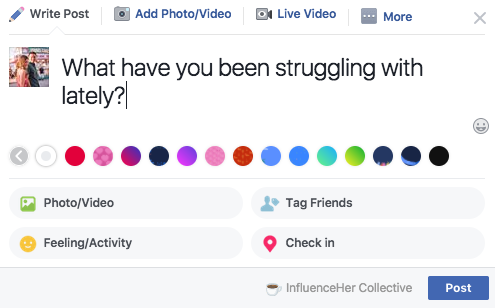
You can also look to your comments and social media messages. Which questions are people asking you? Do you hear one or two questions over and over again? That might be a good place to start for narrowing down a course topic. You could also post a message in a niche Facebook group to discover common struggles your audience is dealing with.
First things first: congratulations on beginning this new adventure! Things are about to get very exciting for you.
With your clean slate, you can build a brand and create a course on any topic at all. Figure out what you love to do and what you could teach people. Now try and figure out where the two overlap.
Theoretically, you could create infinite online courses and bring all of your brilliant ideas to life. But let’s say our goal is to release your first profitable online course as quickly as possible.
Ask yourself these questions:
Validating your online course idea is essential if you’re worried about whether or not you’ll have any interest in your course.
We’ve borrowed a validation tactic from Jeff Cobb that involves four categories of research: searching, listening, asking, and testing.
Searching: Searching is the easiest and fastest way to validate your course topic. All you do is search the Internet to see what other people are looking for, clicking on, and engaging with.
BuzzSumo is a great tool for seeing what online content is attracting the most attention. It’s particularly useful for seeing what is being shared on social media.
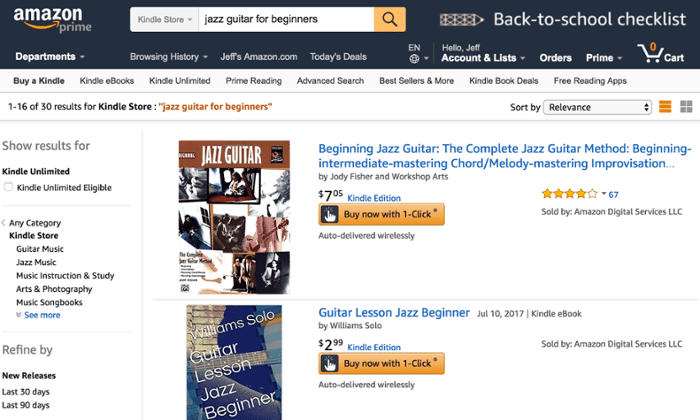
Another tool is the Amazon Kindle Store, which is actually a search engine filled with ebooks and other information products. You can search for successful ebooks on your topic.
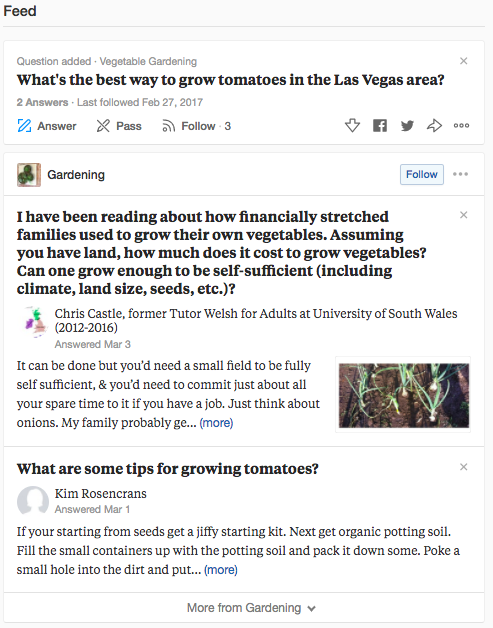
Listening: See what people in your target audience are already wondering. Quora is a place for people to ask any kind of question they have, and wait for subject matter experts to weigh in on the answers. It’s valuable here for you to see not just what questions people are asking, but also how others are answering.
Asking: Get the answer on whether not people will buy straight from the source. The thing is, you can’t actually straight up ask because often times people aren’t able to accurately predict their own future behavior.
Instead, you should ask questions that will tell you what challenges people are facing. If your course solves their problems, that’s a good sign that people will purchase.
A few ways to ask are:
Testing: The idea is to put a product in front of your audience and see if they’re interested in buying. This can be a smaller ticket item like an ebook or PDF.
Instead of starting off the bat with a paid product, you can use a lead magnet. This allows you to see if your audience are willing to give you something in exchange for your expertise. In this case it’s just their email address.
Once you’ve got your foot in the door, they’ll be more likely to pay for your products down the road.
One of the common mistakes we see online entrepreneurs make is they don’t know who it is they’re selling to. It’s hard to cater a product to your audience when you don’t even know who your audience is.
Step 1: Who do you want to help?
I’m sure you have a vague idea of who you’re best suited to help. If not, ask yourself a few of these questions: What group do you understand better than anyone else? WHat do you care most deeply about? Is there a specific community that could truly benefit from your knowledge? A group that you’re part of that you deeply understand?
Step 2: Research
Researching is the fun part. First, Google your course topic and related words and phrases. Take a look at the results. What sites are popping up? What are the similarities that you’re seeing? Is there a certain group of people that is interested in your topic?
Check Quora and see what questions people are asking about your topic and dig into their profiles. What other things are they interested and where else are they spending their time? See how deeply you can dig and try to make predictions about who these people are.
Step 3: Find similarities
1. Is your audience mostly located in a specific country?
2. What language does your audience speak?
3. Are they mostly male, female, or evenly represented?
4. What’s the level of education?
5. What age range are most of them?
6. Are there any other identifying characteristic or similarities in the group?
The more nitty gritty you can get with your course topic, the better. If you’re too broad, you’ll find yourself in the creation stage for forever. Try to narrow it down to one specific transformation.
For example: Instead of creating a course on how to open your own online shop on Etsy, you could create a course walking your audience through how to create your own online shop selling handmade goods on Etsy while balancing their full-time job.
When you’re writing your course curriculum, the easiest way to begin is to put yourself back into your students’ shoes. Look back to when you were learning whatever it is you’re teaching and write out the major milestones that you had to cover to get to where you are.
Write each milestone down. This will help you visualize what your course will look like and ensure that it won’t be too big.
Example milestone / transformation:
After taking my course, people who are trying to start a blog will have beautifully designed websites and they’ll have a clear idea of what content to publish. They’ll feel confident about the direction of their site, and have ease when it comes to choosing which content to publish and promote. People who take my course will be able to:
You wouldn’t believe how many people get caught up by this step. They know they want to move forward, but without anything to call their brand they throw in the towel.
I’ll let you in on a secret: You don’t need to have a perfect name to have a successful brand. Of course, a great name is obviously ideal, but don’t get too hung up on this step.
Here are some quick tips for naming your school:
Before naming your course, you need to do two things:
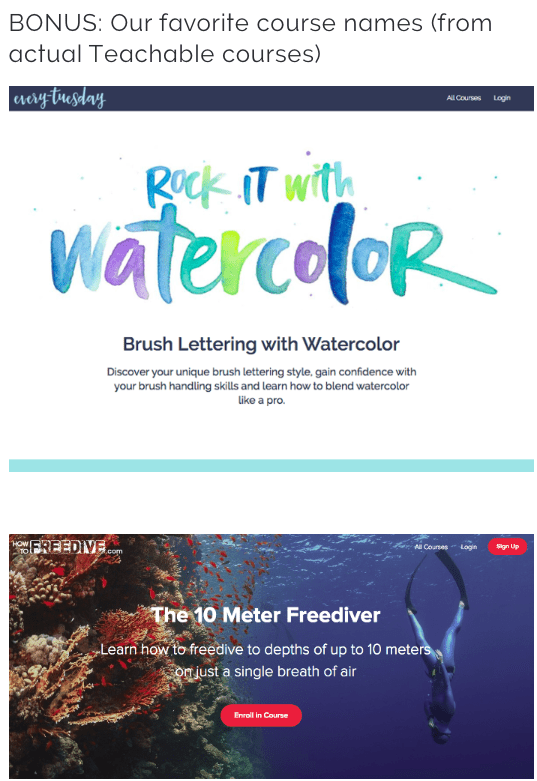
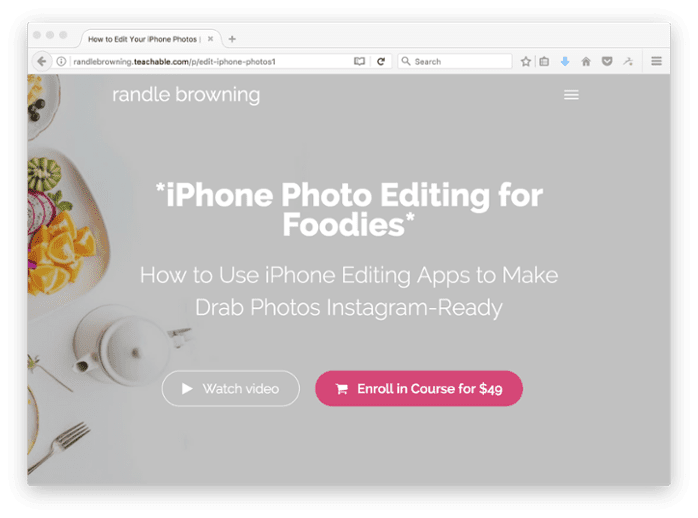
There are three rules to writing a good course name:
To keep in line with my Etsy example, perhaps you want to brand your students as “supermoms.” Naming your course “How to be a supermom” conveys emotion and you could argue it’s benefit driven, but it’s not specific.
Instead, something like “The Supermom’s Guide to Earning More” shows exactly what will happen as a result of taking your online course.
You’ve got your perfect course all mapped out and you’re ready to grow your audience so you can have a massive launch. Good for you!
Luckily, we’ve perfected our audience growing tactics and have created a fool-proof formula to help you explode your audience.
I know, you’re probably super eager to create your bread and butter course, but first we’ll create a mini course that you can use to get your foot in the door and grow your audience. This is something you’ll give away for free in exchange for an email address.
When selecting a mini course topic, you should never start from scratch. Instead, you should work backwards from your main course.
If there is one specific section in your main course that you think would make a great transformation for a mini course, start there.
… is to keep it mini. We see so many people offering “mini-courses” that could be stand-alone products selling for hundreds of dollars because the creator got carried away. And while it’s incredibly generous to give away all of that for free, that’s not our goal today.
Creating a mini course is actually quite formulaic, too:
Try to use only one section, and try not to add more than 5–7 steps.
You can also use video in your mini course, but again, try not to get carried away. Instead, create a single introduction video and a single video in your mini course. Keep with text lessons and valuable downloads for most of your content. We’ll save the high-value videos for your main offer!
Unfortunately, you have to do more than just create your mini course to get people to sign up. It takes a good amount of promotion to get your name out there especially if you’re new to the online marketing space.
Let’s talk about a few ways to attract new traffic to your mini course:
When you tap into someone else’s traffic, you:
And you can also find your audience on an existing platform. To do that, you can:
Your curriculum acts as the skeleton of your online course. You’ll build everything around your curriculum, it acts like an outline.
We crafted our transformation earlier on in the post, and identified our milestones, too. For the sake of the example, I’ll copy them here:
After taking my course, people who are trying to start a blog will have beautifully designed websites and they’ll have a clear idea of what content to publish. They’ll feel confident about the direction of their site, and have ease when it comes to choosing which content to publish and promote. People who take my course will be able to:
You’ll see above that I have seven main “milestones.” As a rule of thumb, we generally recommend choosing between 5-10 milestones.
If your course has more than ten milestones, ask yourself “why?” Is it because your topic really is so extensive, or should you break your topic down into multiple smaller courses? If there are too many milestones, you may want to go back and redefine your topic.
On the other hand, too few milestones might mean that your course would be better off as a minicourse. Trust your gut.
Once you’ve defined your milestones, break them down into lessons.
As a rule of thumb, each lesson should cover one major takeaway and won’t take more than ten minutes to explain.
Let’s break down one of our example milestones into lessons:
You want your course to be munchable, or easy to consume. If your student goes through you course and forgets a very specific point, it’ll be easier for them to go through and find their information if there are clearly labeled 6 minutes videos, rather than having to rewatch an entire 60 minute video.
Online courses don’t have to consist of just videos. There are five main content types we tend to see course creators use.
Text and photo lessons: These are made up a lot like this blog post. Utilizing written word and photos to get a point across. These are the easiest lessons to create and they take no advance skill. Plus, they can be built entirely on Teachable.
PDFs, spreadsheets, and other documents: If your course has a workbook, a cheat sheet, or resource material that you want students to easily reference, you may want to make it available for download in PDF form. Offering these extra materials can really help your students feel like they’re getting a great value.
Screencasting, or screen recording: With screencasts, you can demonstrate a topic on your computer and record the screen. Often, when screencasting, you’ll also include an audio voiceover, which you can record at the same time or after you have the video recorded. These simple videos are a great way for you to directly teach your students without being on camera yourself.
Video: Here you can speak directly to your customers. Sitting down on video is a great way to really make that connection with your audience and get your points across. Video is a great content choice, but there are times when Text & photo might be better, like when there is too much information to recite on video.
There are a number of different ways you can create video for your online course, all with their own set of pro’s and con’s.
Talking head videos: When you’re sitting down and talking to the camera, this is a “talking head” video.
Video demonstrations: Here you’d record a video teaching your audience how to do something specific like cooking or painting or building something.
Interviews: Interviews can add a lot of value to your online course, and you can offer these interviews as bonus content.
Lighting is important. Use natural lighting when possible, but always make sure that you’re well-lit, without shadows or tinted lights. Lamps and house lights can look yellow, but even an inexpensive professional light kit can give your lighting a professional look.
When all else fails, standing near a large window or standing glass door can provide beautiful results.
But audio is more important. Viewers are actually more tolerant of low-quality video than choppy, fuzzy audio. Film in a quiet location, with no air conditioners or heaters running. Make sure there is a lot of soft material covering hard surfaces to prevent echo, too.
Off frame, cover the walls, floors, counters, and other hard surfaces with blankets, pillows, and laundry to dullen the echo.
Think about the scenery. It’s easy to just hit “record,” but first make sure your scenery looks good. What’s in the background of your shot? A blank white sheet always works, but a tidy office or workspace looks great, too.
Make eye contact. When filming, look straight at the camera lens and avoid shifting your eyes around the room, down at your script, etc. If you have to look at your script, make sure to pause before looking down and before looking back up so you can edit those parts out!
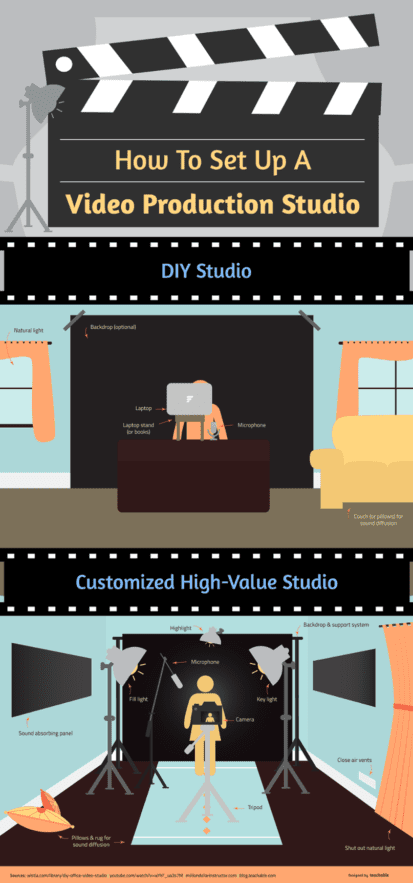
This is the most exciting part of your entire journey, you’ve been working towards this for weeks! When you finally open your doors and launch, that’s when all of your hard work begins to pay off.
But you’re not out of the woods, yet. You see, not all launches are created equally, and some launches have higher success rates than others. To simplify it, we recommend launching to your email list and holding an open-close launch.
An Open-Close Course Launch just means that you make your course available for enrollment for a limited time only. Instead of making your product available year round, your course will have launch windows and you can only purchase within that time frame.
You might feel like this is counterintuitive, afterall, you want as many people as possible to buy your course, right? Well, let me explain the elements that make open-close launches so successful.
The first is anticipation. When you run a course launch, you don’t start the launch with an announcement that your course is available. You send emails leading up to the big release day that build excitement around the topic of your course. This builds anticipation for your audience and keep them reading and waiting to see what comes next.
Next is scarcity. When there is less of something, or if it’s only available for a limited time, people will want it even more. This is why limited-time sales windows work so well for launches. If your course is always available, there’s no scarcity, or no motivation for people to make a purchase right now, rather than later. But if you tell people their opportunity is going away in just a few days, they’re much more likely to seize the moment.
Third is event-based. When there’s a big event going on, like a course launch, people feel like they’re part of something larger than themselves. You’re uniting people around a shared experience, like your course release date, and that gives your audience a sense of connectedness that keeps people feeling involved and engaged.
Next is “reason why.” One of the most powerful words you can use is the word “because.” People are logical beings, and if you give us a reason why we need to make a purchase, we’re much more likely to act than if you just tell us to do something with no cause.
And lastly, storytelling, the biggest psychological trigger of all. People use stories to pass down knowledge through generations, and we don’t need to look further than the box office to see how much humans love to hear stories. Although TV shows and movies often focus on fictional stories, storytelling exists in our everyday lives, from the imaginative stories our kids make up to the stories we recount from our day over dinner. Storytelling is the backbone of human communication, and running a course launch will give you the opportunity to share your story with your audience.
Before we get started, let me tell you this: Most online course creators don’t charge enough for their online product. $100 is the minimum you should charge for your course, and even then sometimes $100 isn’t enough.
As a quick guide for how much you should be charging:
Using premium pricing can be intimidating, I get it. But it’s so important. It’ll help you maintain your sanity and meet your revenue goals with greater ease. Let’s discuss why that is:
Which brings me to the goal setting phase of this conversation. How much money are you hoping to make with your online course?
There is no wrong answer here, dig deep and figure out what number would make you jump for the stars happy.
Now lets reverse engineer that to see how you should price your course.
How many people will you need to sell your course to at $100 to meet that goal? At $250?
Let’s say you still wanted to make $1000 as your revenue target, and you’re offering a $200 course. Now you only need 5 students to buy your course, which means you only need around 250 engaged people on your email list to hit that goal.
Seems doable, right?
Creating your sales page is an exciting aspect of the course creation journey. This is your final tool in convincing people to purchase.
Use your sales page as an opportunity to educate your audience and share why your course is the best possible solution to their problems
Writing sales copy
There’s a well established principle in the world of sales copywriting called the 40/40/20 rule.
This rule says that there are three key factors that contribute to someone’s decision to buy your product.
The first is your offer, which includes your course and maybe a special bonus offering or discount. The offer accounts for 40% of their reasoning.
The second factor is whether or not they are your target audience, so 40% of someone’s decision to buy your course will depend on if you’ve attracted the right audience.
The third and final factor is your creative, which includes the sales page, your emails, the design, and everything else. This creative, or your marketing efforts, only account for 20% of someone’s decision to buy your course.
Despite creative only accounting for 20% of your audience’s decision to purchase, it’s not something you want to get wrong.
Great sales pages are typically made up of a few standard building blocks. These are the essential pieces to your sales page puzzle that will make purchasing a no-brainer for your audience.
A headline
This is your opportunity to be clear and concise about what your course is about. You also have a subheading just underneath the headline, and this is a great opportunity for you to share what the big transformation is for your course.
A course description
The biggest mistake people make in their course description is jumping right into logistics, or into telling your audience about the course features. Remember, benefit driven language is your friend here. You’re really presenting the solution to their problems with this section, not talking about the nitty gritty technicalities of your course.
Social proof
Here is where you’ll use case studies or testimonials to reassure your audience that other people love and trust you.
Think about any purchase you make online, you probably check the reviews to ensure you’re not getting ripped off or wasting your money. That’s what testimonials do for online courses. They show that other people have trusted you and have benefited from it.
Pro tip: If you don’t have any testimonials yet, offer your course for free to a small group of people in exchange for an honest testimonial.
About the instructor
Include relevant information about yourself here – why are you suited to be teaching what you’re teaching? What experiences have you had or trainings have you taken that have qualified you to be an incredible teacher?
CTA buttons
CTA’s are also known as “Calls to Action” and they act as the push to tell your audience, “Hey! Buy this cool course!”
CTA’s can be as simple as saying, “Buy now” or you can make the message more convincing by getting specific. “Earn more on Etsy today” might be more enticing to our audience of moms we mentioned earlier.
Course curriculum
Teachable automatically builds this for you, and it helps your potential students get an idea of what you have to offer inside of your online course. Whenever I’m considering taking a course, I go straight to the curriculum to see the specifics of what is going to be covered.
You can also choose to turn on one or more lessons to Preview Mode. This will allow prospective customers to be able to view these lessons without enrolling. This can be a great way to give prospects a taste of what your course is like.
Your FAQ
Your FAQ is so important and one of your biggest time saving tools. Any relevant questions you don’t include in your FAQ will probably be emailed to you dozens of times by prospective students.
The FAQ section gives you the opportunity to get inside your customers’ heads and think about why they’d choose not to buy your course. So address their worries early on and make their decision easier.
Beautiful sales pages are so important to brand your business and make your school look as professional as possible. Luckily, Teachable makes creating a beautiful sales page easy within our sales page editor, but there are a few essential tips to keep in mind.
You’re also going to want to make your sales page easy to read and digest. Don’t give your audience a wall of text, instead break it up so that it’s not overwhelming.
Here are some great ways to make your sales page more munchable:
This might sound intimidating, but don’t stress. Your checkout page flow is already built into Teachable’s design, but there are a few elements you can customize with your course information to strengthen the checkout.
Teachable checkout pages reinforce your transformation by including testimonials and course bullet points. These are already elements you’ve collected, so it’s as easy as pasting them into your checkout page.
You may also want to consider including a purchase guarantee, sometimes called a trust seal. This guarantee significantly derisks your customer’s decision. If they hate your course, they can get a full refund within 30 days, it’s as easy as that.
Things are finally heating up! It’s time to begin launching your course and getting a return on all of that hard work you’ve put in leading to this moment.
We recommend launching to your email list, after all they’re your most engaged audience and they convert at the highest rate.
Your email launch will have three elements: Engagement, Presales, and Sales.
Engagement
The goal of the engagement phase is simple: you want people to start reading your emails, getting excited about your topic, and building trust and authority. In the engagement phase, the CTA, or call to action, is simply reading your emails, and maybe clicking through to your blog posts or responding to your survey. Your engagement phase will last for a few weeks, depending on how engaged your audience was before today.
Presales
Your presale phase will come in a one-two punch.
Day 1 is the course teaser. This is when you tell your subscribers that you’ll have an exciting announcement coming out soon, and that you’ll be opening an online course. You can share a little bit about what the course covers, but tell them that you’ll mention the full details later. This is where you start building anticipation, which will keep readers engaged and coming back for more.
Day 2 covers the course details. In this email, you answer, “What’s in the course?” and you explain in detail what your milestones and lessons are for the entire course. You aren’t giving away the content, but you are outlining the details of what you’ll be covering, as well as the overall outcome or transformation students will feel by the end of the course. You’ll end by telling them that the course is going to become available tomorrow, but you won’t share the sales page yet.
Sales
On Day 3, you’ll announce that your course is open. This email is your big moment, when you finally get to share that your course is available. You’ll link to your sales page, and you might consider including a few testimonials in your email. You’ll also need to ake it clear that this is a limited-time offer.
Day 4 is your FAQ email. Using an FAQ email is the perfect opportunity for you to appeal to your subscribers’ logical side and squash any concerns they might have about your course.
Tell them about your 30-day guarantee, and reassure them that they’ll have lifetime access.
Share what the course includes, and see if you can anticipate their burning questions. You’ll provide the questions and answers right in the body of your email. Again, the CTA for this email will be to click on your sales page link, and you’ll want to reiterate that this offer ends on X date at Y time.
Day 5 is the surprise bonus email. This is a fun opportunity for you to tell you subscribers that you’re giving them a new surprise that you haven’t mentioned on the sales page if they buy now. This should either be bonus content or an even steeper discount. In either case, it should be something truly valuable to your customers, and you’ll again remind them that this incredible offer goes away on X date.
Day 6 is the thank-you & social proof email. At this point, you want to thank everyone for reading your emails and being part of your launch. Hopefully by now you may have gotten excited emails or social media posts from new customers, so you can include some anonymized screenshots where new customers are raving about your content. This social proof will be exactly what a few people need to convince them to act now and enroll in your course.
By now you’re nearing the end of your launch, so Day 7 – the day before your launch ends – is the logical argument. You’ll tell everyone that your course will be closing, and you’ll build a logical argument convincing them why they need to buy right now. Remind them about your bonus, and remind them how soon the sales window closes.
Then finally you’ll arrive at Day 8, the final day in your launch. On this last day, you’ll be sending not one but two emails. Is this a little aggressive? Yes. But it’s proven and effective. Trust us on this one! It’s worked for our most successful instructors here at Teachable.
The morning email goes out at 11 AM. You’ll announce that today is the absolute last day to get the course, and that sales end at midnight. Then the afternoon email should go out around 3 or 4 PM, and this is their last chance email, when you’ll reiterate that sales close at midnight, and that they won’t want to miss out on this opportunity.
Congratulations! You’ve hosted your first launch and I’ve got a feeling that you killed it. But even after launching there are a few steps you’re going to want to take to keep the momentum and end your launch on the right foot.
Analyze your launch
After all of the chaos surrounding your first launch, you might never want to have to think about launching again. But I recommend you reconsider.
You should be collecting data, or information, about how things are going along the way so you can know what to expect for next time.
First, track how much money you brought in per day. You’ll be able to easily access this data in Teachable. Next, if you’re a little more comfortable with data, track your email analytics. Email analytics are useful because they can show you where people are engaged – or not engaged – with your launch experience.
Knowing which emails performed the best can help you when you’re refining your launch sequence for round two.

I’m Gabby Beckford, and I teach people how to make travel happen through inspirational, empowering, and innovative travel tips! My Teachable school, the Packs Light School, contains courses, get-started guides, digital downloads, and tell-all programs that break down my expertise in travel: solo travel, becoming a digital nomad, and traveling via scholarships in grants at any age.
I say that I specialize in “empowering edutainment” because I teach my material in a way that is accessible, engaging, entertaining, and always with optimism and good vibes. I believe my students are capable of anything and inherently deserve everything, and I’m here to help them reach their goals.
I’ve always loved to travel, but as I got into high school, I realized that I’d have to find opportunities to travel without my family. I began to learn more about the different types of travel, and that’s when I discovered niche online communities of Black adventurers who were equally obsessed with travel as I am.
In those communities, I realized the extent of privilege that leisure travel has historically been. I learned about the slow and painful desegregation of transportation in America in the Civil Rights movement by young Black patriots not much older than I was. I was introduced to The Negro Motorist Greenbook by Victor Hugo Green, published in 1936—not yet 100 years ago—a resource designed to help Black people simply navigate this country safely. Leisure travel is often reduced to Instagrammable angles and the excitement of vision-boarding your Spring Break trip. But for so many of us, leisure travel takes a lot of active effort, planning, and emotional labor to be leisurely.
For example: when I search “solo female travel tips” on Pinterest, a Black face doesn’t appear until the 19th search result. When I search “digital nomad vlog” on YouTube, a Black creator isn’t shown until the 54th result!
If we can’t find concrete examples of people we can relate to, how can we feel that it’s possible for us, too? To take action on this, I helped cofound the Black Travel Alliance in 2020, a 501c(3) non-profit with the mission of increasing equitable opportunity and representation for Black travel creators. Because more than a teacher or educator, I am a community builder.
When I took my first solo trip to Iceland in 2017, I was the youngest, the only woman of color, and the least experienced on the trip. When I studied abroad in Dubai, UAE, I was one of only three other Black women in the program. Honestly, part of me created my teaching materials at Packs Light School for the past version of me! For the high school student who spent hours and hours Googling “how to travel for free”, “jobs that let you travel the world”, or “how to travel when you’re 17”. It would turn up with no search results, and I used to think I was crazy. But not now! I became an educator so that other young, ambitious women of color might find my school and realize that they aren’t crazy, or dreaming too big. And that while I may have been the “first” in many spaces, I will not be the last.
I’ve created the Packs Light School as a suite of value-packed tools to help you anywhere that you might need on your journey. Need inspiration? My PTO Dashboard and my Go Remote Guide ebook are packed full of resources and information to help you figure out the many possibilities to travel out there, and which ones fit best for you. Need accountability? My Opportunity Tracker Spreadsheet helps you stay organized and productive. As someone with ADHD, this is my favorite way to gamify my search for travel opportunities! And my big ticket course, How to Take $10K Trips… For FREE is exactly that: my tell-all guide of information that walks you from the start—overwhelmed, confused, yet hopeful just like I was—to being able to travel in the same ways I do.
Taking my first solo trip at age 17, being awarded $40,000 in study abroad scholarships in college, and even traveling to expensive destinations like Fiji and South Africa
The more Black and brown people travel and see the world, the more their views of self and their place in the world expand. The impacts of hope, curiosity, community, and knowledge on our quality of life are immeasurable. And the small role that I play is to continue the legacy of educators, innovators, disruptors, and hopeful visionaries before me!

Your most productive self shouldn’t only appear from time to time. In fact, it should be allowed to thrive all the time. And you’ll be able to learn the skills to do just that with an upcoming workshop from productivity expert, founder of Forte Labs, and Teachable creator Tiago Forte.
Tiago, who is most widely known for his online course Building a Second Brain, is a leading expert in the productivity and online knowledge space. He’s devoted his career to educating fellow knowledge workers (aka creators, entrepreneurs, and the like) on the best tools, skills, and frameworks for utilizing technology to help harness their most productive and creative selves.
On Monday, April 19, Tiago Forte is hosting a very special live workshop on Discover, Teachable’s marketplace platform showcasing some of the very best Teachable courses. The workshop, How to Take Digital Notes, will be Tiago’s introduction to the world of digital note taking aka personal knowledge management. The workshop will also cover the best methods for capturing, organizing, and sharing ideas in a systematic way to fuel creative expression and reach peak productivity. Best part: It’s totally free.
In advance of his workshop, we scored an exclusive interview with Tiago to get his history with teaching online, his thoughts on the growing trend of cohort-based courses, and the productivity myth he wishes would go away for good.
“I created my Teachable account in mid 2015,” Tiago said. “I had a self-paced course, so I did the traditional: pre-record a bunch of videos, plan out the curriculum, deliver it in one package in my school for people to take at their own pace. And I loved that. That was the start of my career. That was the start of my business.”
And Tiago’s course was very successful. That success was what helped him grow his business, become a thought leader and speaker in the productivity space, and educate more than 20,000 people through his programs. And yet, even during the early years of his course’s success, Tiago had an inkling toward the future.
Although we may all be accustomed to logging onto Zoom for work, social hangs, and more nowadays, that simply wasn’t the case back in 2016 when Tiago was envisioning a better way to facilitate his course. After having taken a course that’s curriculum was delivered via Zoom, Tiago knew this type of connection was the future.
“I just realized that there was this interesting intersection emerging, which we now call CBCs, cohort-based courses,” he said. “It was teaching, but it was also facilitation. It was also coaching, also consulting. It was like all these different things intersecting that no one at the time had a word for it.”
So Tiago started DIYing his own version of this in conjunction with his course. Of course today, there’s no hacking or DIYing necessary on Teachable. The ideas of coaching and community learning are more commonplace now. In fact, we believe in this connection so much, we launched our very own coaching feature to make this easier for creators to form a deeper connection with their students, gather feedback, experiment with cohorts, and boost the value of their businesses.
Today, Tiago’s course operates in a cohort structure with the 12th iteration starting in less than a month. But for many creators, the term cohort-based course, or CBC, is still relatively new. As Tiago explains it, CBCs are the “first truly Internet-native form of learning” and are “the first to tap into the essential nature of the Internet” in its open-ended and interactive nature.
He breaks down the trend and the various “waves of education” in his very own blog post and explains that those creators who are used to delivering their material via self-paced courses are already primed to expand to a cohort-based course.
“I think some people who have created self-paced courses are perfectly positioned for this. Like perfectly,” he said. “In fact, it’s really hard to make the jump from not having taught at all to doing a CBC.” He explained that with a self-paced course under your belt, you’re already equipped with many of the skills needed to dive into cohorts or coaching.
“I feel like [starting with] a self-paced course is perfect. You get practice developing content, you learn what works and what doesn’t, you get good at design, you get good at filming. You validate the course,” he said. “And if you’re going to put in that much time and effort, you don’t just pick an idea out of a hat. It has to be validated. And a great way to validate is with a lower price, more self-paced content or curriculum.”
With Tiago’s free workshop coming up, the launch of his 12th cohort of BASB on the horizon, and an elusive book deal under his belt, it’s clear the desire for his knowledge on productivity is at an all-time high for creators and entrepreneurs.
“Until now, it’s felt like this has been a very small nerdy internet subculture,” he said. “You know, to even know what a second brain is and why you might want one. And to want one, you just had to be part of such a little niche.”
But, as more and more creators are looking to maximize their output and build their business in an online world, Tiago Forte’s methods are definitely moving from that niche subculture to the forefront.
“I think it’s rapidly becoming more mainstream because everyone is just completely overwhelmed with the volume of information that they have to manage and [they’re] wanting to not just solve that pain—which would be nice—but get that problem and turn it into an opportunity. It’s like: Wait, I have all this information and knowledge and expertise that I could, as you all know very well, monetize or leverage or share or express or turn into some positive thing for me in my career.”
And we couldn’t agree more with Tiago’s vision toward a more customized and responsive way to deliver course content to students. But our talk with Tiago couldn’t end without some words of wisdom to help foster and nurture that hyper-productive self we all crave. So when it comes to the productivity myth he wishes people would simply stop believing, it’s actually quite simple: stress less about the heavy lift.
“I think it’s a myth that to accomplish great things and to do important work, that makes a difference, it has to be this stressful, what I call a heavy lift,” he said. “This big, grinding, heavy, anxiety-provoking, keeping-you-up-all-night heavy lift. I think when people do heavy lifts, it’s because they lack skills and tools such as the ones that I teach.”
Want to learn more of those skills and organizational tools Tiago Forte is talking about? Sign up for his free workshop, How to Take Digital Notes on Discover set for April 19 to become your most productive self.